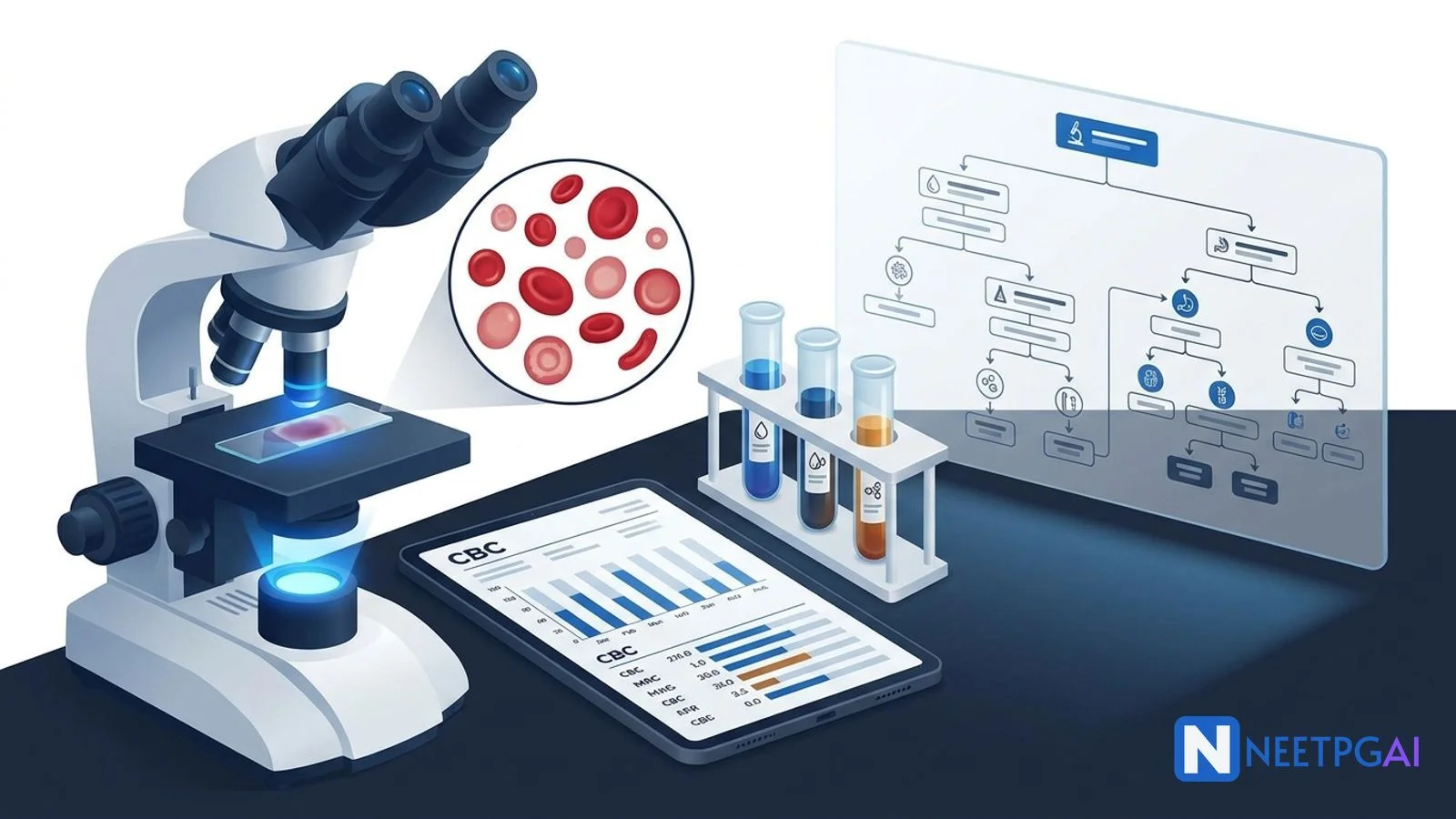
Anemias for NEET PG — Classification and Diagnosis 2027 | NEETPGAI
medicinehematologyneet pg 2027
Anemias for NEET PG — Classification and Diagnosis 2027
Master anemia classification for NEET PG 2027: MCV-based approach, iron deficiency, megaloblastic anemia, hemolytic anemias (spherocytosis, G6PD, sickle cell, thalassemia), aplastic anemia, peripheral smear findings, and diagnostic algorithms.
NEETPGAI EditorialPublished 2 Jan 2026Updated 29 Sept 202618 min read
Share this article
This content is for educational purposes for NEET PG exam preparation. It is not a substitute for professional medical advice, diagnosis, or treatment. Clinical information has been reviewed by qualified medical professionals.
Ready to put this into practice?
Start practicing NEET PG MCQs with AI-powered explanations.
Comparison of the authorities that shape NEET PG, INI-CET, FMGE, and Indian medical education: NMC (regulator), NBEMS (exam conductor), MCC (AIQ counseling), DGHS (health services), AIIMS (INI-CET), plus state councils and FMG pathway — clarifies who does what.
Iron deficiency anemia — most common anemia worldwide, low ferritin (most specific marker), low serum iron, high TIBC, microcytic hypochromic with pencil cells on smear
Megaloblastic anemia — B12 vs folate deficiency, hypersegmented neutrophils (pathognomonic), B12 deficiency causes subacute combined degeneration (lateral + posterior columns), Schilling test for pernicious anemia
Anemia is defined as a reduction in hemoglobin concentration below the normal range for age and sex — below 13 g/dL in adult males and below 12 g/dL in adult females (WHO criteria). It is not a diagnosis but a finding that demands systematic investigation. In NEET PG, anemia appears across medicine, pathology, pediatrics, and obstetrics — making it one of the highest-yield cross-subject topics. The student who builds a reliable MCV-based diagnostic algorithm and memorizes the key peripheral smear findings will capture marks across at least three subjects.
This guide covers every testable anemia subtype with the lab profiles and smear findings that NBE tests as image-based and clinical vignette questions. Pair this with MCQ practice on the Medicine subject hub and cross-reference high-yield pathology topics for the histopathology angle.
MCV-based classification of anemia
MCV-based classification is the systematic approach to anemia using mean corpuscular volume as the primary sorting criterion — and it is the framework that NEET PG expects you to apply in every anemia vignette.
MCV category
MCV value
Causes
Key lab clue
Microcytic
<80 fL
Iron deficiency, thalassemia trait, sideroblastic anemia, anemia of chronic disease, lead poisoning
Low MCV + low MCH = hypochromic microcytic
Normocytic
80–100 fL
Acute blood loss, hemolysis, anemia of chronic disease, early iron/B12 deficiency, renal failure (low EPO), bone marrow failure
Reticulocyte count separates production vs destruction
Check reticulocyte count → production defect (<2%) vs destruction/loss (>2%)
For microcytic: iron studies (serum iron, TIBC, ferritin, transferrin saturation)
For macrocytic: B12, folate levels, peripheral smear for hypersegmented neutrophils
Iron deficiency anemia
Iron deficiency anemia (IDA) is the most common cause of anemia worldwide — affecting approximately 1.2 billion people globally (WHO 2021) and 50% of Indian women of reproductive age (NFHS-5, 2019-2021).
Stages of iron deficiency
Iron depletion progresses through three stages — and NEET PG tests the lab profile at each stage:
Stage
Bone marrow iron
Serum ferritin
Serum iron
TIBC
Transferrin saturation
Hemoglobin
RBC morphology
1. Iron depletion
Absent
Low (<20 ng/mL)
Normal
Normal
Normal
Normal
Normal
2. Iron-deficient erythropoiesis
Absent
Low
Low
High
Low (<16%)
Normal or borderline
Early microcytosis
3. Iron deficiency anemia
Absent
Very low
Very low
Very high
Very low
Low
Microcytic hypochromic + pencil cells
Key lab interpretation:
Ferritin is the MOST SPECIFIC single test for iron deficiency (low ferritin = iron deficiency until proven otherwise)
TIBC is elevated in iron deficiency (the body upregulates transferrin to capture more iron)
Children: dietary insufficiency, hookworm (Ancylostoma duodenale in India)
Menstruating women: menorrhagia (most common cause in reproductive-age women)
Adult males and postmenopausal women: GI blood loss until proven otherwise — ALWAYS investigate for colon cancer
Treatment: Oral ferrous sulfate (200 mg TDS, contains 60 mg elemental iron each). Response: reticulocyte count peaks at 5–10 days. Continue for 3–6 months after hemoglobin normalizes to replenish stores. Parenteral iron (IV iron sucrose, ferric carboxymaltose) for malabsorption, intolerance, or severe anemia.
Megaloblastic anemia
Megaloblastic anemia is a macrocytic anemia caused by impaired DNA synthesis due to B12 or folate deficiency — resulting in nuclear-cytoplasmic asynchrony (nucleus matures slower than cytoplasm) and the characteristic oval macrocytes and hypersegmented neutrophils on peripheral smear.
B12 vs folate deficiency
Feature
Vitamin B12 deficiency
Folate deficiency
Common causes
Pernicious anemia (most common in developed countries), strict vegetarianism, ileal resection, Crohn disease, Diphyllobothrium latum, metformin
Absent (folate deficiency does NOT cause neurological disease)
Serum B12/folate
Low B12, normal folate
Normal B12, low folate
Methylmalonic acid
Elevated (specific for B12)
Normal
Homocysteine
Elevated
Elevated
Treatment
IM cyanocobalamin (1000 mcg daily x 7 days → weekly x 4 → monthly lifelong)
Oral folic acid 5 mg/day
Critical NBE point: NEVER give folate alone to a patient with B12 deficiency — it corrects the hematological picture but worsens the neurological damage (folate trap hypothesis).
Pernicious anemia:
Autoimmune destruction of gastric parietal cells → loss of intrinsic factor → B12 malabsorption
Hemolytic anemia is premature destruction of red blood cells (lifespan <120 days) leading to anemia with compensatory reticulocytosis — characterized by elevated LDH, elevated indirect bilirubin, low haptoglobin, and increased reticulocyte count.
DIC, TTP, HUS, mechanical heart valve, march hemoglobinuria
Infections
—
Malaria, Clostridium perfringens, Babesia
Key rule: All intrinsic defects are inherited EXCEPT paroxysmal nocturnal hemoglobinuria (PNH), which is an acquired membrane defect (somatic PIGA gene mutation).
Hereditary spherocytosis
Hereditary spherocytosis is the most common inherited hemolytic anemia in northern European populations — caused by defects in RBC membrane proteins (spectrin, ankyrin, band 3, protein 4.2).
Inheritance: Autosomal dominant (75% of cases)
Clinical: Jaundice, splenomegaly, pigment gallstones (bilirubin stones in a young patient — classic NEET PG clue)
Diagnosis: Osmotic fragility test (spherocytes lyse at higher NaCl concentration than normal RBCs), EMA binding test (flow cytometry — gold standard)
Smear: Spherocytes (small, round, dense, no central pallor)
Treatment: Splenectomy (curative for hemolysis, not the membrane defect). Vaccinate against encapsulated organisms (pneumococcus, meningococcus, H. influenzae) before splenectomy.
G6PD deficiency
G6PD deficiency is the most common enzyme deficiency worldwide — an X-linked recessive disorder affecting approximately 400 million people, with highest prevalence in Africa, Mediterranean, and Southeast Asia.
Mechanism: G6PD catalyzes the first step of the pentose phosphate pathway, generating NADPH to maintain reduced glutathione (protects RBCs from oxidative stress). Deficiency → oxidative damage → hemolysis.
Smear findings: Heinz bodies (denatured hemoglobin — seen with supravital staining), bite cells (removal of Heinz bodies by splenic macrophages)
Key NBE trap: G6PD levels may be NORMAL during an acute hemolytic episode (because old, deficient cells have already been destroyed — reticulocytes have near-normal G6PD). Repeat the test 2–3 months after the acute episode.
Sickle cell disease
Sickle cell disease is caused by a point mutation in the beta-globin gene (glutamic acid → valine at position 6) producing hemoglobin S (HbS), which polymerizes under low oxygen tension causing RBC sickling.
Hydroxyurea (increases HbF, reduces crises by 50%)
Penicillin V prophylaxis from 2 months to 5 years
Pneumococcal, meningococcal, Hib vaccines
Blood transfusion for acute chest syndrome, stroke prevention
Bone marrow transplant — only curative option
Thalassemia
Thalassemia is a quantitative defect in globin chain synthesis — reduced alpha chains (alpha-thalassemia) or reduced beta chains (beta-thalassemia) — leading to ineffective erythropoiesis and hemolysis.
Beta-thalassemia classification:
Type
Genotype
HbF
HbA2
Clinical severity
Beta-thal trait (minor)
Beta/beta+ or Beta/beta0
Normal or slightly elevated
Elevated (>3.5%) — diagnostic
Asymptomatic, mild anemia
Beta-thal intermedia
Beta+/beta+
Elevated
Elevated
Moderate anemia, variable transfusion need
Beta-thal major (Cooley anemia)
Beta0/beta0
60–90%
Variable
Severe transfusion-dependent anemia from 6 months
Beta-thal major clinical features:
Severe anemia presenting at 6 months (when fetal hemoglobin declines)
Iron overload from transfusions → hemochromatosis (cardiac, hepatic, endocrine)
Alpha-thalassemia:
Genotype
Alpha genes deleted
Condition
Clinical
-alpha/alpha alpha
1
Silent carrier
Normal
-alpha/-alpha or --/alpha alpha
2
Alpha-thal trait
Mild microcytic anemia
--/-alpha
3
HbH disease
Moderate hemolytic anemia, HbH inclusions
--/--
4
Hb Barts hydrops fetalis
Incompatible with life (Hb Barts = gamma-4 tetramers)
Iron deficiency vs thalassemia trait — the classic NEET PG differentiation:
Parameter
Iron deficiency
Thalassemia trait
MCV
Low
Low
RBC count
Low
Normal or HIGH
RDW
High (anisocytosis)
Normal
Serum ferritin
Low
Normal or high
Serum iron
Low
Normal
TIBC
High
Normal
HbA2
Normal or low
Elevated (>3.5% in beta-thal trait)
Mentzer index
>13
<13
Peripheral smear
Pencil cells, anisocytosis
Target cells, uniform microcytosis
Aplastic anemia
Aplastic anemia is bone marrow failure resulting in pancytopenia (anemia + leukopenia + thrombocytopenia) with a hypocellular bone marrow — a hematological emergency when severe.
Causes:
Idiopathic: 50–65% of cases (likely immune-mediated T-cell destruction of stem cells)
Drugs: Chloramphenicol (dose-independent idiosyncratic reaction — most tested drug cause), benzene, gold, carbamazepine, phenytoin
Infections: Parvovirus B19 (pure red cell aplasia), hepatitis (seronegative hepatitis → aplastic anemia), EBV, HIV
Radiation
Inherited: Fanconi anemia (autosomal recessive, associated with short stature, cafe-au-lait spots, absent thumbs, horseshoe kidney — DNA repair defect)
Diagnostic criteria for severe aplastic anemia (2 of 3):
Neutrophils <500/mcL
Platelets <20,000/mcL
Reticulocytes <1% (corrected)
Bone marrow biopsy: Hypocellular (<25% cellularity) with fat replacement — this distinguishes aplastic anemia from leukemia or myelodysplasia (both hypercellular).
Treatment:
Age <40 + matched sibling donor: Allogeneic hematopoietic stem cell transplant (treatment of choice)
Age >40 or no donor: Immunosuppressive therapy (ATG + cyclosporine + eltrombopag)
Supportive: transfusions (irradiated, leukoreduced), antibiotics for febrile neutropenia
Anemia of chronic disease
Anemia of chronic disease (ACD) is the second most common anemia worldwide — a normocytic (sometimes microcytic) anemia occurring in the setting of chronic infection, inflammation, autoimmune disease, or malignancy, mediated by hepcidin.
Pathophysiology:
Chronic inflammation → IL-6 → hepatic hepcidin production
Hepcidin binds ferroportin on enterocytes and macrophages → ferroportin degradation
Iron is trapped inside cells (cannot be exported to plasma)
Result: low serum iron, low transferrin saturation, BUT normal or elevated ferritin (iron is present but sequestered)
The critical lab comparison — ACD vs IDA:
Parameter
Iron deficiency
Anemia of chronic disease
Serum iron
Low
Low
TIBC
High
Low or normal
Ferritin
Low (<20)
Normal or high (>100)
Transferrin saturation
Low
Low
Soluble transferrin receptor
High
Normal
NBE tip: When serum iron is low in BOTH conditions, ferritin is the single best differentiator. Low ferritin = iron deficiency. High ferritin with low iron = chronic disease.
Treatment: Treat the underlying disease. EPO (erythropoietin) for moderate-severe ACD in CKD or cancer. Iron supplementation is generally NOT useful (iron is sequestered, not deficient).
Peripheral smear findings — the comparison table
Peripheral smear identification is among the most directly testable topics in pathology and medicine — NBE frequently shows an image or describes findings and asks for the diagnosis.
Approach to a patient with anemia — the diagnostic algorithm
The systematic approach to anemia diagnosis is a clinical algorithm that starts with MCV, adds reticulocyte count, and uses specific tests to reach the final diagnosis — this is the framework NBE expects in every anemia vignette.
Harrison's Principles of Internal Medicine, 21st Edition (Loscalzo et al., 2022) — Chapters on anemia, iron metabolism, and hemolytic disorders.
Robbins and Cotran Pathologic Basis of Disease, 10th Edition (Kumar et al., 2021) — RBC disorders, hemoglobinopathies, and bone marrow pathology.
Williams Hematology, 10th Edition (Kaushansky et al., 2021) — comprehensive hematology reference for iron metabolism and hemolysis.
WHO — Worldwide prevalence of anaemia 1993-2005 (updated 2021) — global epidemiological data on anemia burden.
NFHS-5 (National Family Health Survey, 2019-2021) — Indian-specific anemia prevalence data.
Frequently asked questions
How many anemia questions appear in NEET PG?
Anemia-related questions contribute 4-6 questions per NEET PG paper, spanning medicine, pathology, and pediatrics. Iron deficiency anemia lab profiles, peripheral smear findings, and hemolytic anemia differentiation are the three most predictable subtopics across 2019-2025 papers.
What is the most common cause of anemia worldwide?
Iron deficiency anemia is the most common cause of anemia globally and in India, affecting approximately 50% of Indian women of reproductive age (NFHS-5, 2019-2021). It accounts for 60-80% of all anemia cases and presents as microcytic hypochromic anemia with low serum ferritin.
How do I differentiate iron deficiency from thalassemia trait on labs?
Iron deficiency shows low serum iron, high TIBC, low ferritin, and low transferrin saturation. Thalassemia trait shows normal or high serum iron, normal TIBC, normal or high ferritin, and elevated HbA2 on HPLC. The Mentzer index (MCV/RBC count) helps: below 13 suggests thalassemia trait, above 13 suggests iron deficiency.
What causes megaloblastic anemia?
Vitamin B12 deficiency (pernicious anemia, strict vegetarianism, ileal disease, Diphyllobothrium latum) and folate deficiency (poor diet, alcoholism, pregnancy, methotrexate, phenytoin) cause megaloblastic anemia. Both show macrocytic anemia with hypersegmented neutrophils on smear, but only B12 deficiency causes neurological manifestations (subacute combined degeneration).
What is the most common inherited hemolytic anemia?
Hereditary spherocytosis is the most common inherited hemolytic anemia in northern European populations. In India and Southeast Asia, thalassemia and G6PD deficiency are more prevalent. G6PD deficiency is the most common enzyme deficiency worldwide, affecting approximately 400 million people globally.
How do I approach an anemia question in NEET PG?
Start with MCV: microcytic (below 80 fL) narrows to iron deficiency, thalassemia, sideroblastic, chronic disease. Normocytic (80-100 fL) points to acute blood loss, chronic disease, hemolysis, early deficiency. Macrocytic (above 100 fL) suggests B12/folate deficiency, liver disease, hypothyroidism, myelodysplasia. Then use reticulocyte count to separate production defects from destruction.
What peripheral smear finding is pathognomonic for DIC?
Schistocytes (fragmented red cells or helmet cells) on peripheral smear in the setting of thrombocytopenia, prolonged PT/aPTT, elevated D-dimer, and low fibrinogen is the classic pattern for DIC. Schistocytes alone can also indicate TTP, HUS, or mechanical heart valve hemolysis — clinical context differentiates.
What is the treatment for severe aplastic anemia in a young patient?
Allogeneic hematopoietic stem cell transplant from an HLA-matched sibling donor is the treatment of choice for severe aplastic anemia in patients below 40 years. If no matched donor is available, immunosuppressive therapy with anti-thymocyte globulin plus cyclosporine is the alternative. Eltrombopag (TPO receptor agonist) is added to first-line IST in current protocols.
What is the anemia of chronic disease mechanism?
Anemia of chronic disease is mediated by hepcidin, an acute-phase reactant produced by the liver in response to IL-6. Hepcidin blocks ferroportin on enterocytes and macrophages, trapping iron intracellularly. This results in low serum iron but high or normal ferritin — the key lab distinguisher from iron deficiency anemia where ferritin is low.
Which anemia shows target cells on peripheral smear?
Target cells (codocytes) appear in thalassemia, iron deficiency anemia, liver disease, hemoglobin C disease, and post-splenectomy states. The mnemonic HALT helps: HbC disease, Asplenia, Liver disease, Thalassemia. In NEET PG vignettes, target cells with microcytosis most commonly point to thalassemia.
Build your anemia pattern recognition by practicing hematology MCQs daily. The smear findings and lab profiles you drill now become automatic on exam day.
Check our pricing plans for unlimited access to 19 subjects, and build a personalized study plan that covers the entire hematology syllabus.
This content is for educational purposes for NEET PG exam preparation. It is not a substitute for professional medical advice, diagnosis, or treatment. Clinical information has been reviewed by qualified medical professionals.
Written by: NEETPGAI Editorial Team
Reviewed by: Pending SME Review
Last reviewed: March 2026
This article is reviewed by qualified medical professionals for clinical accuracy and exam relevance. For corrections or updates, contact the editorial team.