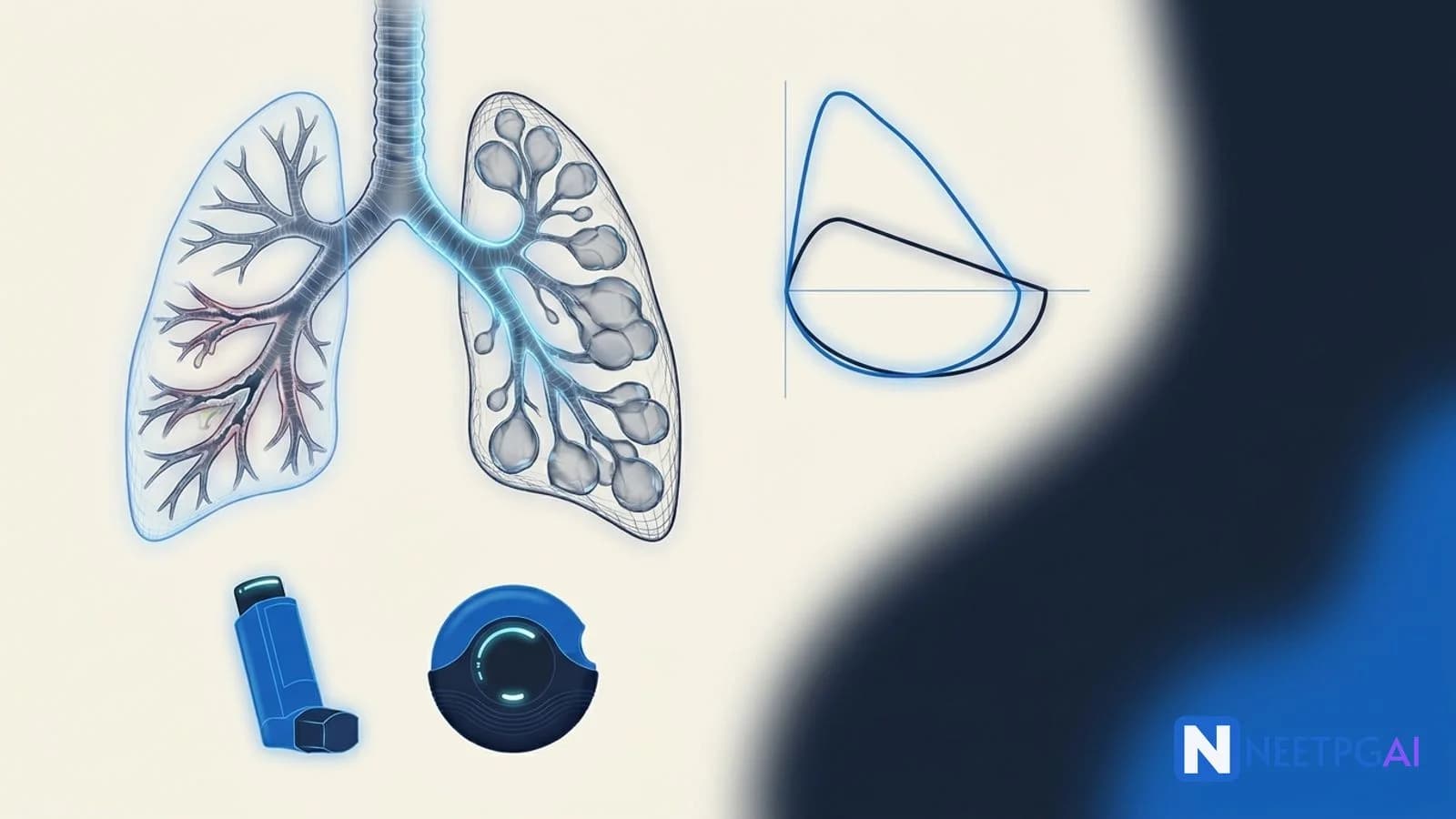
Master asthma and COPD for NEET PG 2027: GINA severity, stepwise management, inhaler devices, GOLD criteria, emphysema vs chronic bronchitis, spirometry interpretation, exacerbation management, and long-term oxygen therapy.
NEETPGAI EditorialPublished 8 Jan 2026Updated 29 Sept 202617 min read
Share this article
This content is for educational purposes for NEET PG exam preparation. It is not a substitute for professional medical advice, diagnosis, or treatment. Clinical information has been reviewed by qualified medical professionals.
Ready to put this into practice?
Start practicing NEET PG MCQs with AI-powered explanations.
Comparison of the authorities that shape NEET PG, INI-CET, FMGE, and Indian medical education: NMC (regulator), NBEMS (exam conductor), MCC (AIQ counseling), DGHS (health services), AIIMS (INI-CET), plus state councils and FMG pathway — clarifies who does what.
COPD definition (GOLD) — Persistent respiratory symptoms + airflow limitation from airway or alveolar abnormalities, usually from significant exposure to noxious particles (tobacco smoke, biomass fuel)
Emphysema vs chronic bronchitis — Emphysema: pink puffer, dyspnea, reduced DLCO, high TLC. Chronic bronchitis: blue bloater, productive cough >=3 months x 2 years, normal DLCO
Exacerbation management — O2, bronchodilators (SABA + SAMA nebs), steroids (5 days), antibiotics if increased sputum purulence, NIV for hypercapnic respiratory failure
LTOT indications — PaO2 <=55 mmHg OR SaO2 <=88%; OR PaO2 55–60 with cor pulmonale / Hct >55%. Target >=15 hr/day. Only LTOT and smoking cessation reduce COPD mortality
Asthma and COPD are the two major obstructive airway diseases in NEET PG — and while both feature airflow obstruction on spirometry, they differ fundamentally in pathology, reversibility, age of onset, and treatment. The student who masters the GINA and GOLD frameworks, spirometry interpretation, and acute exacerbation management has covered 2–3 marks across medicine and pharmacology. Pair this guide with daily MCQ practice on the Medicine subject hub and cross-reference the high-yield medicine topics overview for adjacent pulmonology topics.
Asthma pathophysiology
Asthma is a chronic inflammatory disease of the airways characterized by reversible airflow obstruction, airway hyperresponsiveness, and episodic wheezing.
Core pathologic features:
Airway inflammation — dominated by Type 2 (Th2) cytokines: IL-4, IL-5, IL-13
Bronchoconstriction — smooth muscle contraction mediated by histamine, leukotrienes, acetylcholine
Mucus hypersecretion — goblet cell hyperplasia and Curschmann spirals in sputum
GINA severity classification and stepwise management
Asthma severity is classified by the level of treatment required to achieve and maintain control — with the Global Initiative for Asthma (GINA) 2023 framework as the NEET PG standard.
Severity categories (retrospective, based on treatment step):
Mild asthma — well-controlled on GINA Step 1 or 2 (as-needed low-dose ICS-formoterol)
Moderate asthma — well-controlled on Step 3 or 4 (low-medium dose ICS-LABA)
Key 2023 update: GINA eliminated SABA-only therapy (even at Step 1) due to rebound bronchospasm, increased inflammation, and mortality with SABA over-reliance (>=3 canisters per year = increased death risk).
MART (Maintenance And Reliever Therapy): ICS-formoterol used both as scheduled controller and as-needed reliever. Reduces exacerbations by 30% vs SABA reliever.
Achieving asthma control (GINA):
Daytime symptoms ≤2 times/week
No nocturnal awakening
SABA use ≤2 times/week (for non-MART regimens)
No limitation of activity
Step-down: After 3 months of good control, reduce to the lowest effective step. Never discontinue ICS entirely — loss of control risk.
Inhaler devices
Inhaler devices are the delivery systems for inhaled medications, and device selection based on patient capability is a practical NEET PG topic.
Cannot be used in severe exacerbation (low inspiratory flow)
Soft mist inhaler (Respimat)
Slow-moving mist (1.5 seconds)
Easier coordination; higher deposition (50%)
Pricier; limited drug options
Nebulizer
Compressor or ultrasonic generates aerosol
Best for acute severe exacerbation, young children, elderly
Slow (10–15 min); bulky
Device selection rules:
Acute exacerbation — nebulizer or pMDI + spacer (patient may be unable to generate inspiratory flow for DPI)
Young children (<5 yr) — pMDI + spacer + face mask
Elderly with arthritis — Respimat (low actuation force)
Poor coordination — spacer or DPI
Most common NEET PG error: Using a DPI during severe acute asthma — these require inspiratory flow patients cannot generate when severely obstructed.
COPD — definition and diagnosis
COPD is a heterogeneous lung condition characterized by persistent respiratory symptoms (dyspnea, cough, sputum) and airflow limitation due to airway and/or alveolar abnormalities from significant exposure to noxious particles (GOLD 2024).
Diagnostic criteria:
Exposure: Tobacco smoke (most common worldwide), biomass fuel (major cause in Indian women), occupational dust/chemicals
Alpha-1 antitrypsin deficiency (young onset, basal emphysema, consider if COPD in non-smoker <45 years)
Childhood respiratory infections
GOLD 2024 classification of airflow limitation severity (based on FEV1 % predicted, post-bronchodilator):
GOLD grade
FEV1 % predicted
Severity
GOLD 1
>=80%
Mild
GOLD 2
50–79%
Moderate
GOLD 3
30–49%
Severe
GOLD 4
<30%
Very severe
GOLD ABE classification (2023+, used for treatment):
Group
Exacerbations in past year
Symptoms
Group A
0–1 (no hospitalization)
Low (CAT <10, mMRC 0–1)
Group B
0–1 (no hospitalization)
High (CAT >=10, mMRC >=2)
Group E
>=2 moderate OR >=1 hospitalized
Any
(Previous GOLD used ABCD — simplified to ABE because exacerbation history matters more than symptom burden for choosing therapy.)
Emphysema vs chronic bronchitis
Emphysema and chronic bronchitis are the two pathologic phenotypes of COPD, traditionally distinguished as "pink puffer" and "blue bloater" — most patients have overlapping features.
Feature
Emphysema (pink puffer)
Chronic bronchitis (blue bloater)
Pathology
Destruction of alveolar walls, loss of elastic recoil
Hypertrophy of mucus glands, Reid index >0.4
Body habitus
Thin, cachectic
Overweight
Predominant symptom
Dyspnea
Productive cough (≥3 months/year for ≥2 consecutive years)
Breath sounds
Diminished (silent chest)
Rhonchi, wheezing
Cyanosis
Absent (pink)
Present (blue)
Cor pulmonale
Late
Early
Chest X-ray
Hyperinflation, flattened diaphragm, bullae
Increased bronchovascular markings, "dirty lung"
TLC
Increased
Normal
DLCO
Decreased
Normal
Posture
Pursed-lip breathing, tripod position
Normal
Types of emphysema:
Centriacinar (centrilobular) — most common, apical, smoking-related, destroys central acinus
Life-threatening: Silent chest, cyanosis, confusion, hypotension, bradycardia, SpO2 <88%, PEF <33%, PaCO2 rising (normal or high in severe attack is a RED FLAG — impending respiratory failure)
Management:
Oxygen — target SpO2 93–95% (not higher — risk of hyperoxemic hypercapnia in chronic respiratory disease)
SABA (salbutamol) — nebulizer 2.5–5 mg every 20 minutes x 3 doses, then hourly
Ipratropium — add-on in severe, 500 mcg with each SABA neb for first 3 doses
Systemic steroids — oral prednisolone 40–50 mg daily x 5 days (equivalent efficacy to IV), IV hydrocortisone 100 mg if unable to take oral
IV magnesium sulfate — 2 g over 20 minutes for severe exacerbation not responding
Non-invasive ventilation — consider if acidotic respiratory failure not improving
Antibiotics: NOT routinely indicated for asthma exacerbation (most triggered by viral infection).
COPD exacerbation is defined as an acute worsening of respiratory symptoms requiring additional therapy — and is the leading cause of hospital admission among COPD patients.
Anthonisen criteria (bacterial vs viral trigger):
Increased dyspnea
Increased sputum volume
Increased sputum purulence
Antibiotic indications (COPD exacerbation): All 3 cardinal symptoms, OR 2 with increased sputum purulence, OR mechanical ventilation required. First-line: amoxicillin-clavulanate, macrolide, or doxycycline. Pseudomonas cover (levofloxacin, piperacillin-tazobactam) if severe COPD / frequent exacerbations / prior Pseudomonas.
Most common pathogens: Streptococcus pneumoniae, Haemophilus influenzae, Moraxella catarrhalis; rhinovirus, influenza.
Non-invasive ventilation (NIV): First-line for hypercapnic respiratory failure (pH <7.35, PaCO2 >45). Reduces intubation rate by 58% and mortality by 46% in COPD exacerbation.
Long-term oxygen therapy in COPD
Long-term oxygen therapy (LTOT) is continuous home oxygen (>=15 hours/day) — the ONLY pharmacological intervention proven to reduce mortality in COPD.
Indications (must meet criteria on arterial blood gas at rest, room air, stable):
Absolute: PaO2 <=55 mmHg OR SaO2 <=88%
Relative: PaO2 55–60 mmHg with evidence of end-organ damage:
Pulmonary hypertension
Cor pulmonale (right heart failure)
Secondary polycythemia (hematocrit >55%)
Target: PaO2 >60 mmHg or SaO2 >90%. Flow typically 1–2 L/min via nasal cannula.
Mortality benefit:
NOTT trial (1980): 19-hour/day oxygen reduced mortality vs 12-hour
MRC trial (1981): Oxygen >=15 hr/day reduced mortality vs no oxygen
Must be continuous to work — ambulatory oxygen alone does not reduce mortality
Contraindication: Continued smoking (fire risk) — smoking cessation is mandatory before LTOT prescription.
Pharmacologic management of stable COPD (GOLD 2024):
GOLD group
Initial therapy
A
Bronchodilator (SABA, SAMA, LABA, or LAMA)
B
LABA + LAMA
E
LABA + LAMA (add ICS if blood eosinophils >=300 or history of asthma)
ICS considerations in COPD: Not first-line monotherapy. Combine with LABA only if frequent exacerbations and eosinophilic phenotype (>=300/microL). Increased risk of pneumonia.
Smoking cessation remains the single most impactful intervention — reduces rate of FEV1 decline from 62 to 31 mL/year (Lung Health Study).
Asthma vs COPD — the discriminating comparison
A direct comparison is consistently tested because NBE loves this distinction.
Feature
Asthma
COPD
Age of onset
Childhood typically
After age 40
Smoking history
Not required
Usually >10 pack-years
Symptom pattern
Episodic, variable
Persistent, progressive
Reversibility
Significant (>=12% and >=200 mL)
Partial or absent
Predominant cells
Eosinophils, mast cells, Th2
Neutrophils, macrophages, CD8 T cells
Cytokines
IL-4, IL-5, IL-13
IL-8, TNF-alpha
DLCO
Normal or increased
Decreased (emphysema) or normal (bronchitis)
First-line therapy
ICS-formoterol
LABA, LAMA, or LABA+LAMA
ICS role
Foundation of therapy
Only with LABA in severe/eosinophilic
Course
Waxing and waning
Progressive decline
Mortality reduction
Low-dose ICS (in severe)
Smoking cessation, LTOT
ACOS (Asthma-COPD Overlap Syndrome): Patient with persistent airflow limitation (like COPD) but significant reversibility and eosinophilic inflammation (like asthma). Features of both diseases. Treat with ICS-LABA-LAMA triple therapy.
Sources and references
Global Initiative for Asthma (GINA) — 2023 Global Strategy for Asthma Management and Prevention — the international standard for asthma classification and management.
Global Initiative for Chronic Obstructive Lung Disease (GOLD) — 2024 Global Strategy for Prevention, Diagnosis and Management of COPD.
Harrison's Principles of Internal Medicine, 21st Edition (Loscalzo et al., 2022) — Chapters on Asthma and COPD.
Fishman's Pulmonary Diseases and Disorders, 5th Edition (Grippi et al., 2015) — detailed pathophysiology of obstructive lung disease.
Nocturnal Oxygen Therapy Trial Group — Annals of Internal Medicine 1980; 93:391-398 — landmark evidence for LTOT mortality benefit in COPD.
API Textbook of Medicine, 11th Edition (Munjal et al., 2019) — Indian-context epidemiology including biomass fuel exposure.
Frequently asked questions
How many asthma/COPD questions appear in NEET PG?
Obstructive airway disease contributes 2-3 direct questions per NEET PG paper across medicine, pharmacology, and pediatrics. Spirometry interpretation (FEV1/FVC ratio), GINA stepwise management, and COPD exacerbation treatment are the three most frequently tested subtopics based on 2019-2025 pattern analysis.
What is the key spirometry finding in obstructive disease?
Post-bronchodilator FEV1/FVC ratio less than 0.70 (or less than lower limit of normal) defines airflow obstruction in both asthma and COPD. In asthma, reversibility is demonstrated by FEV1 improvement of 12 percent and 200 mL after bronchodilator. In COPD, airflow limitation is persistent and not fully reversible. TLC is increased in emphysema; DLCO is reduced.
How is asthma severity classified by GINA?
GINA classifies asthma severity retrospectively based on the step of treatment required for control. Mild asthma is well-controlled on Steps 1-2 (as-needed ICS-formoterol). Moderate asthma requires Step 3-4 (low-medium dose ICS-LABA). Severe asthma requires Step 5 (high-dose ICS-LABA plus add-ons like tiotropium, biologics, or oral steroids).
What is the first-line controller in GINA 2023?
As-needed low-dose ICS-formoterol is first-line for mild asthma across all adults and adolescents (Step 1-2). GINA eliminated SABA-only therapy because of rebound bronchospasm and mortality risk. For persistent symptoms (Step 3), add regular low-dose ICS-formoterol as maintenance plus as-needed reliever (MART regimen).
What is the GOLD ABCD classification for COPD?
GOLD 2024 uses ABE classification (simplified from ABCD in 2023): Group A is low symptoms (CAT less than 10, mMRC 0-1) with 0-1 moderate exacerbations. Group B is high symptoms with 0-1 exacerbations. Group E is high exacerbation history (2 or more moderate OR 1 severe requiring hospitalization) regardless of symptoms. Management is tailored to groups.
How do I differentiate emphysema from chronic bronchitis?
Emphysema is the pink puffer: thin, dyspnea-predominant, hyperinflated chest, diminished breath sounds, increased TLC, reduced DLCO, pursed-lip breathing. Chronic bronchitis is the blue bloater: overweight, cough and sputum for 3 months in 2 consecutive years, cyanosis, cor pulmonale, normal TLC, normal DLCO, productive cough. Most COPD patients have mixed phenotypes.
When is long-term oxygen therapy indicated in COPD?
Long-term oxygen therapy (LTOT, greater than 15 hours per day) is indicated when PaO2 is less than or equal to 55 mmHg or SaO2 less than or equal to 88 percent at rest. LTOT is also indicated when PaO2 is 55-60 mmHg with evidence of pulmonary hypertension, cor pulmonale, or polycythemia (hematocrit over 55 percent). LTOT is the only intervention proven to reduce mortality in COPD alongside smoking cessation.
What is the management of acute asthma exacerbation?
Treat with oxygen to target SpO2 93-95 percent, nebulized short-acting beta-2 agonist (salbutamol 2.5-5 mg every 20 minutes x 3 doses), systemic corticosteroids (oral prednisolone 40-50 mg daily x 5 days or IV hydrocortisone), ipratropium nebulizer if severe, and IV magnesium sulfate 2 g for severe exacerbations not responding to initial therapy. ICU admission if impending respiratory failure.
Which vaccines are recommended in COPD?
Annual influenza vaccine, 23-valent pneumococcal polysaccharide (PPSV23) once after age 65 (or earlier if at risk), 13-valent pneumococcal conjugate (PCV13) in sequence, Tdap booster, and Herpes zoster vaccine after age 50. These reduce COPD exacerbations and mortality. COVID-19 vaccine is also recommended. Smoking cessation remains the single highest-impact intervention.
What is the role of biologics in severe asthma?
Biologics target Type 2 inflammation in severe asthma uncontrolled on high-dose ICS-LABA. Anti-IgE (omalizumab) for allergic asthma with elevated IgE. Anti-IL-5 (mepolizumab, reslizumab) or anti-IL-5R (benralizumab) for eosinophilic asthma (blood eosinophils over 300). Anti-IL-4R-alpha (dupilumab) for both eosinophilic and Type 2 high asthma. Reduce exacerbations by 50-70 percent.
Explore our pricing plans for unlimited practice across all 19 subjects, AI-powered doubt resolution, and personalized study plans.
This content is for educational purposes for NEET PG exam preparation. It is not a substitute for professional medical advice, diagnosis, or treatment. Clinical information has been reviewed by qualified medical professionals.
Written by: NEETPGAI Editorial Team
Reviewed by: Pending SME Review
Last reviewed: February 2026
This article is reviewed by qualified medical professionals for clinical accuracy and exam relevance. For corrections or updates, contact the editorial team.