Version 1.0 — Published April 2026
Quick Answer
A first-ever focal seizure with secondary generalization in an Indian adult, paired with a ring-enhancing brain lesion on MRI, is a high-yield NEET PG vignette that tests differential diagnosis, empirical management, AED choice, and the Indian epidemiology of neurocysticercosis. In a 42-year-old with no fever, no immunocompromise, and a small (<20 mm) solitary frontal-lobe ring-enhancing lesion with surrounding edema, follow this 7-step workflow:
- ABC and post-ictal observation — protect airway, recovery position, monitor; recurrent or prolonged seizure = status epilepticus
- Detailed history and examination — semiology (focal vs generalized onset), aura, postictal Todd paresis, fever, immunocompromise, malignancy, travel, pork exposure
- Investigations — non-contrast and contrast-enhanced MRI brain (T1, T2, FLAIR, DWI, post-gadolinium), HIV, ESR, blood glucose, electrolytes, EEG, fundoscopy
- Build the differential — neurocysticercosis (top in India), tuberculoma, glioma, metastasis, abscess, lymphoma, demyelination, toxoplasmosis (HIV)
- Initiate AED — IV / oral levetiracetam 1000-3000 mg/day (preferred); avoid valproate in women of childbearing age
- Treat the lesion — empirical albendazole 15 mg/kg/day for 14-28 days plus dexamethasone for typical solitary cysticercus granuloma; biopsy for atypical features; antitubercular therapy (4 drugs) for likely tuberculoma; surgical resection plus radiation plus temozolomide for high-grade glioma
- Driving, work, and counselling — comply with Indian driving restrictions for a first seizure; counsel on epilepsy stigma, follow-up MRI at 6-12 weeks, recurrence risk
The case
A 42-year-old male schoolteacher from rural Maharashtra is brought to the emergency department by his colleagues at 11:30 AM with witnessed loss of consciousness and convulsive movements during a staff meeting. The episode lasted 90 seconds. Witnesses describe an initial vacant stare and rhythmic twitching of the left side of the face, followed by jerking of the left arm and leg, then loss of consciousness with stiffening, generalized tonic-clonic activity, urinary incontinence, and tongue biting. He returned to baseline over 30 minutes but remains drowsy and slow to respond. He has had no prior seizures, no head injury, no recent illness, no fever, no headache, no vomiting, no neck stiffness. He has no chronic medical conditions, takes no medications, has not consumed alcohol in the past 48 hours, and has never used recreational drugs. He lives in a peri-urban village with mixed livestock including pigs in the neighbourhood, eats home-cooked food including occasional pork from the local market, and has no known TB or HIV contact. There is no family history of seizures, brain tumor, or stroke.
On arrival, vitals are: HR 96/min, BP 134/82 mmHg, RR 18/min, SpO2 98 percent on room air, axillary temperature 37.0 C, capillary glucose 108 mg/dL. He is post-ictal — drowsy but rousable, GCS 13 (E3 V4 M6), oriented to place but slow with month and date. Pupils equal and reactive at 3 mm. Mild left-sided weakness (4/5) of the upper limb that improves over 60 minutes (Todd paresis). No facial droop, no dysarthria. Cranial nerves intact. Sensory exam normal. Reflexes symmetrical, plantars downgoing. No neck stiffness. No papilledema. Cardiovascular and respiratory examinations normal. No skin rashes, no subcutaneous nodules. Fundoscopy is performed in the ED — no intraocular cysts, normal optic discs.
The medical registrar is paged. The case is registered as first-ever focal motor seizure with secondary generalization, with post-ictal Todd paresis — and an urgent contrast-enhanced MRI brain is ordered. He is loaded with IV levetiracetam 30 mg/kg over 15 minutes for AED cover.
ABCD assessment and initial investigations
This patient has had a single discrete focal seizure with secondary generalization in an adult without prior seizure history — by definition, new-onset focal epilepsy until investigations clarify the cause. The single biggest decision is excluding a structural lesion with contrast MRI, then narrowing the differential.
A — Airway: Patent. Drowsy but airway-protective reflexes intact. Recovery position with continuous monitoring; intubate if loses airway protection or has recurrent seizure with apnea.
B — Breathing: RR 18, SpO2 98 — adequate. Continue monitoring.
C — Circulation: HR 96, BP 134/82 — within range. IV access, basic labs.
D — Disability: GCS 13, mild Todd paresis on left, fundoscopy clear, no neck stiffness, glucose 108. Capillary glucose ruled out hypoglycemia as a seizure precipitant. No focal deficit beyond Todd paresis.
Status protocol if seizure recurs or persists >5 minutes:
- 0-5 min: ensure airway, oxygen, IV access, glucose check, lorazepam 0.1 mg/kg IV (or buccal midazolam 10 mg if no IV)
- 5-20 min: repeat lorazepam if needed, then IV levetiracetam 60 mg/kg up to 4500 mg over 15 min (current ESETT-supported first-line second therapy) — alternatives are IV fosphenytoin/phenytoin or IV valproate
- 20-40 min: if still seizing, intubation, anesthetic infusion (midazolam, propofol, or thiopental), continuous EEG, ICU
- >40 min: refractory status — escalate anesthetic; ketamine, pentobarbital coma, hypothermia, immunotherapy if NORSE/FIRES suspected
This patient does not meet status criteria. He gets a loading dose of levetiracetam, observation, and rapid imaging.
Initial investigations (first 60-90 minutes):
- CBC: WBC 9,800 (normal), Hb 14.2, platelets 268,000
- Renal: BUN 14, creatinine 0.9
- Electrolytes: Na 138, K 4.0, Cl 102, HCO3 24 — normal
- Calcium 9.4, magnesium 2.0 (normal — exclude as precipitant)
- Glucose: 108
- LFTs: Normal
- CRP: 6 (normal — argues against pyogenic abscess)
- ESR: 22 (mildly raised — non-specific)
- HIV antibody: Pending — request as routine
- VDRL: Pending
- Urine toxicology: Negative
- Blood alcohol: Not detected
- Chest X-ray: No active TB, no malignancy
- ECG: Normal sinus rhythm, no QT prolongation (relevant for AED safety)
- EEG (within 24-48 hours): Right frontal focal sharp-and-slow-wave discharges in interictal recording — supports the focal-onset semiology
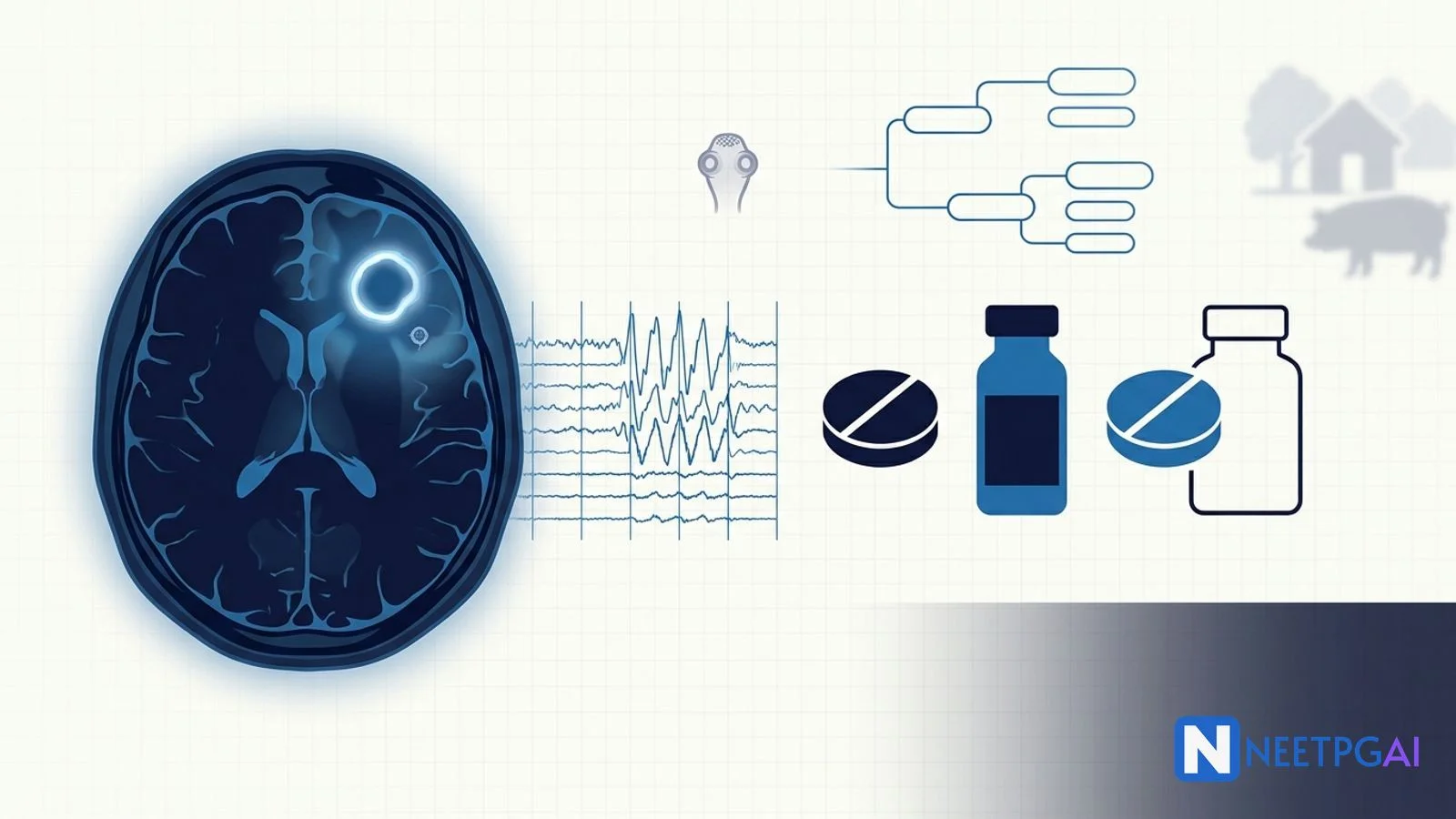
- MRI brain with contrast (T1, T2, FLAIR, DWI, post-gadolinium, SWI): A single 14 mm ring-enhancing lesion in the right frontal cortex/subcortical white matter with surrounding T2/FLAIR hyperintense vasogenic edema and mild local mass effect. Within the ring, an eccentric T1-hyperintense focal point ('scolex') is visible — characteristic of neurocysticercosis in the colloid-vesicular stage. No other lesions, no leptomeningeal enhancement, no hydrocephalus.
- Fundoscopy: Normal (rules out ocular cysticercosis — important before starting albendazole)
- Serology: EITB (enzyme-linked immunoelectrotransfer blot) for cysticercus antibodies — sent to a reference lab; turnaround 5-7 days
- Stool microscopy for Taenia eggs: Negative (intestinal taeniasis often co-exists; treat with niclosamide or praziquantel if positive)
The diagnostic algorithm — building the differential
Three imaging features anchor the differential: lesion size, ring/scolex appearance, location and number, plus surrounding edema.
Differential of solitary ring-enhancing lesion (MAGIC DR mnemonic + India-specific additions)
| Cause | Typical features | Key clues |
|---|
| Neurocysticercosis (NCC) | 5-20 mm cyst with eccentric scolex, vesicular or colloid-vesicular stage, cortex/grey-white junction | Endemic India, Latin America, Asia; pork exposure or village setting; eosinophilia uncommon; positive EITB |
| Tuberculoma | 10-30 mm lesion, often with central calcification ('target sign'), surrounding edema, basal-ganglia or cerebellar predilection | Indian endemic disease; raised ESR; chest X-ray may show TB; positive Mantoux/IGRA; CSF may show lymphocytic pleocytosis with low glucose |
| Pyogenic abscess | 10-50 mm lesion, ring with diffusion restriction (DWI bright, ADC dark — pus restricts diffusion), surrounding edema | Fever, headache, focal deficit; raised CRP/WBC; ear/sinus/dental source; immunocompromise; recent neurosurgery |
| High-grade glioma | Irregular thick enhancing rim, central necrosis, marked vasogenic edema, often crosses corpus callosum (butterfly glioma) | Older age (median 64 for GBM), progressive deficit over weeks, no fever, no infection clues |
| Metastasis | Often multiple, grey-white junction, marked edema relative to small lesion | Known primary (lung, breast, melanoma, RCC, GI); sometimes hemorrhagic (melanoma, RCC, choriocarcinoma) |
| Primary CNS lymphoma | Periventricular, often immunocompetent or HIV (with CD4 <50), homogeneous enhancement (not classical ring) | DWI may restrict (high cellularity); marked steroid response (vanishing tumor); biopsy required |
| Demyelinating (tumefactive) | Open ring (incomplete enhancement), DWI peripheral restriction, less mass effect for size | Subacute course, prior MS history, oligoclonal bands |
| Toxoplasmosis | Multiple ring-enhancing lesions in basal ganglia and grey-white junction | HIV with CD4 <100; positive serology (IgG); empirical pyrimethamine-sulfadiazine |
| Radiation necrosis | Ring-enhancement at site of prior radiation 6-12 months later | Past CNS radiotherapy; biopsy may be needed to differentiate from recurrence |
| Infarct / contusion | Wedge-shaped infarct or post-contusion contusion at base of skull | Acute event, vascular territory on infarct, history of head injury for contusion |
NCC stages on MRI
| Stage | T1 | T2 | Enhancement | Edema | Implication |
|---|
| Vesicular (live cyst) | Hypointense, isointense to CSF | Hyperintense | None or thin rim | Minimal | Active live parasite, often asymptomatic |
| Colloid-vesicular (dying cyst) | Hyperintense to CSF | Hypointense (relative) | Thick ring | Marked | Most epileptogenic — host immune response to dying cyst |
| Granular-nodular (resolving) | Variable | Hypointense | Nodular | Decreasing | Healing phase |
| Calcified (inactive) | Iso/hypointense | Hypointense (blooming on SWI) | None | None | Late phase, may still cause focal seizure if perilesional gliosis persists |
Why our patient is most likely NCC
Five features lock it in: (1) single 14 mm ring-enhancing lesion with eccentric scolex in the cortex/subcortical white matter, (2) colloid-vesicular stage features with surrounding edema, (3) Indian peri-urban setting with pig-rearing community and pork consumption, (4) no fever, no immunocompromise, normal CRP — argues against abscess and toxoplasmosis, and (5) age 42 with first-ever focal seizure — atypical for high-grade glioma which has older median age and progressive deficit, and atypical for metastasis which is usually multiple and with known primary.
Tuberculoma remains a real possibility — the imaging features can overlap. The classic 'target sign' (central calcification) is more typical of tuberculoma; ESR was only mildly raised; chest X-ray normal; Mantoux pending. If EITB positive and the lesion has a clear scolex, NCC is confirmed. If EITB negative, lesion shows target sign, ESR markedly raised, and there is an active pulmonary lesion — switch to ATT.
Diagnosis
Solitary cysticercus granuloma (neurocysticercosis, colloid-vesicular stage) in the right frontal cortex/subcortical white matter, presenting as new-onset focal motor seizure with secondary generalization and post-ictal Todd paresis, in a 42-year-old previously well male from a Taenia solium-endemic peri-urban Indian setting — requiring antihelminthic therapy with albendazole plus corticosteroid cover, antiepileptic drug therapy with levetiracetam, fundoscopy clearance prior to cysticidal treatment, follow-up MRI at 6-12 weeks, occupational and driving counselling, and contact-tracing for intestinal taeniasis.
Management — antiepileptic, antihelminthic, and cerebral edema control
Antiepileptic drug (AED) initiation
A first unprovoked seizure with a structural cause on imaging is treated with an AED — recurrence risk in this group is high (60-70 percent at 2 years). The choice:
Levetiracetam (LEV) — first-line for new-onset focal seizure in most adults
- IV loading: 60 mg/kg up to 4500 mg over 15 min (for status); 1500-2000 mg one-time if no status (for our patient, 30 mg/kg = 2400 mg given over 15 min is reasonable)
- Oral maintenance: 500-1500 mg twice daily (1000-3000 mg/day total)
- Renal dose adjustment if eGFR <50 mL/min
- Side effects: irritability, drowsiness, behavioural disturbance, rarely Stevens-Johnson syndrome
- Pregnancy class B — preferred AED in women of childbearing age
- No CYP450 induction; few drug interactions
Alternatives
| AED | Indication | Caveats |
|---|
| Lamotrigine | Focal and generalized epilepsy | Requires slow titration over 4-6 weeks (Stevens-Johnson risk); not for acute new-onset use |
| Oxcarbazepine | Focal epilepsy | Hyponatremia risk; less hepatotoxicity than carbamazepine |
| Lacosamide | Focal epilepsy add-on, first-line in some new diagnoses | PR prolongation — caution in heart block |
| Phenytoin | Status, IV loading | Narrow therapeutic index; CYP inducer; gingival hyperplasia, hirsutism, SJS |
| Valproate | Generalized epilepsy | Avoided in women of childbearing age (teratogenic); useful in older men |
| Carbamazepine | Focal epilepsy | Older drug; CYP inducer; HLA-B*1502 testing in Asians (SJS risk) |
In the Indian context, levetiracetam, lamotrigine, oxcarbazepine and lacosamide are increasingly preferred over older drugs due to better safety profiles and pregnancy compatibility.
Antihelminthic therapy for NCC
Indications: viable parenchymal cysts (vesicular and colloid-vesicular stages). Calcified inactive cysts do NOT need antihelminthic therapy — only AED for any seizures.
Standard regimen for solitary cysticercus granuloma:
- Albendazole 15 mg/kg/day in 2 divided doses for 14-28 days (max 1200 mg/day in adults)
- Plus dexamethasone 0.1-0.15 mg/kg/day (or prednisolone 1 mg/kg/day) starting 1-3 days BEFORE albendazole and continuing through the cysticidal course; taper over 1-2 weeks after antihelminthic completion — covers the inflammatory response from dying parasites
- Praziquantel 50 mg/kg/day in 3 divided doses for 15-30 days is an alternative (less commonly used as monotherapy; sometimes added for multiple cysts or treatment failure)
Pre-treatment requirements:
- Fundoscopy to exclude ocular cysticercosis — antihelminthic-induced inflammation around an intraocular cyst can cause permanent visual loss
- Avoid in racemose (basal/subarachnoid) NCC and ventricular NCC without neurosurgical input — risk of acute hydrocephalus and herniation; surgical drainage or shunting may be needed first
- Counsel on possible transient worsening of seizures, headache, and edema in the first week of therapy
Cerebral edema management
Vasogenic edema around granulomas, tumors, and abscesses responds to corticosteroids:
- Dexamethasone 8-16 mg IV stat, then 4 mg every 6 hours; reduce gradually over 1-2 weeks once symptomatic edema improves
- For raised ICP or impending herniation: head-up 30 degrees, normocapnia, mannitol 1 g/kg IV over 20-30 min OR 3 percent saline 250-500 mL bolus, neurosurgical referral
For our patient, dexamethasone 8 mg IV stat then 4 mg every 6 hours, started 24 hours BEFORE albendazole, tapered over 2 weeks.
When to biopsy or empirically treat for tuberculoma vs glioma
| Scenario | Action |
|---|
| Typical solitary cysticercus granuloma (small, scolex visible, EITB positive or strong epidemiology) | Empirical albendazole + dexamethasone + AED; follow-up MRI 6-12 weeks |
| Suspected tuberculoma (target sign, ESR markedly raised, active pulmonary TB, or no response to antihelminthic at 6-8 weeks) | Empirical 4-drug ATT (HRZE) for 2 months then 2-drug for 7-10 months PLUS pyridoxine; steroids during inflammatory phase |
| Atypical lesion (size >20 mm, multiple lesions without infectious context, irregular thick rim, mass effect out of proportion, no clear scolex) | Stereotactic biopsy or open resection — confirms tumor, lymphoma, abscess, or atypical infection |
| Suspected pyogenic abscess (fever, raised WBC/CRP, DWI restriction in cavity) | Aspiration with culture, empirical IV ceftriaxone + metronidazole (+ vancomycin if MRSA risk) for 6-8 weeks; surgical drainage |
| Suspected high-grade glioma | Stereotactic biopsy or maximal safe resection; postoperative radiotherapy + temozolomide (Stupp protocol) for GBM |
| Suspected toxoplasmosis (HIV, multiple lesions, CD4 <100) | Empirical pyrimethamine + sulfadiazine + folinic acid for 6 weeks; consider HAART; biopsy if no response at 2 weeks |
Driving, occupation, and counselling in India
- Indian Motor Vehicles Act and IES (Indian Epilepsy Society) recommendations: a person with a single seizure should not drive for at least 6 months (private vehicles); commercial drivers require longer, often 2 years seizure-free. Explicit medical certification is required to resume driving.
- Occupation: schoolteachers can usually continue with workplace risk-mitigation; manual labour at heights, machinery, electrical work, and water work need risk assessment.
- Stigma counselling: epilepsy carries social and matrimonial stigma in many parts of India; structured counselling for the patient and family reduces non-adherence and isolation.
- AED adherence: emphasise need for daily medication for at least 2 years (often longer with structural cause), regular follow-up, reporting any new symptom.
Complications — early and late
Early (days to weeks)
- Recurrent seizures or status epilepticus during initial AED titration — adjust dose, consider second AED
- Inflammatory worsening of NCC in first week of albendazole — manage with steroids, AED, ICP control if needed
- Ocular cysticercosis flare if missed at fundoscopy — emergency ophthalmology referral
- Hydrocephalus from racemose or ventricular NCC — neurosurgical shunt
- AED side effects — irritability (LEV), rash (lamotrigine, carbamazepine), tremor (valproate), gingival hyperplasia (phenytoin)
- Aspiration pneumonia post-status
Late (months to years)
- Persistent epilepsy even after cyst resolution (10-30 percent) — perilesional gliosis or calcification
- Cognitive and mood symptoms — depression, anxiety, memory issues; multidisciplinary support
- Pregnancy planning in women — prefer LEV or lamotrigine, supplement folate, monitor levels
- Drug-resistant epilepsy in 30 percent of structural epilepsies — refer to epilepsy surgery centre for evaluation if >2 AEDs at adequate doses fail
- Recurrent NCC with new exposure — public health follow-up, household screening for taeniasis
Prevention — public health for NCC
Taenia solium life cycle break points
- Pig sanitation and meat inspection — preventing porcine cysticercosis at source
- Hand hygiene and food hygiene — preventing fecal-oral spread of Taenia eggs
- Treatment of human taeniasis with niclosamide 2 g single dose or praziquantel 5-10 mg/kg single dose — interrupts ongoing egg shedding
- Improved sanitation and elimination of open defecation — Swachh Bharat Abhiyaan contributes
- Mass drug administration in highly endemic clusters (research stage in India)
Indian programmatic context
- National Programme for Prevention and Control of Brain Disorders is gradually building neuro-infection awareness
- National Centre for Disease Control (NCDC) tracks NCC clusters in some states
- NCC remains under-recognized in primary care; many adult-onset focal seizure cases are under-investigated outside tertiary centres
- Public-health partnership with veterinary services for porcine cysticercosis control is a recognised gap
How NEET PG tests this presentation
Six recurring patterns. Recognise the pattern and the question collapses to a 30-second answer.
Pattern 1 — The MRI ring-enhancing lesion question: Vignette gives an Indian adult with first focal seizure, MRI shows a 14 mm cortical ring-enhancing lesion with eccentric scolex. Diagnosis? Neurocysticercosis (colloid-vesicular stage). Trap: answers offering "high-grade glioma" — incorrect for size, age, and scolex sign.
Pattern 2 — The empirical-treatment question: Indian adult with typical solitary cysticercus granuloma. Treatment? Albendazole 15 mg/kg/day for 14-28 days plus dexamethasone, with AED. Trap: "biopsy first" — typical lesions do not require biopsy in current guidelines.
Pattern 3 — The fundoscopy question: Why is fundoscopy mandatory before starting albendazole for NCC? To exclude ocular cysticercosis — antihelminthic-induced inflammation around an intraocular cyst can cause permanent visual loss.
Pattern 4 — The first-line AED question: First-line AED for new-onset focal seizure in a 42-year-old man? Levetiracetam. In a 28-year-old woman planning pregnancy? Levetiracetam or lamotrigine — avoid valproate.
Pattern 5 — The tuberculoma differentiation question: Indian adult with focal seizure, MRI shows a 25 mm ring-enhancing basal ganglia lesion with central calcification ('target sign'), markedly raised ESR, chest X-ray shows upper-zone fibrosis. Best treatment? Empirical 4-drug antitubercular therapy (HRZE) for 2 months then 2-drug continuation for 7-10 months, plus pyridoxine. Trap: starting albendazole — wrong target.
Pattern 6 — The driving / counselling question: First seizure with MRI structural lesion. When can the patient drive in India? Not for at least 6 months for private vehicles; longer for commercial drivers; explicit medical certification required.
High-yield one-liners:
- NCC is the commonest cause of adult-onset focal seizure in India
- MAGIC DR plus NCC and tuberculoma = the Indian ring-enhancing lesion differential
- Eccentric scolex within ring = NCC
- Target sign with central calcification + raised ESR = tuberculoma until proven otherwise
- DWI restriction in cavity = pyogenic abscess
- Multiple ring-enhancing lesions in HIV with CD4 <100 = toxoplasmosis (empirical pyrimethamine + sulfadiazine)
- Albendazole 15 mg/kg/day × 14-28 days + dexamethasone for typical NCC
- Fundoscopy mandatory before albendazole — exclude ocular cysticercosis
- Levetiracetam first-line AED for new-onset focal seizure
- Avoid valproate in women of childbearing age
- Drive ban in India: at least 6 months after a seizure for private; longer for commercial
- Treat household intestinal taeniasis with niclosamide or praziquantel
Frequently Asked Questions
What is the differential diagnosis of a ring-enhancing brain lesion in an Indian adult with new-onset focal seizure?
In an Indian adult, the differential of a solitary ring-enhancing brain lesion in descending frequency is: (1) neurocysticercosis (NCC) in the colloid-vesicular or granular-nodular stage — the single commonest cause of new-onset adult focal seizure in India; (2) tuberculoma — particularly with 'target sign' (central calcification within the ring); (3) pyogenic brain abscess — clinical picture of fever, headache, focal deficit, raised inflammatory markers; (4) primary brain tumor (high-grade glioma, primary CNS lymphoma); (5) metastasis — typically multiple, more so if known primary; (6) demyelinating tumefactive plaque (rare); (7) toxoplasmosis (immunocompromised, especially HIV with CD4 below 100); (8) radiation necrosis if prior radiotherapy. The MAGIC DR mnemonic captures Metastasis, Abscess, Glioma, Infarct, Contusion, Demyelination, Radiation necrosis — with NCC and tuberculoma added for the Indian context.
When is empirical antihelminthic therapy started for a suspected solitary cysticercus granuloma versus biopsy?
In a typical Indian adult presenting with a single brief focal seizure and an MRI showing a small (under 20 mm) solitary ring-enhancing lesion with surrounding edema in the colloid-vesicular stage, empirical antihelminthic therapy with albendazole 15 mg/kg/day for 14-28 days plus dexamethasone 0.1-0.15 mg/kg/day (tapered over 2 weeks) is appropriate without biopsy if positive serology, exposure history, or characteristic imaging features (scolex, vesicular cyst). Biopsy is reserved for atypical lesions: lesions over 20 mm, rapid growth, multiple non-vesicular lesions, no response after a 4-8 week trial, atypical location, or features suggesting tumor or tuberculoma. A 'wait and watch' approach with serial MRI at 6-12 weeks is also acceptable for small inactive-appearing lesions in patients without persistent seizures. Rule out ocular cysticercosis with fundoscopy before starting albendazole — antihelminthic-induced inflammation can cause permanent visual loss.
What is the first-line antiepileptic drug for new-onset focal seizure in an adult and why?
Levetiracetam (LEV) is the preferred first-line AED for new-onset focal seizure in most adults: rapid IV loading (60 mg/kg up to 4500 mg over 15 min for status; 1000-3000 mg/day oral maintenance), favourable interaction profile (renal clearance, no CYP induction), no need for level monitoring, safe in pregnancy (lower teratogenic risk than valproate or phenytoin), and proven efficacy. Alternatives include lamotrigine (slow titration limits acute use), oxcarbazepine, and lacosamide. Phenytoin remains useful for IV loading in status epilepticus but has narrow therapeutic index, multiple drug interactions, and gingival hyperplasia, hirsutism, and Stevens-Johnson syndrome risk. Valproate is avoided in women of childbearing age due to teratogenicity (neural tube defects, fetal valproate syndrome) — IAP, ILAE and Indian Epilepsy Society now strongly recommend against routine valproate in this group. Carbamazepine is inferior to LEV in tolerability and pregnancy safety profile.
How is cerebral edema around a brain mass managed acutely in adults?
Vasogenic edema around a brain tumor or granuloma is managed with dexamethasone 8-16 mg IV stat, then 4 mg every 6 hours, with reduction over 1-2 weeks once symptomatic edema improves. Dexamethasone is preferred over methylprednisolone for vasogenic edema because of greater BBB penetration and lower mineralocorticoid effect. For acute herniation or rising ICP — head-up 30 degrees, ensure adequate analgesia and sedation, treat fever, normocapnia (avoid hyperventilation except as bridge to definitive management), 3 percent saline 250-500 mL bolus or mannitol 1 g/kg IV over 20-30 min if osmotic therapy needed, neurosurgical referral for decompression. Anticonvulsant prophylaxis is given for any patient with documented seizure but is NOT routinely recommended for asymptomatic supratentorial lesions in current guidelines.
Why is neurocysticercosis the commonest cause of adult-onset focal seizure in India?
Neurocysticercosis (NCC) is endemic across most of India, driven by a combination of pork tapeworm (Taenia solium) infection in pig-rearing communities, fecal-oral transmission of Taenia eggs through contaminated food and water, poor sanitation, and open defecation in many areas. Larval cysts lodge in the brain parenchyma, where they pass through vesicular (live), colloid-vesicular (dying — most epileptogenic), granular-nodular (resolving) and calcified (inactive) stages over months to years. The host immune response to dying cysts is the proximate trigger for focal seizures, often presenting as a single brief secondarily-generalized seizure. NCC accounts for up to 50 percent of new-onset adult focal seizures in many Indian regions. Cysticidal treatment (albendazole or praziquantel) plus steroids targets the active cyst; phenytoin, levetiracetam or lamotrigine controls seizures during recovery; lifelong epilepsy is uncommon if cysts calcify without recurrent seizures. India's National Programme for Prevention and Control of Brain Disorders is gradually building NCC awareness, but it remains under-recognized in primary care.
This content is for educational purposes for NEET PG exam preparation. It is not a substitute for professional medical advice, diagnosis, or treatment. Clinical information has been reviewed by qualified medical professionals.
Written by: NEETPGAI Editorial Team
Reviewed by: Pending SME Review
Last reviewed: April 2026