Version 1.0 — Published April 2026
Quick Answer
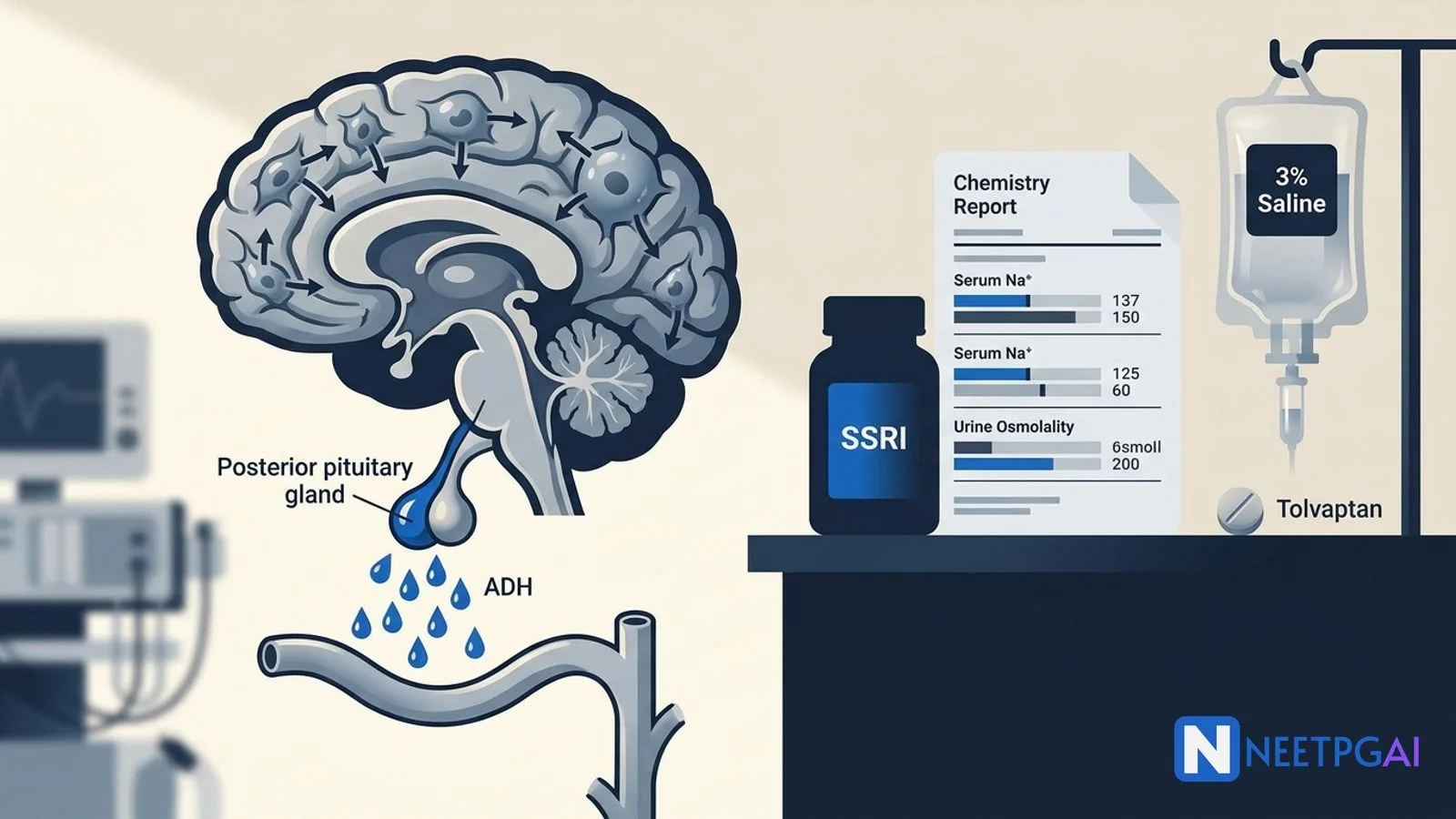
SIADH is the leading cause of euvolemic hyponatremia in elderly Indian inpatients on SSRIs, carbamazepine, or post-CNS event. In a 72-year-old on sertraline presenting with confusion and Na 118 mEq/L, follow this 6-step workflow:
- Confirm hypotonic hyponatremia — serum Na, serum osmolality (<275 mOsm/kg), urine osmolality (>100), urine Na (>30)
- Assess volume status clinically — JVP, mucous membranes, skin turgor, postural BP, edema
- Exclude mimics — TFT (hypothyroidism), 8 AM cortisol or short Synacthen (adrenal insufficiency), creatinine, glucose
- Identify SIADH cause — review drugs (SSRI, carbamazepine), look for malignancy (small-cell lung), CNS event (stroke, SAH), pulmonary cause (pneumonia, TB)
- Treat by severity, not by absolute Na — symptomatic severe = 3% saline bolus; chronic asymptomatic = fluid restriction first, then tolvaptan or salt tablets
- Cap correction at 10 mEq/L per 24 hours — overcorrection causes osmotic demyelination syndrome (irreversible)
The case
A 72-year-old retired schoolteacher is brought to the emergency department by her son with 3 days of progressive confusion, lethargy, and one episode of vomiting. The son reports that she has been forgetting names, slurring words, and unsteady on her feet since yesterday morning. There is no fever, no headache prior to today, no chest pain, no focal weakness, no incontinence, and no seizure activity witnessed.
Past medical history: hypertension on amlodipine 5 mg daily, hypothyroidism on levothyroxine 50 mcg daily (TFT was normal 4 months ago), major depressive disorder on sertraline 100 mg daily for the past 8 weeks (recently up-titrated from 50 mg), and osteoarthritis. No diabetes, no known cardiac, renal, or liver disease. She lives independently, takes her own medications, and was fully oriented at her last clinic visit 3 weeks ago.
On arrival, vitals are: pulse 84/min regular, BP 138/82 mmHg with no postural drop, respiratory rate 16/min, SpO2 97 percent on room air, temperature 36.9 C, capillary glucose 122 mg/dL. She is drowsy but rousable to voice (GCS 13 — E3 V4 M6), oriented to person but not to place or time. Mucous membranes are moist; JVP is not raised; no peripheral edema; skin turgor is reasonable for age; capillary refill is 2 seconds. Clinically euvolemic. No focal neurological deficit. Reflexes are brisk and symmetric. Plantars are flexor. Chest is clear, heart sounds normal, abdomen soft and non-tender.
Bedside fingerstick: glucose 122. Bedside ECG: sinus rhythm, no ischemic changes. The on-call resident sends a basic metabolic panel and is alarmed by the result.
ABCD assessment and initial investigations
Hyponatremia with altered sensorium is a metabolic emergency, but unlike DKA, the priority is getting the diagnosis right before treating — overzealous correction is more dangerous than the underlying low sodium in most chronic cases.
A — Airway: Patent. GCS 13, gag reflex intact, no pooling of secretions. Position left lateral with suction available; reassess every 30 minutes.
B — Breathing: Spontaneous, regular, 16/min. SpO2 97 percent. Continuous pulse oximetry. ABG only if respiratory compromise or to confirm acid-base status; not routinely needed in pure hyponatremia.
C — Circulation: Normotensive without postural drop, no tachycardia, mucous membranes moist, JVP not raised, no edema. The euvolemic exam is the single most important data point — it eliminates hypovolemic causes (vomiting, diuretics, salt-losing nephropathy) and hypervolemic causes (heart failure, cirrhosis, nephrotic syndrome) and points squarely at SIADH or its mimics.
D — Disability/Dextrose: GCS 13, glucose 122 (normal). No focal deficit. Pupils equal and reactive. Look for subtle myoclonus, asterixis, or papilledema (none here).
Initial investigations:
- Serum Na: 118 mEq/L (severe hyponatremia)
- Serum K: 4.2 mEq/L (normal)
- Serum Cl: 86 mEq/L
- Serum HCO3: 24 mEq/L
- Urea/BUN: 14 mg/dL (low-normal — argues against hypovolemia)
- Creatinine: 0.7 mg/dL (normal; eGFR 78)
- Serum glucose: 122 mg/dL (no pseudohyponatremia)
- Serum osmolality (measured): 248 mOsm/kg (low — confirms hypotonic hyponatremia)
- Calculated osmolality: 2 × Na (118) + glucose/18 (7) + urea/2.8 (5) = 248 mOsm/kg (normal osmolar gap, no toxic alcohol)
- Urine osmolality: 462 mOsm/kg (inappropriately concentrated — this is the SIADH fingerprint)
- Urine sodium: 58 mEq/L (high — argues against hypovolemia, supports SIADH)
- Urine output (last 12 hours): 380 mL (low-normal; SIADH urine output is variable)
- TSH: 2.4 mIU/L (normal — excludes overt hypothyroidism)
- 8 AM cortisol: 14 mcg/dL (normal — short Synacthen test deferred unless borderline)
- Free T4: 1.1 ng/dL
- Uric acid: 3.1 mg/dL (low — supports SIADH; hypovolemic states have high uric acid)
- CBC: WBC 7,800; Hb 12.4 g/dL; platelets 240,000 (normal)
- LFTs: AST 22, ALT 18, bilirubin 0.6 (normal — argues against cirrhosis)
- Chest X-ray: clear, no consolidation, no mass (would screen for small-cell lung cancer or TB)
- NCCT brain: mild age-related atrophy, no infarct, no hemorrhage, no mass
The diagnostic algorithm — euvolemic hyponatremia
Hyponatremia is approached in three branching steps. Skipping any one wastes investigations and miscategorises the patient.
Step 1: Is it hypotonic, isotonic, or hypertonic?
Measure serum osmolality. Hypotonic hyponatremia (osm <275) is "real" hyponatremia. Isotonic (pseudo) hyponatremia comes from severe hyperlipidemia or hyperproteinemia (multiple myeloma) — sodium is artefactually low because plasma water is displaced. Hypertonic hyponatremia comes from hyperglycemia (correct: add 1.6 mEq/L to measured Na for every 100 mg/dL glucose above 100) or mannitol or contrast. Our patient is hypotonic (osm 248).
Step 2: What is the urine osmolality?
If urine osm is <100 mOsm/kg, ADH is appropriately suppressed — this is primary polydipsia (psychogenic water intake) or beer potomania (low solute intake). If urine osm is >100 mOsm/kg, ADH is inappropriately active — this is the SIADH-like bucket. Our patient has urine osm 462 (inappropriately concentrated).
Step 3: What is the volume status?
Examine clinically (JVP, mucous membranes, skin turgor, postural BP, edema), supported by urine sodium.
| Volume status | Urine Na | Differential |
|---|
| Hypovolemic | <20 mEq/L | Extra-renal losses — vomiting, diarrhea, third-spacing |
| Hypovolemic | >30 mEq/L | Renal losses — thiazides, loop diuretics, salt-wasting nephropathy, mineralocorticoid deficiency, cerebral salt wasting |
| Euvolemic | >30 mEq/L | SIADH, hypothyroidism, adrenal insufficiency (glucocorticoid deficiency), reset osmostat |
| Hypervolemic | <20 mEq/L | Heart failure, cirrhosis, nephrotic syndrome (avid sodium retention) |
| Hypervolemic | >30 mEq/L | Renal failure (advanced CKD, AKI) |
Our patient is clinically euvolemic, urine Na 58, normal TSH, normal cortisol, normal renal function — SIADH is the diagnosis.
Diagnosis
Syndrome of Inappropriate Antidiuretic Hormone secretion (SIADH), severe symptomatic hyponatremia (Na 118 mEq/L), most likely drug-induced from sertraline (recently up-titrated to 100 mg/day), in a 72-year-old female with no clinical or radiological evidence of malignancy, CNS event, or pulmonary infection.
Bartter-Schwartz criteria fully met: hypotonic hyponatremia (Na 118, osm 248), inappropriately concentrated urine (urine osm 462), high urine Na (58), clinical euvolemia, normal thyroid and adrenal axis, normal renal function.
SIADH causes — the 4-bucket framework
Memorise the four buckets; on NEET PG the vignette will name the trigger and ask you to identify SIADH from the lab pattern.
Bucket 1: Drugs (most common cause in elderly Indian inpatients)
- SSRIs and SNRIs: sertraline, fluoxetine, paroxetine, citalopram, venlafaxine, duloxetine — highest yield in NEET PG vignettes; risk peaks 2-4 weeks after initiation or dose increase
- Antiepileptics: carbamazepine (classic), oxcarbazepine, lamotrigine, valproate
- Antipsychotics: haloperidol, risperidone, olanzapine
- Chemotherapy: vincristine, vinblastine, cyclophosphamide, cisplatin
- Recreational: MDMA (ecstasy) — combination of SIADH and excessive water intake, classic on dance-club vignettes
- Others: opioids, NSAIDs, PPIs, desmopressin overdose, oxytocin (intrapartum)
- Thiazides cause a similar clinical picture but technically by different mechanism (free water retention plus distal sodium loss); approach the same way
Bucket 2: Malignancy (ectopic ADH production)
- Small-cell lung carcinoma — the prototypical paraneoplastic SIADH, present in 10-15 percent of SCLC
- Head and neck squamous cell carcinoma
- Pancreatic, prostate, lymphoma, thymoma
- NEET PG trap: any chronic smoker with weight loss and SIADH = order CT chest
Bucket 3: CNS pathology
- Stroke (large hemispheric, brainstem)
- Subarachnoid hemorrhage (also causes cerebral salt wasting — different management)
- Meningitis, encephalitis
- Traumatic brain injury
- Brain tumors, abscess
- Guillain-Barré syndrome, acute intermittent porphyria
Bucket 4: Pulmonary pathology
- Pneumonia (especially atypicals — Legionella, Mycoplasma)
- Tuberculosis
- Acute respiratory failure on positive-pressure ventilation
- Lung abscess, empyema
A useful Indian-context pearl: in a febrile young adult with cough and SIADH, think TB before SCLC.
Management — three parallel decisions
The first decision is how fast to correct, governed entirely by symptom severity and chronicity. The second is what to use (water restriction, salt tablets, tolvaptan, hypertonic saline). The third is fix the cause (stop the drug, treat the malignancy, treat the infection).
Decision 1: Acute symptomatic versus chronic asymptomatic
| Pattern | Definition | Approach |
|---|
| Severe symptomatic | Seizures, coma, GCS <8, impending herniation, regardless of chronicity | 3% hypertonic saline 100-150 mL bolus over 10 min, up to 3 doses, until symptoms abate |
| Moderate symptomatic | Confusion, falls, vomiting, headache, ataxia (our patient) | Targeted slow correction — fluid restriction or tolvaptan; may give 3% saline if rapidly worsening; cap rise at 6-8 mEq/L in 24 hr |
| Asymptomatic chronic | Incidental finding, no neurological symptoms | Fluid restriction 800-1000 mL/day as first line; salt tablets, urea, tolvaptan if refractory |
| Acute (<48 hr) | Documented rapid drop, e.g., post-op, water intoxication, MDMA | Faster correction is safe (osmotic demyelination risk is much lower); 3% saline if symptomatic |
Our patient (Na 118, confused, drugs as cause, likely chronic over weeks): moderate symptomatic chronic SIADH. Plan: fluid restriction 800 mL/day, hold sertraline, give a single 100 mL 3% saline bolus only if her sensorium worsens or she becomes seizure-prone. Target sodium rise of 4-6 mEq/L in the first 24 hours.
Decision 2: The correction-rate ceiling
| Time window | Maximum rise | Conservative target |
|---|
| First 24 hours | 10 mEq/L | 6-8 mEq/L |
| First 48 hours | 18 mEq/L | 12-14 mEq/L |
| High-risk patients (alcoholism, malnutrition, K<3, liver disease, Na<105) | 8 mEq/L per 24 hr | 4-6 mEq/L per 24 hr |
The Adrogue-Madias formula for predicting Na rise per 1 L of infusate:
Change in Na = (infusate Na - serum Na) / (total body water + 1)
For 3% saline (Na 513) given to a 60 kg woman (TBW ~30 L): change in Na per 1 L = (513 - 118) / 31 = 12.7 mEq/L per L. So a 100 mL bolus raises sodium by approximately 1.3 mEq/L — useful for back-of-envelope calculations, but always recheck Na 4-6 hours after any intervention.
Decision 3: What if you overcorrect?
If sodium rises by more than 10 mEq/L in 24 hours or more than 18 mEq/L in 48 hours, re-lower with:
- D5W 6 mL/kg infused over 1-2 hours
- DDAVP 2-4 mcg subcutaneous or IV to block free water excretion
- Recheck Na every 2 hours; aim to bring sodium back into the safe correction window
Osmotic demyelination syndrome (ODS, formerly central pontine myelinolysis) presents 2-6 days after overcorrection with progressive dysarthria, dysphagia, quadriparesis, and locked-in syndrome from pontine and extrapontine demyelination. MRI brain at 1-2 weeks shows symmetric T2 hyperintensity in the central pons. Outcome is variable; some recover with intensive rehabilitation, others remain locked-in.
Decision 4: Specific treatments
Fluid restriction 800-1000 mL/day — first-line in chronic asymptomatic SIADH. Counsel patient and family carefully; compliance is poor. Predictors of failure: urine osm/serum osm ratio >1, 24-hour urine output <1.5 L, urine Na + K > serum Na (the Furst formula).
Salt tablets (NaCl 1-3 g three times daily) plus loop diuretic (furosemide 20-40 mg daily) — increases solute load and free water excretion. Used in moderate SIADH unresponsive to fluid restriction alone.
Urea (15-30 g/day in juice) — produces an osmotic diuresis without lowering sodium. Effective but unpalatable; better tolerated formulations exist abroad.
Tolvaptan 15 mg orally daily — selective V2 receptor antagonist, blocks ADH at the collecting duct, produces aquaresis (free water excretion without sodium loss). Indicated for moderate-severe SIADH refractory to fluid restriction. Monitor sodium every 6-8 hours for the first 24 hours (rapid correction risk). Cap therapy at 30 days due to hepatotoxicity. Avoid in hypovolemic hyponatremia. Cost is a real-world barrier in India; conivaptan IV is an inpatient alternative.
Hypertonic 3% saline — only for severe symptomatic hyponatremia. Bolus 100-150 mL over 10 minutes, repeat up to 3 times until symptoms resolve. Do NOT use to chase a target sodium.
For our patient: stop sertraline today, fluid restriction 800 mL/day, recheck Na in 6 hours and then every 6 hours, do not give 3% saline unless GCS drops or seizure occurs. If Na has not risen by 4-6 mEq/L in 24 hours, add salt tablets or start tolvaptan.
Complications
1. Osmotic demyelination syndrome (ODS)
The dreaded complication of overcorrection. Risk is highest in patients with chronic hyponatremia (more than 48 hours), severe baseline (Na <120), alcoholism, malnutrition, hypokalemia, and liver disease. Onset 2-6 days after correction. Clinical course: dysarthria, dysphagia, mutism, quadriparesis, locked-in syndrome, sometimes coma. Diagnosis: MRI brain (T2 hyperintensity in central pons, also extrapontine — basal ganglia, thalamus, cerebellum). Treatment: supportive; some recover partially over months.
2. Falls and fractures
Even mild chronic hyponatremia (Na 130-135) doubles the risk of falls and hip fractures in elderly patients via subclinical gait instability and impaired attention. Aggressively investigate and correct mild hyponatremia in geriatric patients before discharge.
3. Seizures
Severe acute hyponatremia (Na <115 with rapid drop) causes cerebral edema, seizures, and herniation. Treat as severe symptomatic — 3% saline bolus.
4. Cerebral edema and herniation
In acute water intoxication (marathon runners, MDMA, psychogenic polydipsia, post-TURP), sodium can drop fast and cause fatal cerebral edema. Hypertonic saline is life-saving here; do not wait for confirmatory osm.
5. Recurrence
If the underlying cause persists (chemotherapy ongoing, malignancy untreated, drug not discontinued), SIADH recurs. Long-term management: maintenance fluid restriction, salt tablets, or chronic tolvaptan if hospitalisations are frequent.
How NEET PG tests SIADH and hyponatremia
NEET PG tests this topic through six recurring patterns. Recognising the pattern means you can solve the question in under 30 seconds.
Pattern 1 — The osmolality classification question: Vignette gives Na, glucose, lipids, proteins. Identify hypotonic vs isotonic vs hypertonic. Trap: hyperglycemia of 600 mg/dL with measured Na 130 — corrected Na is actually ~138 (normal). Always check glucose before treating hyponatremia.
Pattern 2 — The volume status question: Patient with Na 122. Vignette gives JVP, mucous membranes, edema, urine Na. Identify hypovolemic vs euvolemic vs hypervolemic. Trap: answers offering "IV normal saline" for SIADH — wrong, because saline given to SIADH worsens the hyponatremia (the kidney excretes the salt and retains the water).
Pattern 3 — The drug question: Elderly woman 4 weeks after starting sertraline presents with confusion and Na 118. Identify SSRI-induced SIADH. Trap: answers offering "thyroid storm" or "Cushing syndrome" — read the timeline of the drug.
Pattern 4 — The correction-rate question: Na rises from 110 to 130 in 12 hours. What complication? Answer: osmotic demyelination syndrome. Trap: answers offering "wait and watch" — this is a treatment emergency; re-lower with D5W and DDAVP.
Pattern 5 — The 3% saline indication question: Na 112, seizing. Treatment? Answer: 3% saline 100-150 mL bolus over 10 min. Trap: answers offering "fluid restriction" — too slow for severe symptomatic; or "normal saline" — too dilute to raise sodium.
Pattern 6 — The differential question: Euvolemic hyponatremia, urine osm 380, normal TSH, low cortisol on Synacthen. Diagnosis? Adrenal insufficiency, not SIADH. Always exclude hypothyroidism and adrenal insufficiency before labelling SIADH.
High-yield one-liners:
- SIADH = euvolemic + hypotonic + urine osm >100 + urine Na >30
- Always exclude TSH and cortisol before diagnosing SIADH
- Cap correction at 10 mEq/L per 24 hr (8 mEq/L if high risk)
- Overcorrection → ODS at day 2-6; treat with D5W + DDAVP
- 3% saline ONLY for severe symptomatic (seizure, coma)
- SSRIs are the most common drug cause; sertraline tops the list
- Smoker + weight loss + SIADH = order CT chest for SCLC
- Tolvaptan for refractory SIADH; cap at 30 days; hepatotoxicity
- SIADH urine Na >30; hypovolemia urine Na <20
- Cerebral salt wasting (post-SAH) looks like SIADH but is hypovolemic — fluid restriction WORSENS it; treat with saline
Frequently Asked Questions
What are the diagnostic criteria for SIADH?
Bartter and Schwartz criteria require all of the following: hypotonic hyponatremia (serum Na less than 135 mEq/L with serum osmolality less than 275 mOsm/kg), inappropriately concentrated urine (urine osmolality more than 100 mOsm/kg), urine sodium more than 30 mEq/L on a normal salt intake, clinical euvolemia (no edema, no orthostasis), and exclusion of hypothyroidism and adrenal insufficiency. SIADH is a diagnosis of exclusion within the euvolemic hyponatremia bucket.
What is the maximum safe rate of sodium correction in chronic hyponatremia?
Correct sodium by no more than 10 mEq/L in any 24-hour period and no more than 18 mEq/L in 48 hours. The conservative target is 6-8 mEq/L per 24 hours in high-risk patients (alcoholism, malnutrition, hypokalemia, liver disease, serum Na less than 105). Overcorrection causes osmotic demyelination syndrome (formerly central pontine myelinolysis), presenting 2-6 days later with dysarthria, dysphagia, quadriparesis, locked-in syndrome. If overcorrection occurs, re-lower sodium with D5W or DDAVP.
When is hypertonic 3 percent saline indicated in hyponatremia?
Hypertonic 3 percent saline is indicated only for severe symptomatic hyponatremia: seizures, coma, GCS less than 8, or impending herniation. Give 100-150 mL bolus of 3 percent NaCl over 10 minutes; repeat up to 2-3 times until symptoms abate or sodium rises by 4-6 mEq/L. Stop bolusing once symptoms resolve — do not chase a target sodium at this stage. Asymptomatic chronic hyponatremia, even with sodium of 115, should NOT receive hypertonic saline first-line.
Which drugs commonly cause SIADH on the wards?
The high-yield drug list: SSRIs and SNRIs (especially in elderly women, sertraline, fluoxetine, venlafaxine), carbamazepine and oxcarbazepine, vincristine and cyclophosphamide, MDMA (ecstasy), thiazide diuretics (technically not pure SIADH but cause similar euvolemic hyponatremia), antipsychotics (haloperidol, risperidone), opioids, NSAIDs, PPIs, and desmopressin overdose. In elderly patients on multiple drugs, drug-induced SIADH is the single most common cause.
How does tolvaptan work and when is it indicated?
Tolvaptan is an oral selective V2 receptor antagonist (vaptan family) that blocks ADH at the renal collecting duct, producing aquaresis (free water excretion without sodium loss). Indicated for moderate-severe SIADH unresponsive to fluid restriction and for euvolemic or hypervolemic hyponatremia in heart failure. Start 15 mg orally daily; monitor sodium every 6-8 hours for the first 24 hours. Risks: rapid correction with osmotic demyelination, hepatotoxicity (limit to 30 days), thirst. Avoid in hypovolemic hyponatremia.
This content is for educational purposes for NEET PG exam preparation. It is not a substitute for professional medical advice, diagnosis, or treatment. Clinical information has been reviewed by qualified medical professionals.
Written by: NEETPGAI Editorial Team
Reviewed by: Pending SME Review
Last reviewed: April 2026