Version 1.0 — Published April 2026
Quick Answer
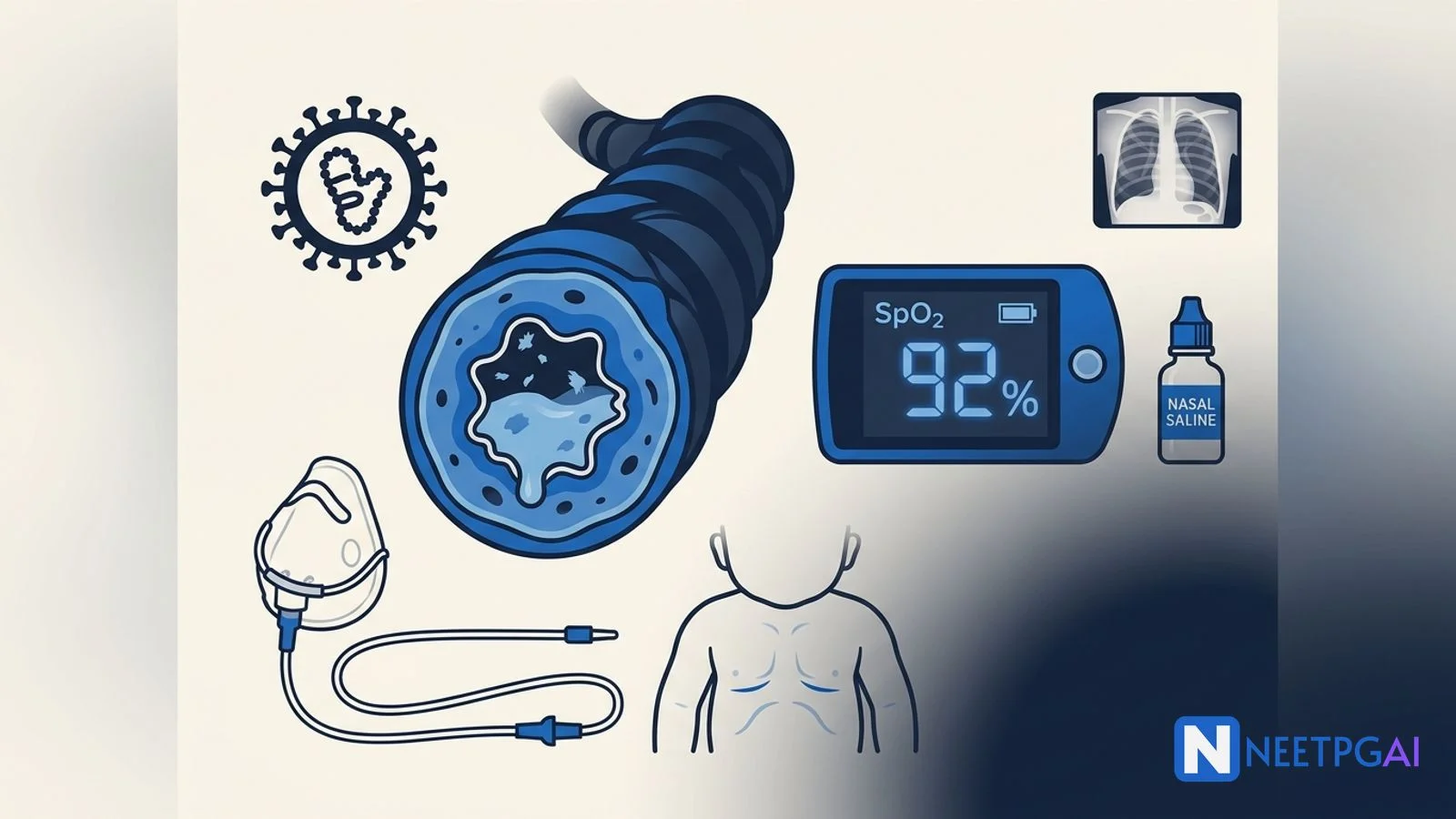
Acute bronchiolitis is the most common lower-respiratory infection in infants under 2 years and one of the highest-yield NEET PG pediatric topics. In a 9-month-old with cough, wheeze, tachypnea, and retractions following a URI, follow this 6-step workflow:
- Diagnose clinically — under 24 months, viral prodrome, tachypnea, wheeze, fine crepitations, retractions; routine tests NOT needed
- Score severity at presentation — RR, SpO2 on room air, work of breathing, feeding adequacy, hydration, mental status
- Pick disposition — outpatient if mild and feeding well; admit if SpO2 <90-92, RR >70, severe retractions, apnea, dehydration, age <3 months
- Treat supportively — nasal saline + suction, oxygen if SpO2 <90, IV/NG fluids if not feeding; nasal high-flow if escalating
- Avoid the don't-list — no routine bronchodilators, steroids, antibiotics, chest physio, or CXR (AAP 2014)
- Counsel and prevent — handwashing, breastfeeding, smoke avoidance, palivizumab/nirsevimab in eligible high-risk infants
The case
A 9-month-old male, ex-37-week singleton, breastfed plus complementary feeds, fully immunised for age, is brought to the pediatric emergency by his mother with 3 days of fever (max 38.4 C), runny nose, and dry cough that turned wet on day 2. Since this morning he has been breathing fast, audibly wheezing, taking only short breastfeeds, and his elder brother (4 years) had a "common cold" last week.
Past history: term delivery, birth weight 2.9 kg, no NICU stay, no recurrent admissions, two prior URIs but never wheezed before. No history of eczema, no food allergy, no parental atopy. Father smokes outside the house. Family lives in a three-room flat in Mumbai with two adults and two children. Up-to-date on immunisations including pneumococcal and rotavirus. No travel.
On arrival, vitals: pulse 156/min, RR 64/min, SpO2 89 percent on room air, temperature 38.0 C, capillary refill 2-3 seconds, weight 8.2 kg (50th centile). The infant is alert, mildly fussy, in obvious respiratory distress. Visible moderate-to-severe intercostal and subcostal retractions, nasal flaring, mild head bobbing, no grunting, no cyanosis. Auscultation: bilateral end-expiratory wheeze with widespread fine inspiratory crepitations, prolonged expiratory phase. Heart: tachycardic, normal sounds, no murmurs. Abdomen soft. Anterior fontanelle slightly sunken. Mucous membranes moist but tongue dry. Capillary glucose 92 mg/dL. He has been wet-nappying half his usual today.
Bedside dipstick on a pad-sample urine: trace ketones, no nitrites. The triage nurse starts continuous SpO2 monitoring, places nasal saline drops, and the on-call pediatrician begins assessment.
ABCD assessment and initial investigations
Bronchiolitis is a respiratory illness, but the killer in infants is fatigue and dehydration before frank respiratory failure. The bedside priorities are oxygenation, work of breathing, and feeding adequacy.
A — Airway: Patent. Audible upper airway noise from nasal congestion. First step: nasal saline drops + bulb suction or gentle Yankauer suction, especially before feeds and oxygen titration. Clearing the nose can drop the RR by 5-10/min and raise SpO2 by 3-5 percent in seconds. Never deep-suction routinely — it can cause apnea and bradycardia.
B — Breathing: RR 64, SpO2 89 percent on room air, retractions, nasal flaring, no grunting, no cyanosis. Start humidified oxygen via nasal cannula at 1-2 L/min to target SpO2 ≥92 percent (AAP threshold; many guidelines accept ≥90). Continuous pulse oximetry. CXR not needed unless atypical.
C — Circulation: HR 156 (high-normal for age), CRT 2-3 sec, mucous membranes drying, slightly sunken fontanelle — mild dehydration from poor feeding plus insensible loss. Weigh. Estimate fluid deficit at 3-5 percent. Establish IV access if oral feeding remains poor; otherwise allow small-volume frequent breastfeeds.
D — Disability/Dextrose: Alert, mildly fussy, glucose 92 (normal). No focal neurological deficit. Watch for lethargy or apnea — signs of fatigue and impending failure.
Initial investigations — what NOT to do:
The AAP 2014 guideline explicitly recommends against routine CXR, viral testing, CBC, blood cultures, urine routine, ABG, or electrolytes in typical bronchiolitis. Indications to test:
- CXR — atypical course, severe disease admitted to ICU, suspected pneumothorax, persistent lobar findings, deterioration despite supportive care
- Viral PCR / RSV antigen — for cohort isolation in admitted patients (does not change management); outbreak surveillance
- Blood gas — severe respiratory distress, pre-intubation, suspected respiratory failure
- CBC, urine — only if ≥38 C in <3 month or other signs of bacterial co-infection (rare; bronchiolitis itself causes a viremic-pattern leukocytosis)
- Electrolytes — prolonged hospital stay, IV fluid, suspected SIADH (rare; hyponatremia from over-administered hypotonic IV fluid is more common)
In our patient, given moderate-severe distress and SpO2 89, we do a single CXR for risk stratification (he will be admitted) and a CBC and CRP because of fever 38.4 in a 9-month-old. Results:
- CBC: WBC 9,200 (normal), neutrophils 42 percent, lymphocytes 48 percent (viral pattern); Hb 11.4; platelets 240,000
- CRP: 8 mg/L (low — bacterial co-infection unlikely)
- CXR: hyperinflation with flattened diaphragms, prominent peri-bronchial markings, focal patchy atelectasis in right middle lobe (atelectasis from mucus plugs is common and does NOT mean pneumonia)
- Capillary blood gas: pH 7.36, pCO2 38, HCO3 22 (no respiratory failure yet; rising pCO2 with normal pH = compensated; pH <7.30 with pCO2 >55 = impending failure)
- Nasopharyngeal swab RSV antigen: positive (would be sent only if cohorting required; not needed for management)
The clinical algorithm — bronchiolitis at the bedside
Diagnosis and severity grading take less than 2 minutes if you follow a structured exam. Memorise the three-question framework.
Question 1 — Is this bronchiolitis or something else?
A wheezy infant under 24 months with a viral URI prodrome is bronchiolitis until proven otherwise. Differentials to clear:
| Differential | Distinguishing clue |
|---|
| Pneumonia | Focal crackles, segmental consolidation on CXR, rising CRP, hypoxia disproportionate to wheeze |
| Foreign body aspiration | Sudden choking episode, asymmetric breath sounds, hyperlucent lung on expiratory CXR, no preceding URI |
| Heart failure | Hepatomegaly, cardiac murmur, cardiomegaly on CXR, gallop rhythm, pulmonary edema on CXR |
| Asthma / viral wheeze | Older infant, recurrent episodes, atopy, rapid response to bronchodilator |
| Pertussis | Paroxysmal cough with whoop or post-tussive emesis, lymphocytosis >20,000, contact history |
| Anaphylaxis | Sudden onset, urticaria, angioedema, food/drug trigger, biphasic course |
Question 2 — How severe is it?
Use a structured severity tool. The AAP combines five domains:
| Domain | Mild | Moderate | Severe |
|---|
| RR | <50 | 50-70 | >70 or apnea |
| SpO2 (room air) | ≥95 | 90-94 | <90 |
| Work of breathing | None or mild | Moderate retractions, nasal flaring | Severe retractions, head bobbing, grunting |
| Feeding | >75% of usual | 50-75% | <50% or unable |
| Mental status | Alert | Mildly irritable, easily consolable | Lethargic, poorly responsive |
Our patient: RR 64, SpO2 89, moderate-severe retractions and nasal flaring, feeds at 50 percent — moderate-severe disease.
Question 3 — Where does this child belong?
| Disposition | Criteria |
|---|
| Discharge home with safety-net advice | Mild only, feeding ≥75 percent, RR <60, SpO2 ≥95, no risk factors, reliable caregiver |
| Observe in ED for 4-6 hours | Mild-moderate; reassess after a feed and a sleep |
| Admit to ward | Moderate, SpO2 <90-92, RR >70, severe retractions, feeding <50 percent, dehydration, age <3 months, prematurity, congenital heart disease, chronic lung disease, immunocompromise, social factors |
| Admit to PICU / HDU | Severe — apnea, exhaustion, rising pCO2, persistent SpO2 <90 despite oxygen, need for HFNC ≥2 L/kg/min or non-invasive ventilation |
Our patient meets multiple admit-to-ward criteria. Admit, start nasal cannula 1-2 L/min, NG feeding if oral feeds remain <50 percent.
Diagnosis
Acute moderate-severe viral bronchiolitis (RSV antigen positive) in a previously healthy term-born 9-month-old male, with mild dehydration secondary to poor feeding, no evidence of bacterial superinfection, no underlying cardiopulmonary risk factors.
This phrasing tells the consultant the diagnosis, the severity, the etiology, the comorbidity, and the absence of the high-risk groups — exactly the structure NEET PG questions test.
Etiology — the viral pathogen list
- RSV — 50-80 percent; peaks October-March in north India, June-September in south India (monsoon and post-monsoon)
- Rhinovirus — second most common; year-round
- Parainfluenza types 1, 2, 3
- Human metapneumovirus (hMPV) — clinically indistinguishable from RSV
- Influenza A and B — bronchiolitis-pneumonia overlap
- Adenovirus — more severe disease, can cause necrotising bronchiolitis (bronchiolitis obliterans)
- SARS-CoV-2 — milder bronchiolitis presentations in infants
- Co-infection is common (15-30 percent) and may correlate with severity in some studies
Management — the AAP do/don't framework
What TO do
- Nasal saline drops + gentle suction — before feeds, before oxygen titration, before sleep
- Oxygen via nasal cannula to target SpO2 ≥92 percent (some accept ≥90 percent)
- Maintain hydration — small frequent breastfeeds; if feeding <50 percent of usual, NG feeds or IV maintenance fluids (use isotonic — 0.9 percent saline + dextrose; hypotonic fluids cause hyponatremia and SIADH)
- Continuous pulse oximetry for moderate-severe disease; intermittent for mild stable
- Position — semi-upright, elevated head; avoid supine if not sleeping
- Nebulised hypertonic saline 3 percent — reasonable in admitted patients to reduce length of stay by ~1 day; not first-line; avoid in outpatients
- High-flow nasal cannula (HFNC) — for moderate-severe escalating disease; flow 1-2 L/kg/min, FiO2 titrated to SpO2; reduces intubation rate
- Non-invasive ventilation (NIV) or intubation — for impending respiratory failure (rising pCO2 >55-60 with falling pH, persistent apnea, exhaustion)
What NOT to do (AAP 2014, reaffirmed in subsequent updates)
| Intervention | Recommendation |
|---|
| Albuterol / salbutamol nebs | NOT routinely; consider single trial only if asthma overlap suspected and continue only if documented benefit |
| Nebulised epinephrine | NOT for outpatients; some use in admitted moderate-severe disease |
| Systemic corticosteroids | NOT recommended (oral, IV, or inhaled) |
| Antibiotics | Only for clear bacterial co-infection (otitis media, pneumonia, UTI, sepsis) |
| Chest physiotherapy | NOT recommended |
| Routine CXR | NOT recommended |
| Routine viral testing | NOT recommended (except for cohort isolation) |
| Mist tents, vapouriser steam | NOT recommended |
Indications for ICU/PICU admission
- Persistent SpO2 <90 percent on FiO2 >0.4
- RR >70-80 sustained
- Apnea episodes
- Rising pCO2 with falling pH
- Exhaustion (decreased work of breathing without clinical improvement is ominous — fatigue precedes failure)
- Hemodynamic compromise
Discharge criteria
- SpO2 ≥92 percent on room air for at least 4-12 hours, including a feed and a sleep
- Feeding ≥75 percent of usual
- RR <60 at rest
- No moderate-severe retractions
- Caregiver understands red flags and follow-up plan
For our patient: admit to ward, nasal cannula 1.5 L/min titrated to SpO2 ≥92, NG feeds at maintenance + replacement of mild deficit, hourly RR/SpO2 for 4 hours then 2-hourly, daily weight, no bronchodilators, no steroids, no antibiotics, repeat assessment for HFNC criteria. Father counselled on smoking outside the house and beyond the immediate vicinity.
Complications
Acute (during illness)
- Apnea — especially in young infants (under 6 weeks) and ex-preterm; more common with RSV
- Respiratory failure — pCO2 rise, exhaustion, requiring NIV or intubation; mortality <0.1 percent in healthy infants but rises to 1-3 percent in high-risk groups
- Dehydration — from poor feeding and insensible losses; manage with NG or IV fluids
- SIADH-pattern hyponatremia — from inflammation and over-administered hypotonic IV fluid; use isotonic fluids
- Atelectasis — focal collapse from mucus plugging; usually resolves spontaneously
- Bacterial superinfection — uncommon (1-2 percent); look for new fever, focal CXR changes, rising CRP
- Pneumothorax / pneumomediastinum — rare; severe coughing or HFNC complication
Subacute / chronic
- Recurrent wheezing — 30-50 percent of infants with severe bronchiolitis develop recurrent wheeze in the next 1-3 years; some progress to asthma. Not all wheezers become asthmatics
- Bronchiolitis obliterans — rare, post-adenoviral; permanent small-airway scarring, exercise intolerance, fixed airflow obstruction
- Increased risk of asthma in later childhood — especially if RSV bronchiolitis hospitalisation in first year (debated whether causal or marker of pre-existing airway susceptibility)
High-risk groups for severe disease
- Premature infants (especially <32 weeks)
- Chronic lung disease of prematurity
- Hemodynamically significant congenital heart disease
- Down syndrome
- Immunodeficiency (primary, secondary, post-transplant)
- Neuromuscular disease (impaired cough)
- Age <12 weeks
Prevention — the high-yield NEET PG block
Universal measures
- Hand hygiene — most important measure; soap-and-water or alcohol-based hand rub
- Breastfeeding — protective effect against severe lower-respiratory infection
- Avoid tobacco smoke exposure — household smoking doubles bronchiolitis admission risk
- Avoid daycare crowding in the first year if alternatives exist
- Standard precautions during outbreaks — cohort isolation in hospitals, masks, gowns
Passive immunoprophylaxis
- Palivizumab — humanised monoclonal antibody against the RSV F protein. AAP 2014 indications:
- Preterm infants <29 weeks during their first RSV season
- Infants with chronic lung disease of prematurity in their first 2 RSV seasons (if requiring oxygen, diuretics, or steroids)
- Infants with hemodynamically significant congenital heart disease in the first RSV season
- Selected immunocompromised, neuromuscular, or congenital airway abnormality infants
- Maximum 5 monthly IM injections per season; 15 mg/kg per dose
- Nirsevimab — newer single-dose long-acting RSV monoclonal; broader eligibility (all infants entering first RSV season); replacing palivizumab in high-income settings
- Maternal RSV vaccine (RSVpreF) — given at 32-36 weeks to confer passive immunity to neonate; available globally, expanding into India
Active vaccines
- Influenza — annual seasonal vaccine for ≥6 months
- Pertussis (DTaP) — primary series and boosters
- Pneumococcal (PCV) — universal infant immunisation
- No licensed RSV active vaccine for infants yet; live-attenuated and mRNA candidates in trials
How NEET PG tests bronchiolitis
NEET PG tests this topic through six recurring patterns. Recognise the pattern; the question collapses to a 30-second answer.
Pattern 1 — The diagnosis question: Vignette of a 6-month-old with 2-day URI then wheeze, RR 60, retractions. Diagnosis? Bronchiolitis. Trap: "asthma" — under 2 years with first wheeze plus URI prodrome is bronchiolitis, not asthma.
Pattern 2 — The pathogen question: Most common causative organism? RSV (50-80 percent). Trap: "rhinovirus" — second most common; "Mycoplasma" and "Streptococcus pneumoniae" are bacteria, not bronchiolitis pathogens.
Pattern 3 — The investigation question: Best next investigation in typical bronchiolitis? None — clinical diagnosis. Trap: answers offering "CXR" or "RSV PCR" — both NOT routinely indicated by AAP guidelines.
Pattern 4 — The treatment question: Recommended treatment? Supportive — saline drops, oxygen if SpO2 <90, hydration. Trap: answers offering "salbutamol nebulisation," "oral prednisolone," or "amoxicillin" — none are recommended routinely.
Pattern 5 — The admission question: Which infant must be admitted? Pick the one with SpO2 88, RR 72, feeding 30 percent of usual. Trap: the infant with mild URI and intermittent cough — discharge home.
Pattern 6 — The prevention question: Indication for palivizumab? Preterm <29 weeks in first RSV season; CLD of prematurity; hemodynamically significant CHD. Trap: "all preterm infants" — eligibility is restricted; "all infants <1 year" — not for healthy term infants.
High-yield one-liners:
- Bronchiolitis = first wheeze + URI prodrome + age <24 months
- RSV is the top pathogen; rhinovirus second
- AAP says NO routine bronchodilators, steroids, antibiotics, CXR, or viral testing
- Nasal saline + suction + oxygen + hydration = the supportive triad
- HFNC for escalating moderate-severe disease; reduces intubation
- Hypertonic 3 percent saline acceptable inpatient, modest LOS reduction
- Palivizumab for preterm <29 weeks, CLD of prematurity, hemodynamically significant CHD
- Atelectasis from mucus plugging is NOT pneumonia
- Hyponatremia from hypotonic IV fluid + SIADH-like state — use isotonic
- Apnea risk highest in young (under 6 weeks) and ex-preterm infants
- Tobacco smoke doubles admission risk
- Mortality <0.1 percent in healthy infants; up to 3 percent in high-risk groups
Frequently Asked Questions
How is acute bronchiolitis diagnosed in infants?
Diagnosis is purely clinical in an infant under 24 months presenting with a 1-3 day prodrome of low-grade fever, coryza, and cough followed by tachypnea, wheezing, fine crepitations, and increased work of breathing (intercostal, subcostal, suprasternal retractions; nasal flaring; head bobbing). Routine viral testing, chest X-ray, and lab work are NOT recommended (AAP 2014 guideline). Test only if diagnosis is uncertain, atypical course, or admission to ICU. RSV is the most common pathogen (50-80 percent); rhinovirus, parainfluenza, hMPV, influenza, adenovirus account for the rest.
What is the role of bronchodilators, steroids, and antibiotics in bronchiolitis?
AAP 2014 guideline: do NOT routinely use bronchodilators (albuterol, salbutamol), nebulised epinephrine, corticosteroids (oral, IV, or inhaled), antibiotics, or chest physiotherapy. None of these have shown consistent mortality, length-of-stay, or hospitalisation benefit in RCTs and meta-analyses. Hypertonic saline 3 percent nebulisation is acceptable in admitted patients (modest length-of-stay reduction); not for outpatients. Antibiotics only if there is clear evidence of co-existing bacterial infection (otitis media, pneumonia, UTI, sepsis).
When should an infant with bronchiolitis be admitted?
Admit any infant with: persistent SpO2 less than 90-92 percent on room air, sustained respiratory rate more than 70/min, severe retractions, grunting or apnea, inability to feed (less than 50 percent of normal intake), dehydration, age less than 3 months with significant illness, prematurity, congenital heart disease, immunodeficiency, or chronic lung disease. Social factors matter — uncertain follow-up, distance from hospital, or caregiver inability to recognise deterioration push toward admission. Mortality is now under 0.1 percent in healthy infants but higher in high-risk groups.
Who qualifies for palivizumab prophylaxis?
Palivizumab is a monoclonal antibody against RSV F protein. AAP recommends monthly IM injections during RSV season (October-March in northern hemisphere) for: preterm infants under 29 weeks during the first RSV season, infants with chronic lung disease of prematurity in their first 2 RSV seasons (if requiring oxygen, diuretics, or steroids), and infants with hemodynamically significant congenital heart disease in the first RSV season. Maximum 5 doses per season. Newer alternatives: nirsevimab (single-dose long-acting monoclonal, expanded eligibility) and maternal RSV vaccine — both becoming available globally.
How does bronchiolitis differ from infant asthma and viral-induced wheeze?
Bronchiolitis is the FIRST episode of wheezing in an infant under 24 months associated with a viral URI prodrome — pathology is bronchiolar inflammation, edema, and necrotic debris obstructing small airways. Recurrent wheezing episodes in the same child shift the differential toward viral-induced wheeze (transient early wheezer, episodic with viral infection only) or atopic asthma (with eczema, food allergy, family history). Classic clue: bronchodilators help asthma but not bronchiolitis — though a single trial of albuterol can be considered if response is observed and documented (rarely the case in true bronchiolitis).
This content is for educational purposes for NEET PG exam preparation. It is not a substitute for professional medical advice, diagnosis, or treatment. Clinical information has been reviewed by qualified medical professionals.
Written by: NEETPGAI Editorial Team
Reviewed by: Pending SME Review
Last reviewed: April 2026