Version 1.0 — Published April 2026
Quick Answer
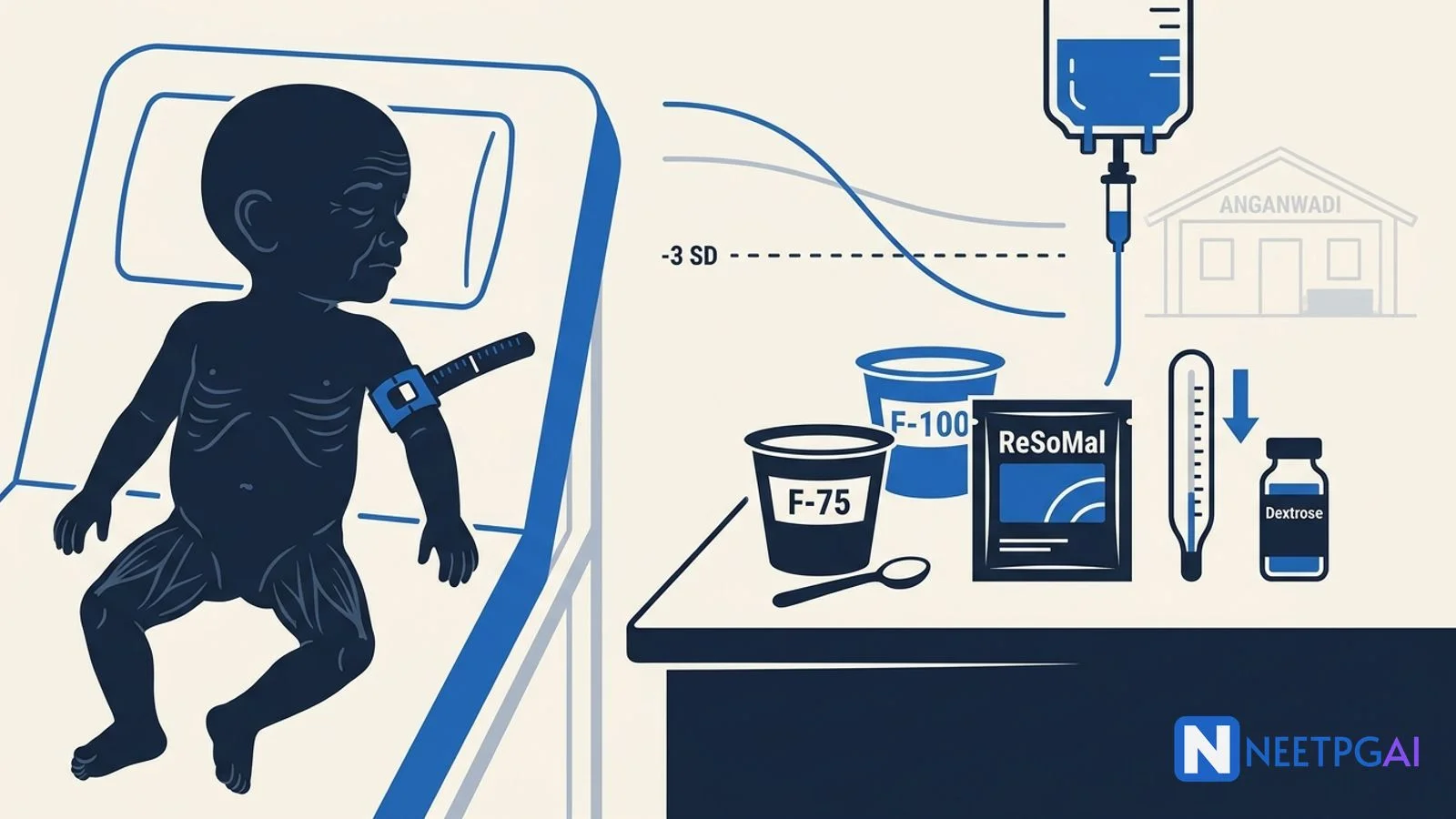
Severe acute malnutrition (SAM) with complications is a high-yield NEET PG vignette that tests the WHO 10-step protocol, the rejection of standard 20 mL/kg fluid boluses, and the stabilization-versus-rehabilitation logic of F-75 and F-100. In an 18-month-old with marasmus (visible severe wasting, MUAC <11.5 cm, weight-for-height <-3 SD), lethargy, hypothermia (axillary <35.0 C), tachycardia, weak pulse and prolonged capillary refill, follow this 8-step workflow:
- Diagnose complicated SAM — MUAC, WHZ, edema check, plus complication (shock, hypothermia, hypoglycemia, severe pneumonia, dehydration, no appetite)
- Treat hypoglycemia immediately — 50 mL of 10 percent dextrose orally or by NG tube; 5 mL/kg of 10 percent dextrose IV if unconscious; then F-75 every 30 minutes for 2 hours
- Treat hypothermia — kangaroo care, warm room, blanket, hot-water bottle (carefully); active warming if axillary temperature is <35.0 C
- Cautious fluid resuscitation — NEVER 20 mL/kg crystalloid; use 15 mL/kg of half-Darrow plus 5 percent dextrose or RL plus 5 percent dextrose over 1 hour, reassess every 5-10 minutes
- ReSoMal for dehydration without shock — 5 mL/kg every 30 min for 2 hr, then 5-10 mL/kg/hr for up to 10 hr; never use standard ORS in SAM (sodium load too high)
- Empirical antibiotics for all complicated SAM — IV ampicillin 50 mg/kg q6h plus gentamicin 7.5 mg/kg once daily; add ceftriaxone or cloxacillin if no improvement
- Begin F-75 feeds slowly — 130 mL/kg/day in 8-12 feeds; advance to F-100 after appetite returns and edema resolves (usually day 3-7)
- Refer to NRC, link to CMAM and ICDS — minimum 14-21 day inpatient course; weekly follow-up at Anganwadi for catch-up growth and RUTF
The case
An 18-month-old boy is brought to the pediatric emergency department of a district hospital in eastern Uttar Pradesh by his mother, a 22-year-old daily-wage labourer. The complaint is loose stools for 3 days, refusal to feed for 2 days, and progressive lethargy over the past 12 hours. The mother reports that the child has not been growing well for the past 6 months — his weight at the last Anganwadi weigh-in (3 months ago) was 6.2 kg, and his clothes have become looser since. He has been weaned to diluted cow's milk and rice gruel since age 8 months, with no animal protein, no fruit, no green leafy vegetables. There is no history of fever or cough. He has had three earlier admissions for diarrhea and pneumonia in his short life. His older sibling died at 14 months of "weakness." The family lives in a single-room dwelling with intermittent water supply. There has been no measles immunization, and only BCG and one dose of OPV were given at birth.
On arrival, the child is profoundly thin and listless. Vitals: heart rate 168/min, respiratory rate 42/min, BP 70/40 mmHg (well below 5th centile for age — hypotensive), capillary refill 5 seconds, axillary temperature 34.6 C (hypothermia), SpO2 93 percent on room air, capillary blood glucose 38 mg/dL (hypoglycemia). Weight 5.8 kg (severe underweight — below -3 SD for age), length 75 cm, weight-for-height -3.8 SD on WHO standards, MUAC 9.8 cm (well below 11.5 cm cutoff). He is alert only to firm pain, with sunken eyes, sunken cheeks, baggy skin folds over the buttocks, severe muscle wasting of the gluteal and thigh regions, and a "wizened old-man" face. The hair is sparse, dry and easily pluckable but not de-pigmented. No pitting edema is present. The radial pulse is weak and thready; the femoral pulse is just palpable. Heart sounds are quiet but regular; no murmur. Lungs are clear. Abdomen is scaphoid; bowel sounds normal; no hepatomegaly, no splenomegaly. There is no skin rash, no flaky-paint dermatosis, no jaundice. The anterior fontanelle is closed. He has not passed urine for 8 hours.
The pediatric registrar is paged. The resuscitation room is activated. The case is registered as complicated severe acute malnutrition with cold shock and hypoglycemia.
ABCD assessment and initial investigations
This child has marasmus with complicated SAM — visible severe wasting, MUAC <11.5 cm, weight-for-height <-3 SD, no edema (so this is marasmus rather than kwashiorkor or marasmic-kwashiorkor), plus complications: cold shock, hypothermia, hypoglycemia, dehydration, and very likely an underlying infection. The default emergency-medicine reflex of "20 mL/kg saline bolus over 5 minutes" is wrong and dangerous here — it causes acute heart failure and pulmonary edema in the SAM child.
A — Airway: Patent. Lethargic but airway-protective reflexes present. Continuous monitoring; intubate if level of consciousness deteriorates further.
B — Breathing: RR 42 — appropriate compensatory tachypnea given dehydration, hypoglycemia and metabolic stress. SpO2 93 percent — give supplemental oxygen via face mask. Any rise in respiratory rate during fluid administration is a red flag for fluid overload.
C — Circulation: Tachycardic (HR 168/min), capillary refill 5 sec, weak thready peripheral pulses, BP 70/40 mmHg, cool extremities — cold shock with profound peripheral vasoconstriction. Do NOT give 20 mL/kg crystalloid bolus. Instead:
- Establish IV access (intraosseous if peripheral fails within 60 seconds — but be aware that IO in malnourished cortex is fragile)
- Slow IV fluid bolus: 15 mL/kg of half-strength Darrow with 5 percent dextrose, OR Ringer lactate with 5 percent dextrose, given over the first hour — that is roughly 87 mL for a 5.8 kg child given over 60 minutes, NOT over 5 minutes
- Reassess every 5-10 minutes for response (improving HR, BP, capillary refill) and for fluid overload (rising RR, hepatomegaly, gallop rhythm, rising JVP, pulmonary crepitations)
- If improvement: give a second 15 mL/kg over the next hour
- If no improvement after 2 boluses or signs of fluid overload appear: stop IV fluids, reassess for possible septic shock with cardiogenic component, consider blood transfusion if Hb <4 g/dL or Hb <6 g/dL with respiratory distress, consider careful inotropic support
- Avoid normal saline as a bolus — high sodium load worsens the SAM child's already raised total-body sodium
D — Disability: Lethargic, AVPU = P (responds to pain). Capillary glucose 38 mg/dL — hypoglycemia, give immediately:
- If alert and able to drink: 50 mL of 10 percent dextrose (or sucrose solution) orally or by NG tube
- If unconscious: 5 mL/kg of 10 percent dextrose IV slowly, then F-75 every 30 minutes for 2 hours, and continue 2-3 hourly feeds
- Repeat glucose at 30 minutes; if still low repeat dose
- All SAM children at admission should be assumed hypoglycemic and fed/dextrosed within minutes
Hypothermia is treated in parallel: active warming with kangaroo mother care (skin-to-skin), warm dry covers, hot-water bottle wrapped in cloth (never directly on skin), warm room (28-32 C). Recheck axillary temperature every 30 minutes until >36.5 C, then every 2 hours. Monitor for hypoglycemia recurrence — the two travel together.
Empirical antibiotics — every complicated SAM case:
- IV ampicillin 50 mg/kg every 6 hours for 2 days, then oral amoxicillin 25-40 mg/kg every 8 hours for 5 days
- PLUS IV gentamicin 7.5 mg/kg once daily for 7 days
- Add ceftriaxone 50-80 mg/kg/day if no clinical improvement at 48 hours, or if severe pneumonia, septic shock, or meningitis is suspected
- Add cloxacillin or vancomycin if staphylococcal infection (skin sepsis, pyomyositis) is suspected
- Consider co-trimoxazole prophylaxis if HIV exposed/infected
- Treat malaria empirically if endemic area and febrile (artesunate-based regimen)
- Albendazole 200-400 mg single dose at the start of rehabilitation (not at admission) for intestinal helminths
Initial investigations (first 30-60 minutes):
- CBC: Hb 7.4 g/dL (anemia), MCV 68 (microcytic), WBC 14,800 with neutrophilia 78 percent, platelets 280,000 — concerning for infection plus iron deficiency
- Blood glucose: 38 mg/dL initially; 84 mg/dL at 30 min after dextrose
- Electrolytes: Na 138, K 2.8 (hypokalemia), Cl 102, HCO3 14 (metabolic acidosis), Mg 1.1 (low), Ca 7.6 (low), phosphate 2.1 (low — risk for refeeding hypophosphatemia)
- Renal: BUN 28, creatinine 0.4 (raised for age — pre-renal AKI from dehydration plus shock)
- Liver: AST 52, ALT 38, albumin 2.4 g/dL (low), total protein 5.6
- CRP: 96 mg/L (raised — supports infection)
- Procalcitonin: Not always available at district level
- Capillary blood gas: pH 7.26, pCO2 26, HCO3 13, BE -12 — metabolic acidosis
- Lactate: 3.6 mmol/L (raised — tissue hypoperfusion)
- Blood culture × 1 before antibiotics if it does not delay them by more than 5 minutes
- Urine routine and culture
- Stool routine, microscopy, occult blood, and Rotavirus antigen
- Mantoux test, gastric aspirate AFB, GeneXpert if any signs suggestive of TB (chronicity, prior contact)
- HIV antibody (mother and child) with consent
- Chest X-ray: ruling out pneumonia, miliary TB, cardiomegaly
- Stool ova-cyst-parasite, Giardia antigen if persistent diarrhea
The diagnostic algorithm — confirming complicated SAM
NEET PG tests the SAM definition, complication criteria, and management cutoffs directly. Memorise this structure cold.
SAM definitions in children 6-59 months
| Criterion | Cutoff | Notes |
|---|
| MUAC | <11.5 cm | Operational community-screening tool (ASHA, Anganwadi) |
| Weight-for-height z-score (WHZ) | <-3 SD on WHO 2006 standards | Requires accurate length and calibrated weighing scale |
| Bilateral pitting edema | Any grade (+, ++, +++) | Defines kwashiorkor or marasmic-kwashiorkor regardless of weight |
Any one criterion = SAM. All three are mutually independent and equally diagnostic.
Complicated vs uncomplicated SAM
| Feature | Complicated | Uncomplicated |
|---|
| Appetite | Poor / refused | Good (passes appetite test with RUTF) |
| Edema | Severe (+++) or any with complications | Mild to moderate without complications |
| Hypoglycemia | Yes (<54 mg/dL) | No |
| Hypothermia | Axillary <35.0 C | No |
| Dehydration | Severe with shock | None or mild |
| Severe pneumonia | Present | Absent |
| Sepsis / septic shock | Present | Absent |
| Severe anemia | Hb <4 g/dL or with respiratory distress | Hb >4 g/dL, no distress |
| Persistent vomiting | Yes | No |
| Severe dermatosis | Flaking, ulcers | Absent |
| Disposition | Inpatient — NRC | Community CMAM with home-based RUTF |
Classification by edema and wasting
| Type | Wasting (WHZ) | Edema | Hair / Skin |
|---|
| Marasmus | <-3 SD | None | Sparse hair, baggy skin, "old-man face" |
| Kwashiorkor | Often -2 to -3 SD only | Bilateral pitting edema | "Flag-sign" depigmented hair, flaky-paint dermatosis, fatty liver, apathy |
| Marasmic-kwashiorkor | <-3 SD | Bilateral pitting edema | Combined features |
Our patient is marasmus — severe wasting, MUAC 9.8 cm, no edema, sparse pluckable but not de-pigmented hair.
Diagnosis
Complicated severe acute malnutrition (marasmus pattern) with cold septic shock, hypothermia, hypoglycemia, hypokalemia, hypomagnesemia, hypoalbuminemia, microcytic anemia, dehydration secondary to acute gastroenteritis, and likely bacterial sepsis — in an 18-month-old previously poorly immunized boy from a food-insecure household — requiring immediate WHO 10-step inpatient stabilization at a Nutrition Rehabilitation Centre (NRC), with subsequent linkage to ICDS, Anganwadi follow-up, and CMAM-based rehabilitation.
Differential diagnosis of severe wasting in a toddler
The clinical pattern of severe wasting, lethargy, and hypothermia in a young child has a defined differential.
Wasting plus chronic feeding failure
- Primary SAM from food insecurity / inadequate complementary feeding (commonest in India)
- Chronic infection — TB, HIV, recurrent pneumonia, recurrent diarrhea
- Chronic non-infective illness — congenital heart disease, chronic kidney disease, cystic fibrosis (rare in India), inflammatory bowel disease
- Malabsorption — celiac disease, tropical sprue, giardiasis, lactose intolerance, cow's milk protein allergy
- Endocrine — diabetes mellitus, congenital adrenal hyperplasia, hyperthyroidism, growth hormone deficiency
- Inborn errors of metabolism — organic acidemias, urea cycle defects, mitochondrial disease (consider in family history of unexplained sibling death)
- Neurological / feeding difficulty — cerebral palsy, severe oromotor dysfunction
- Psychosocial — neglect, abuse, severe maternal mental health issues
Why our patient is primary SAM with intercurrent infection
Five features lock it in: (1) chronic feeding failure with inadequate complementary diet (cow's milk plus rice gruel, no protein, no fruit, no greens), (2) severe wasting plus MUAC plus low WHZ without edema = marasmus, (3) household food insecurity and prior sibling death from "weakness", (4) acute deterioration with diarrhea and shock = intercurrent infection, and (5) absence of dysmorphic features, no congenital cardiac murmur, no chronic respiratory features to suggest an alternate primary diagnosis. TB and HIV must be screened given the history of recurrent infection and sibling death.
Management — the WHO 10-step protocol
The WHO 10-step protocol is the canonical framework. Memorise the order and the reason for each step. NEET PG tests the order, the reasons, and the dosing.
Stabilization phase (days 1-7)
Step 1 — Treat or prevent hypoglycemia
- All SAM children at admission are assumed hypoglycemic
- 50 mL of 10 percent dextrose orally or by NG tube if alert
- 5 mL/kg of 10 percent dextrose IV if unconscious, then F-75 every 30 minutes for 2 hours
- Then F-75 every 2-3 hours including night feeds
Step 2 — Treat or prevent hypothermia
- Axillary temperature target >36.5 C
- Active warming: kangaroo care, warm dry covers, warm room 28-32 C, hot-water bottle wrapped in cloth (never directly on skin)
- Hypothermia and hypoglycemia travel together — recheck glucose every 30 min while hypothermic
Step 3 — Treat or prevent dehydration
- Use ReSoMal, NOT standard ORS (standard ORS sodium 75 mmol/L is too high; ReSoMal sodium 45 mmol/L, K 40 mmol/L)
- 5 mL/kg every 30 minutes for the first 2 hours
- Then 5-10 mL/kg/hour for up to 10 hours
- After each ReSoMal feed, alternate with F-75
- Reassess hourly for fluid overload (rising RR, hepatomegaly, eyelid edema)
- IV fluids only for shock — see step on cautious resuscitation above
Step 4 — Correct electrolyte imbalance
- All SAM children have low intracellular K and Mg, raised total-body Na
- Extra K — 3-4 mmol/kg/day (added to feeds)
- Extra Mg — 0.4-0.6 mmol/kg/day (added to feeds)
- Restrict Na — do NOT add salt to food; ReSoMal already has reduced Na
- Treat any hypocalcemia (typically responds to feeds plus vitamin D)
Step 5 — Treat infection
- All complicated SAM children get empirical antibiotics — see above
- Treat any specific infection identified (pneumonia, UTI, sepsis, TB, HIV)
- Measles vaccine if not previously given and aged >9 months — give at admission
Step 6 — Correct micronutrient deficiencies
- Vitamin A — single dose at admission: 50,000 IU if <6 months, 100,000 IU if 6-12 months, 200,000 IU if >12 months (give 3 doses if eye signs of vitamin A deficiency: day 0, day 1, day 14)
- Folic acid — 5 mg on day 1, then 1 mg daily
- Zinc — 2 mg/kg/day (already in F-75/F-100; supplement if separate)
- Copper — 0.3 mg/kg/day (already in formula)
- Multivitamin — daily
- Iron — DELAYED until step 8 (rehabilitation) — early iron worsens infection (free iron feeds bacteria) and oxidative stress
Step 7 — Begin cautious feeding (F-75 stabilization)
- F-75: 75 kcal and 0.9 g protein per 100 mL — low protein, low sodium, low lactose
- Feed every 2-3 hours including overnight
- Volume: 130 mL/kg/day starting (less if edematous)
- Continue for 2-7 days until appetite returns and edema starts resolving
- Use NG tube if intake is <80 percent of prescribed volume
- Reassess feeding tolerance after every feed
Rehabilitation phase (weeks 2-6)
Step 8 — Achieve catch-up growth (F-100 or RUTF)
- Transition criteria: appetite returned, edema resolving, infections controlled, no clinical deterioration
- Gradual transition over 2-3 days — replace F-75 feeds with equal volumes of F-100 progressively
- F-100: 100 kcal and 2.9 g protein per 100 mL
- Or transition to RUTF (ready-to-use therapeutic food, e.g., Plumpy'Nut or locally adapted) — 200 kcal/sachet, 92 g per sachet
- Target weight gain: 10-15 g/kg/day during catch-up
- Start oral iron (3 mg/kg/day) only once on F-100 or RUTF
- Increase frequency and volume as the child tolerates
Step 9 — Provide sensory stimulation and emotional support
- Loving care, play therapy, structured stimulation
- Encourage maternal involvement; counsel on feeding and infant-care practices
Step 10 — Prepare for discharge and follow-up
- Discharge criteria: WHZ >-2 SD, MUAC >12.5 cm, edema absent for at least 2 weeks, no acute infection, mother/caregiver trained, able to attend follow-up
- Link to Anganwadi for ICDS supplementation and to community CMAM with weekly RUTF
- Follow-up at 2, 4, 8, 12 and 16 weeks; growth monitoring at every visit
- Review immunization (catch-up doses of pentavalent, OPV, measles, MMR)
The forbidden bolus and the refeeding-syndrome traps
| Wrong | Right | Why |
|---|
| 20 mL/kg normal saline bolus over 5-10 min | 15 mL/kg half-Darrow + 5 percent dextrose or RL + 5 percent dextrose over 1 hour | SAM heart cannot tolerate rapid expansion — heart failure and pulmonary edema |
| Standard ORS for dehydration | ReSoMal | Standard ORS Na too high; ReSoMal lower Na, higher K |
| Skipping straight to F-100 on day 1 | F-75 stabilization for 2-7 days, then gradual F-100 transition | Premature high-protein, high-sodium load triggers refeeding syndrome and cardiac failure |
| Iron at admission | Iron only at step 8 (rehabilitation) | Free iron worsens infection, oxidative stress, and competes with chelation defenses |
| Adding salt to food | Restricting Na, supplementing K and Mg | Total body Na is raised; intracellular K and Mg depleted |
| Discharging once weight gain plateaus | Discharge at WHZ >-2 SD, MUAC >12.5 cm, no edema × 2 weeks, mother trained, follow-up in place | Premature discharge has 30-50 percent relapse rate |
Refeeding syndrome — recognition and prevention
- Risk window: first 7 days of refeeding, especially with rapid F-100 or high-protein loading
- Mechanism: rapid carbohydrate refeeding causes insulin surge, intracellular shift of potassium, magnesium, phosphate; pre-existing depletion is unmasked
- Features: hypophosphatemia, hypokalemia, hypomagnesemia, fluid overload, cardiac arrhythmia, sudden death
- Prevention: start F-75 at low volume (130 mL/kg/day), supplement K, Mg, phosphate, advance feeds slowly, monitor electrolytes on days 1, 3, 5, 7
- Treatment: correct phosphate (oral or IV), K, Mg; reduce feed volume; treat any arrhythmia; thiamine 100 mg/day if Wernicke risk
Complications — early and late
Early (hours to days)
- Heart failure from inappropriate bolus or rapid F-100 transition
- Refeeding syndrome — hypophosphatemia, hypokalemia, hypomagnesemia, arrhythmia
- Sepsis with multi-organ failure — antibiotic-resistant organisms, gram-negative shock
- Severe hypoglycemia with neurological injury if missed
- Severe hypothermia with cardiac arrest if missed
- Aspiration pneumonia — risk during NG feeding, especially in lethargic child
- Acute kidney injury from dehydration or sepsis
Late (weeks to months)
- Persistent diarrhea — may need probiotics, lactose-free formulas, antibiotics for small-bowel bacterial overgrowth
- Stunting — chronic linear growth failure even after WHZ recovery; impacts IQ, school performance, adult productivity
- Recurrent infection — residual immune dysfunction for months
- Tuberculosis — high prevalence; screen rigorously
- HIV-related opportunistic infections if HIV positive
- Neurodevelopmental delay — cognitive impact of early-life undernutrition is significant; structured stimulation helps but does not fully reverse
- Relapse — without ICDS / CMAM linkage, 30-50 percent relapse rate within 6 months
India-specific context — NRC, CMAM, ICDS, Poshan Abhiyaan
NEET PG asks about programme architecture as often as it asks about pathophysiology. Memorise these levels.
Levels of care for SAM in India
| Level | Setting | Cases | Workforce |
|---|
| Anganwadi (AWC) | Village | Screening, MUAC, monthly weighing, supplementary nutrition | AWW, ASHA, ANM |
| Primary Health Centre (PHC) | Block | Uncomplicated SAM, growth monitoring, immunisation, IFA, deworming | MO, ANM, LHV |
| Community Health Centre (CHC) / FRU | Sub-district | Complicated SAM stabilization if no NRC, referrals | MO, pediatrician |
| Nutrition Rehabilitation Centre (NRC) | District / sub-district hospital | Complicated SAM 14-21 days inpatient | Pediatrician, dietician, nurse, counsellor |
| Tertiary care | Medical college | Refractory SAM, complications, research | Pediatric subspecialists |
Key programmes
- ICDS (1975) — Integrated Child Development Services, delivers supplementary nutrition, immunization, growth monitoring, preschool education through Anganwadi
- NRC (since 2009) — facility-based 14-21 day stabilization for complicated SAM, follow-up at 2, 4, 8, 12, 16 weeks
- CMAM — Community-based Management of Acute Malnutrition; uses MUAC, RUTF and weekly Anganwadi follow-up for uncomplicated SAM
- Poshan Abhiyaan (2018) — National Nutrition Mission targeting stunting, anemia, low birth weight; ICT-enabled monitoring
- National Family Health Survey (NFHS) — periodic survey monitoring nutrition indicators (NFHS-5: 35.5 percent under-5 stunting, 7.7 percent SAM among under-5)
- RUTF debate — choice between imported peanut-paste-based RUTF (Plumpy'Nut) and locally produced multigrain alternatives; cost, supply chain, and acceptability are policy issues; National Technical Board on Nutrition recommends a context-specific approach
- Eat Right India, Anaemia Mukt Bharat, Mission Indradhanush — adjacent national initiatives that touch on SAM prevention
How NEET PG tests SAM
Six recurring patterns. Recognise the pattern and the question collapses to a 30-second answer.
Pattern 1 — The MUAC cutoff question: Vignette gives an 18-month-old with MUAC 10.8 cm, weight-for-height -3.2 SD, no edema. Diagnosis? Marasmus (severe acute malnutrition without edema). Trap: answers offering "moderate acute malnutrition" — MAM is MUAC 11.5-12.4 cm and WHZ -2 to -3 SD.
Pattern 2 — The "first step in management" question: Lethargic SAM child with capillary glucose 38 mg/dL. First step: 50 mL of 10 percent dextrose (or 5 mL/kg of 10 percent dextrose IV if unconscious), then F-75 every 30 minutes for 2 hours. Trap: answers offering "20 mL/kg normal saline" — wrong and dangerous.
Pattern 3 — The fluid-resuscitation question: SAM child with cold shock, capillary refill 5 sec, BP at 5th centile. Best fluid? 15 mL/kg of half-Darrow with 5 percent dextrose OR Ringer lactate with 5 percent dextrose, slowly over the first hour. Trap: standard 20 mL/kg saline bolus — risk of fatal heart failure.
Pattern 4 — The F-75 vs F-100 transition question: SAM child on F-75 day 4, edema resolving, appetite returning. Next step? Gradual transition to F-100 over 2-3 days. Trap: "switch to F-100 immediately" — premature transition triggers refeeding syndrome.
Pattern 5 — The empirical-antibiotic question: Complicated SAM child at admission. Empirical regimen? IV ampicillin plus IV gentamicin for 7 days. Add ceftriaxone or cloxacillin if no improvement at 48 hours or specific complications.
Pattern 6 — The micronutrient question: When is iron started in SAM management? Only at step 8 (rehabilitation), once the child is on F-100 or RUTF. Trap: "iron at admission" — early iron worsens infection.
High-yield one-liners:
- MUAC <11.5 cm, WHZ <-3 SD, or bilateral pitting edema = SAM
- Marasmus = wasting without edema; kwashiorkor = edema with relatively preserved weight; marasmic-kwashiorkor = both
- All complicated SAM children at admission are assumed hypoglycemic — feed/dextrose within minutes
- ReSoMal (not standard ORS) for dehydration in SAM
- 15 mL/kg slow over 1 hour, NOT 20 mL/kg bolus over 5 min — SAM heart cannot tolerate rapid expansion
- Empirical antibiotics in all complicated SAM — IV ampicillin + IV gentamicin
- F-75 stabilization (days 1-7) → gradual F-100 transition (days 3-7) → catch-up growth on F-100/RUTF (weeks 2-6)
- Iron delayed to step 8 — early iron worsens infection
- Vitamin A at admission; folate, K, Mg supplementation throughout
- Discharge at WHZ >-2 SD, MUAC >12.5 cm, no edema × 2 weeks
- Refeeding syndrome — hypophosphatemia, hypokalemia, hypomagnesemia, arrhythmia within first 7 days
- NRC (facility, complicated SAM) and CMAM (community, uncomplicated SAM) are the Indian operational levels
Frequently Asked Questions
Why is the standard 20 mL/kg saline bolus dangerous in severe acute malnutrition with shock?
Children with severe acute malnutrition (SAM) have reduced cardiac reserve, profound electrolyte derangement (low intracellular potassium and magnesium, raised total body sodium), low serum albumin, and impaired renal handling of fluid. A standard 20 mL/kg crystalloid bolus over 5-10 minutes produces rapid intravascular expansion that the failing myocardium cannot manage, precipitating heart failure, pulmonary edema, and worsening mortality. The WHO 10-step protocol replaces the standard bolus with 15 mL/kg of half-strength Darrow with 5 percent dextrose or Ringer lactate with 5 percent dextrose given slowly over the first hour, with frequent reassessment for fluid overload (hepatomegaly, gallop, raised respiratory rate). If oral intake is feasible, ReSoMal is used cautiously at 5 mL/kg every 30 minutes for 2 hours, then 5-10 mL/kg/hour for up to 10 hours.
What is the difference between F-75 and F-100 therapeutic milks in SAM?
F-75 (75 kcal and 0.9 g protein per 100 mL) is the stabilization-phase formula, used to gently restore metabolic function without overwhelming the malnourished child. It is low in protein, sodium and lactose and is given every 2-3 hours during the first 1-7 days. F-100 (100 kcal and 2.9 g protein per 100 mL) is the rehabilitation-phase formula, started only once the child has regained appetite, edema is resolving, and infections are controlled — typically after 2-7 days. F-100 supports rapid catch-up growth (target 10-15 g/kg/day weight gain). The transition is gradual, replacing F-75 feeds with equal volumes of F-100 over 2-3 days. Premature transition to F-100 is the single most dangerous error — it can precipitate refeeding syndrome with fatal hypophosphatemia, hypokalemia, and cardiac arrhythmia.
What MUAC and weight-for-height cutoffs define severe acute malnutrition in 6-59 month-olds?
WHO and IAP define SAM in children aged 6-59 months by any one of three criteria: mid-upper arm circumference (MUAC) under 11.5 cm, weight-for-height z-score under -3 SD on WHO 2006 growth standards, or visible bilateral pitting edema of nutritional origin (kwashiorkor or marasmic-kwashiorkor). MUAC under 11.5 cm is the operational community-screening tool used by ASHA and Anganwadi workers and at the Nutrition Rehabilitation Centre (NRC) entry point. Children with any of the three criteria plus complications (poor appetite, lethargy, hypothermia, hypoglycemia, severe pneumonia, dehydration, septic shock) are classified as complicated SAM and require inpatient stabilization. Children meeting the SAM criteria but without complications and with good appetite are uncomplicated SAM and managed in community-based programmes with ready-to-use therapeutic food (RUTF).
What are the WHO 10 steps in SAM management and which steps are stabilization versus rehabilitation?
The WHO 10-step protocol is divided into stabilization (days 1-7) and rehabilitation (weeks 2-6), followed by follow-up. Stabilization steps: (1) treat or prevent hypoglycemia; (2) treat or prevent hypothermia; (3) treat or prevent dehydration with ReSoMal; (4) correct electrolyte imbalance (extra K, Mg; low Na); (5) treat infection with broad-spectrum antibiotics empirically; (6) correct micronutrient deficiencies (vitamin A, folate, zinc, copper; iron is delayed until rehabilitation phase); (7) cautious feeding with F-75 every 2-3 hours. Rehabilitation steps: (8) catch-up growth with F-100 or RUTF, target 10-15 g/kg/day; (9) sensory stimulation and emotional support; (10) prepare for discharge and follow-up. Iron is started only in step 8 because early iron worsens infection and oxidative stress.
How is severe acute malnutrition managed under India's CMAM and NRC programmes?
India's facility-based Nutrition Rehabilitation Centres (NRCs) admit complicated SAM cases for 14-21 days of WHO-protocol stabilization and early rehabilitation, with structured follow-up at 2, 4, 8, 12 and 16 weeks. Community-based Management of Acute Malnutrition (CMAM) reaches uncomplicated SAM children at the Anganwadi level using MUAC screening, appetite testing and home-based RUTF or locally adapted therapeutic food. The 2018 RUTF debate in India centres on cost, supply chain and the choice between imported peanut-paste-based RUTF and locally produced multigrain alternatives — the National Technical Board on Nutrition recommends a context-specific approach. ICDS, the Poshan Abhiyaan, the National Family Health Survey monitoring framework, and the Anganwadi-ASHA-ANM workforce together support nutrition surveillance. NEET PG questions test MUAC cutoff, the 10-step protocol, F-75 versus F-100 transition, ReSoMal indication, and the Indian programme architecture.
This content is for educational purposes for NEET PG exam preparation. It is not a substitute for professional medical advice, diagnosis, or treatment. Clinical information has been reviewed by qualified medical professionals.
Written by: NEETPGAI Editorial Team
Reviewed by: Pending SME Review
Last reviewed: April 2026