Version 1.0 — Published April 2026
Quick Answer
Acute pancreatitis is the third most common GI cause of hospital admission in India and one of the most heavily tested NEET PG topics across medicine and surgery. In a 35-year-old man with severe epigastric pain radiating to the back, vomiting, and lipase >3x ULN, follow this 6-step workflow:
- Confirm diagnosis with revised Atlanta criteria — 2 of 3: characteristic pain, lipase or amylase ≥3x ULN, imaging
- Identify etiology fast — gallstones (USG abdomen), alcohol (history), triglycerides >1000, post-ERCP, drugs, hypercalcemia
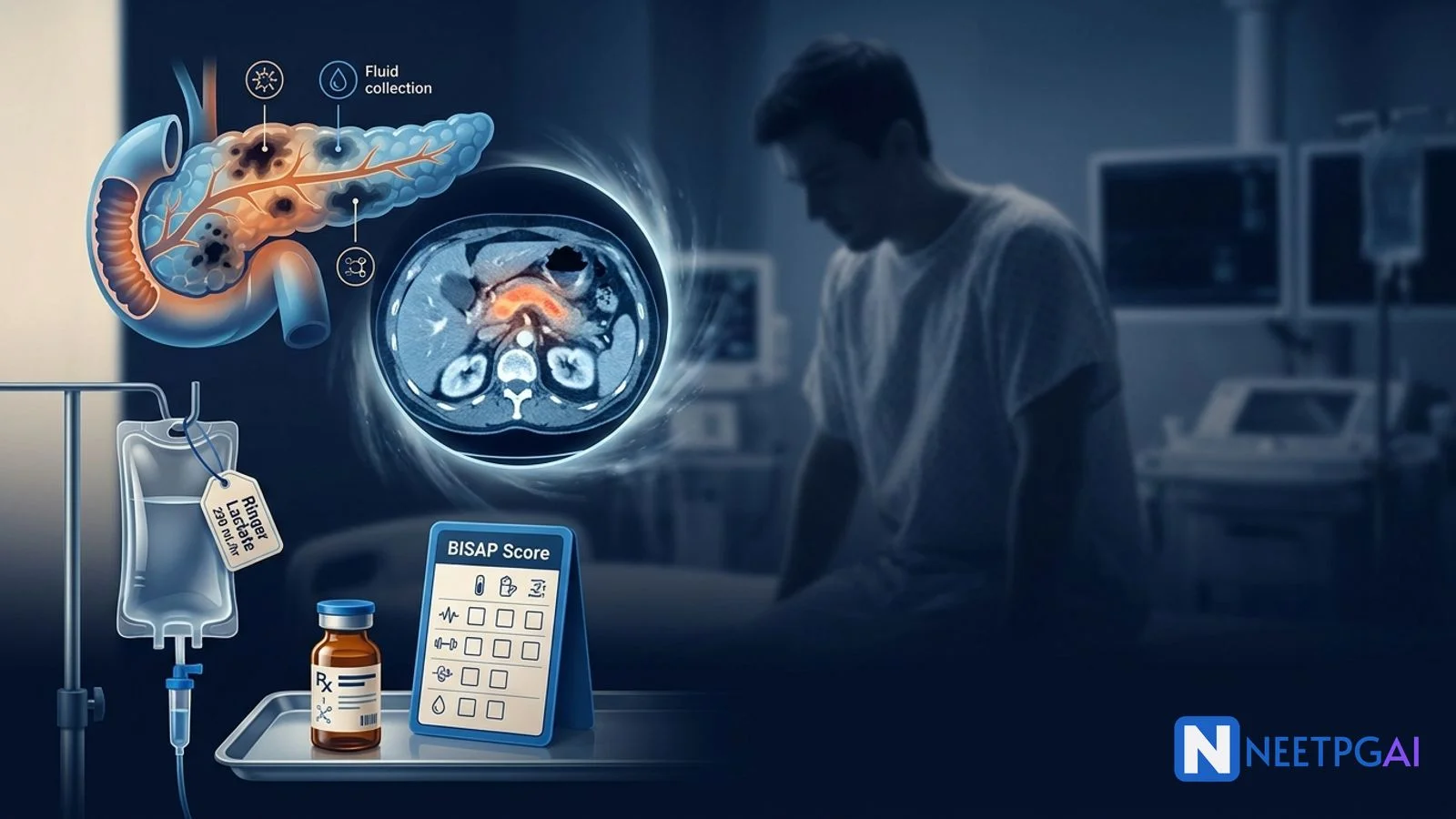
- Score severity at admission and 24 hours — BISAP (bedside), mCTSI at 72-96 hours, look for organ failure (Marshall score)
- Resuscitate aggressively for the first 24-48 hours — Ringer lactate at 5-10 mL/kg/hr, target urine output >0.5 mL/kg/hr, watch lactate
- Feed early; avoid prophylactic antibiotics — start oral or NG feeds within 24-48 hours; antibiotics only for infected necrosis or extrapancreatic infection
- Anticipate complications — necrosis, pseudocyst, walled-off necrosis, organ failure, ARDS, AKI, abdominal compartment syndrome
The case
A 35-year-old auto-rickshaw driver is brought to the emergency department with 14 hours of severe, constant epigastric pain that started after a heavy meal and several drinks at a friend's wedding the previous night. The pain radiates straight through to his back, is partially relieved when he leans forward, and is associated with three episodes of bilious vomiting that have not eased the pain. He denies fever, jaundice, hematemesis, melena, or chest pain.
Past history: he drinks 180-240 mL of locally distilled liquor most evenings, more on weekends; this has been his pattern for the past 8 years. He has had two similar but milder episodes in the past 18 months — both treated symptomatically at a peripheral hospital and discharged within 48 hours, without imaging or pancreatic enzyme testing. He smokes 10-15 bidis daily. No diabetes, no known cardiac, renal, or hepatic disease, no prior surgery, no recent ERCP, no prescription drugs, no family history of pancreatitis.
On arrival, vitals are: pulse 122/min regular, BP 96/62 mmHg, respiratory rate 24/min, SpO2 95 percent on room air, temperature 37.8 C, capillary glucose 168 mg/dL. He is restless, in obvious distress, leaning forward on the trolley. Mucous membranes are dry; capillary refill 3 seconds; cool peripheries; JVP not raised. Abdomen is distended, tenderness to deep palpation in the epigastrium with voluntary guarding, no rebound, bowel sounds reduced. No flank or peri-umbilical bruising. Chest is clear; heart sounds normal but tachycardic.
Bedside ECG: sinus tachycardia, no ischemic changes. The on-call resident sends a focused panel and orders a USG abdomen.
ABCD assessment and initial investigations
Severe acute pancreatitis behaves like a sepsis equivalent in the first 24-48 hours. The mortality curve is dictated by how aggressively you resuscitate in the first 12 hours and how attentively you watch for organ failure between 24 and 72 hours.
A — Airway: Patent. GCS 15, no airway compromise. Reassess hourly; severe pancreatitis can develop ARDS within 48-72 hours and may need intubation.
B — Breathing: RR 24, SpO2 95 percent on room air. Order chest X-ray to look for pleural effusion (a BISAP component). Continuous SpO2 monitoring; nasal O2 if SpO2 drops below 94. ABG if RR remains >25 or SpO2 falls.
C — Circulation: Tachycardic, hypotensive, dry mucous membranes, cool peripheries, capillary refill 3 seconds — this is hypovolemic shock from third-spacing into the retroperitoneum and into the gut. Two large-bore IV cannulas (16G or 18G), bolus 1-2 L Ringer lactate over the first hour, then maintenance at 5-10 mL/kg/hr titrated to urine output. Insert urinary catheter to track urine output every hour. Avoid normal saline alone — RL has been shown to reduce SIRS at 24 hours compared with NS in randomised trials.
D — Disability/Dextrose: GCS 15, glucose 168 (mild stress hyperglycemia, not diabetic ketoacidosis — pH and ketones are normal on dipstick). Pain score 9/10 on the numerical rating scale. IV opioid analgesia (titrated fentanyl or morphine; tramadol is acceptable but avoid in elderly). Antiemetic — ondansetron 4 mg IV.
Initial investigations (within 30 minutes):
- Serum lipase: 1,850 U/L (normal <60; 31x ULN — diagnostic)
- Serum amylase: 1,240 U/L (normal <100; lipase preferred — more specific, longer half-life)
- CBC: WBC 16,800; Hb 14.8 g/dL (raised — hemoconcentration, marker of severity); platelets 280,000
- BUN: 32 mg/dL (raised — BISAP component); creatinine 1.4 mg/dL (mild AKI)
- Glucose: 168 mg/dL
- LFTs: AST 86, ALT 64, ALP 142, bilirubin 1.4 mg/dL (mild transaminitis; ALT >3x ULN strongly suggests biliary etiology — but here we suspect alcohol; LFTs can rise mildly in alcoholic pancreatitis too)
- Calcium: 8.4 mg/dL (low-normal; persistently low calcium is a poor prognostic marker)
- Triglycerides: 320 mg/dL (raised but not the cause; etiologic threshold is >1,000 mg/dL)
- CRP: 24 mg/L (will peak at 48-72 hours; CRP >150 at 48 hours predicts severe disease)
- LDH: 480 IU/L (Ranson component)
- Lactate: 3.4 mmol/L (raised — hypoperfusion)
- ABG: pH 7.32, pCO2 32, HCO3 16, lactate 3.4 (mild metabolic acidosis with respiratory compensation)
- CXR: small left pleural effusion, no consolidation (pleural effusion = BISAP component, also a Ranson criterion at admission)
- USG abdomen: pancreas obscured by bowel gas (typical), no gallstones, normal common bile duct (5 mm), liver normal echotexture, no ascites
- CT abdomen with IV contrast: deferred at admission — most useful at 72-96 hours to grade necrosis. Order earlier only if diagnosis is unclear or the patient is deteriorating
The Atlanta-based diagnostic algorithm
The revised Atlanta classification (2012) is the canonical NEET PG framework. Memorise the diagnostic and severity halves separately.
Diagnostic criteria (any 2 of 3)
- Characteristic abdominal pain — acute onset, persistent, severe epigastric pain, often radiating to the back, partially relieved by leaning forward, worsened by lying flat
- Serum lipase or amylase ≥3x ULN — lipase is preferred; rises within hours, peaks at 24, stays elevated 8-14 days; amylase has shorter half-life and is less specific (rises in salivary disease, ectopic pregnancy, bowel ischemia)
- Characteristic imaging findings on CECT, MRI, or USG — pancreatic enlargement, peripancreatic fat stranding, fluid collections, necrosis on CECT (best at 72-96 hours)
If the first two are met, imaging is not mandatory at admission. Our patient meets all three, although USG was unrevealing for pancreas — the lipase >3x ULN plus pain confirms the diagnosis.
Severity classification (revised Atlanta)
| Severity | Definition |
|---|
| Mild | No organ failure, no local or systemic complications |
| Moderately severe | Transient organ failure (resolves within 48 hr) OR local complications (peripancreatic fluid, pseudocyst, necrosis) without persistent organ failure |
| Severe | Persistent organ failure beyond 48 hours (single or multiple organ) |
Organ failure is defined by the modified Marshall score ≥2 in any of three systems: respiratory (PaO2/FiO2 ratio), renal (creatinine), or cardiovascular (SBP not responsive to fluids). At admission our patient has SBP 96 (responsive to fluids), creatinine 1.4 (Marshall score 1), no respiratory failure — so no organ failure yet, but high risk.
Severity scoring at the bedside
NEET PG tests three scoring systems. Know what goes into each, the cut-off, and when to use it.
BISAP (best 24-hour bedside score)
Each criterion = 1 point. Total max 5.
| Component | Threshold |
|---|
| BUN | >25 mg/dL |
| Impaired mental status | GCS <15 |
| SIRS | ≥2 of: temp <36 or >38, HR >90, RR >20, WBC <4 or >12 |
| Age | >60 years |
| Pleural effusion | On CXR or CT |
Score interpretation: 0-1 = low risk (mortality <1 percent), 2 = intermediate (~2 percent), ≥3 = high risk (5-20 percent). Our patient: BUN 32 (1), GCS 15 (0), SIRS yes — temp 37.8, HR 122, RR 24 (1), age 35 (0), pleural effusion yes (1) = BISAP 3 — high risk.
Ranson criteria (admission and 48 hours)
11 criteria total — 5 at admission and 6 at 48 hours. Used historically; clunky for early decisions but still tested.
At admission: age >55, WBC >16,000, glucose >200, AST >250, LDH >350.
At 48 hours: Hct fall >10 percent, BUN rise >5 mg/dL, calcium <8, PaO2 <60, base deficit >4, fluid sequestration >6 L.
≥3 = severe; mortality 0-3 percent if <3, 11-15 percent if 3-4, 40 percent if ≥6.
Modified CT Severity Index (mCTSI)
Best at 72-96 hours after onset to allow necrosis to declare. Max 10 points.
| Parameter | Score |
|---|
| Pancreatic inflammation: normal (A) | 0 |
| Focal/diffuse enlargement (B-C) | 2 |
| Peripancreatic fluid (D-E) | 4 |
| Necrosis: 0% | 0 |
| Necrosis: <30% | 2 |
| Necrosis: 30-50% | 4 |
| Necrosis: >50% | 6 |
| Extrapancreatic complications (effusion, ascites, vascular, GI) | 2 |
mCTSI 0-2 mild, 4-6 moderate, 8-10 severe.
Diagnosis
Acute pancreatitis (revised Atlanta criteria met — characteristic pain, lipase 31x ULN), most likely alcohol-induced (8-year history of daily alcohol intake, no gallstones on USG, triglycerides <1000), with high-risk severity at admission (BISAP 3, mild AKI, hemoconcentration, pleural effusion) — predicted to evolve into moderately severe to severe disease.
This phrasing tells the consultant the diagnosis, the etiology, and the trajectory — exactly the structure NEET PG vignettes test.
Etiology — the I-GET-SMASHED mnemonic
Memorise the high-yield order; in India, alcohol and gallstones together account for 70-80 percent of cases.
- Idiopathic (~10 percent — work up for microlithiasis, autoimmune, pancreas divisum)
- Gallstones (40-50 percent — most common cause overall and in women)
- Ethanol/alcohol (25-35 percent — most common in young Indian men)
- Trauma (blunt abdominal trauma, post-surgical, post-ERCP — 5-10 percent of ERCPs)
- Steroids and other drugs (azathioprine, valproate, asparaginase, didanosine, statins, GLP-1 agonists at high doses, estrogens, thiazides, sulfonamides)
- Mumps and other infections (Coxsackie, CMV, HIV, mycoplasma, ascariasis)
- Autoimmune (IgG4-related; bulky sausage-shaped pancreas on imaging)
- Scorpion sting (Tityus trinitatis — Caribbean/South America; classic boards trivia)
- Hyperlipidemia (TG >1000 mg/dL), Hypercalcemia (primary hyperparathyroidism, malignancy)
- ERCP (post-procedural)
- Drugs (covered above) and Divisum (pancreas divisum)
Every patient gets: history (alcohol, drugs, family), USG abdomen (gallstones, biliary dilatation), triglycerides, calcium, IgG4 if recurrent and atypical, MRCP if biliary etiology suspected with non-diagnostic USG.
Management — the first 72 hours decide outcome
Hour 0-24: aggressive fluid resuscitation
Third-spacing into the retroperitoneum can sequester 4-6 L in the first 24 hours. Under-resuscitation kills.
- Ringer lactate (preferred over normal saline — lower 24-hr SIRS rate)
- Initial bolus 10-20 mL/kg over 30-60 minutes if hypovolemic shock
- Maintenance 5-10 mL/kg/hr for the first 12-24 hours, then titrate
- Targets: urine output >0.5 mL/kg/hr, MAP >65 mmHg, falling BUN, falling lactate, falling hematocrit toward 35-40
- Caution: avoid over-resuscitation (>4 L in 24 hr is associated with abdominal compartment syndrome, ARDS, longer ICU stay) — use dynamic measures (urine output, lactate, IVC variability) rather than fixed-volume targets
Pain control and antiemesis
Opioids: fentanyl 25-50 mcg IV bolus then 0.5-2 mcg/kg/hr infusion, or morphine 2-4 mg IV every 2-4 hours. Tramadol is reasonable for moderate pain. The old teaching that morphine causes sphincter of Oddi spasm and worsens pancreatitis is not supported by clinical evidence — do not withhold opioids. Antiemetic — ondansetron 4-8 mg IV.
Nutrition
Old teaching of "pancreatic rest with prolonged NPO" is wrong. Modern guidelines (IAP/APA 2013, ACG 2024):
- Mild pancreatitis — start oral feeds (clear liquid → solid as tolerated) within 24 hours once nausea/pain settle
- Moderately severe to severe — start enteral feeds within 24-72 hours via NG tube; nasojejunal not required (NJ vs NG is equivalent in most trials)
- Parenteral nutrition — only if enteral feeds fail or contraindicated (mesenteric ischemia, ileus >5 days)
Enteral nutrition reduces infection rates, ICU stay, and mortality compared with TPN.
Antibiotics — the no-prophylaxis rule
No prophylactic antibiotics in sterile pancreatitis (interstitial or necrotising) — multiple RCTs and the 2013 IAP/APA guidelines confirm no mortality benefit and increased fungal infection. Antibiotics only for:
- Extrapancreatic infection at presentation — cholangitis, pneumonia, UTI, line sepsis
- Suspected or proven infected pancreatic necrosis — gas in necrosis on CT, positive FNA culture, or clinical deterioration after the first week (new fever, rising WBC, persistent organ failure)
- Severe sepsis or septic shock — broad-spectrum until source is clear
First-line agents: carbapenems (imipenem 500 mg q6h or meropenem 1 g q8h) — best pancreatic tissue penetration. Alternatives: piperacillin-tazobactam, fluoroquinolone + metronidazole.
ERCP indications
Urgent ERCP within 24-48 hours is indicated for:
- Acute pancreatitis with co-existing acute cholangitis (Charcot triad)
- Acute biliary pancreatitis with persistent biliary obstruction (rising bilirubin, dilated CBD, retained stone on MRCP)
Routine early ERCP in biliary pancreatitis without cholangitis or persistent obstruction does NOT improve outcomes — APEC trial (NEJM 2020).
For mild biliary pancreatitis, same-admission cholecystectomy is recommended (PONCHO trial 2015) — reduces recurrence from 17 percent to 5 percent. Defer cholecystectomy to ≥6 weeks for moderately severe and severe disease until peripancreatic collections settle.
Specific scenarios
- Alcohol-induced pancreatitis — addiction counselling, thiamine 100 mg IV daily (Wernicke prevention), screen for liver disease (LFTs, USG, FibroScan), brief intervention plus referral to de-addiction
- Hypertriglyceridemia-induced (TG >1000) — IV insulin infusion (0.1-0.3 U/kg/hr) plus IV fluids; plasmapheresis if TG persistently >1000 with severe disease; long-term fibrate plus omega-3 plus statin
- Hypercalcemia — IV fluids, bisphosphonate (zoledronate), parathyroidectomy if primary hyperparathyroidism
For our patient: stop alcohol, IV fluids 8 mL/kg/hr titrated to urine output, RL 30 mL/kg over first 4 hours, fentanyl PCA, ondansetron, NG suction not required, start NJ or oral feeds at 48 hours if pain and nausea settle, no prophylactic antibiotics, repeat CT abdomen at 72-96 hours to grade severity, daily clinical and lab monitoring, addiction counselling at discharge.
Complications — early and late
Early (0-2 weeks): systemic and inflammatory
- Organ failure (Marshall score) — respiratory (PaO2/FiO2 <300), renal (creatinine >1.9), cardiovascular (SBP unresponsive to fluids). Persistent >48 hr defines severe disease
- ARDS — second-week complication; CXR shows diffuse bilateral infiltrates; lung-protective ventilation
- Acute kidney injury — pre-renal from hypovolemia, plus inflammatory direct injury
- Disseminated intravascular coagulation — uncommon but bad
- Abdominal compartment syndrome — IAP >20 mmHg with new organ dysfunction; risk factor for over-resuscitation; manage with sedation, NG decompression, paralysis, decompressive laparotomy
- Hyperglycemia — from islet damage and stress; insulin infusion as needed
- Hypocalcemia — saponification of fat plus citrate effect from transfusion; replace if symptomatic or <7
Local — collections and necrosis (revised Atlanta nomenclature)
| Pattern | Type | Time | Wall? | Necrosis? |
|---|
| Acute peripancreatic fluid collection (APFC) | Interstitial | <4 wk | No | No |
| Pseudocyst | Interstitial | ≥4 wk | Yes | No |
| Acute necrotic collection (ANC) | Necrotising | <4 wk | No | Yes |
| Walled-off necrosis (WON) | Necrotising | ≥4 wk | Yes | Yes |
Treatment of collections
- Asymptomatic + sterile — observe; most APFCs and many small pseudocysts resolve
- Symptomatic, large, or infected — step-up approach (PANTER trial, NEJM 2010; TENSION trial 2018):
- Percutaneous catheter drainage first
- Endoscopic transluminal drainage with necrosectomy (lumen-apposing metal stent into stomach or duodenum) — preferred over open surgery
- Open necrosectomy reserved for failures
- Infected pancreatic necrosis — drain plus antibiotics (carbapenem); FNA only if clinically indecisive
Late (>6 weeks)
- Pancreatic exocrine insufficiency — steatorrhea; replace with pancreatic enzymes (creon)
- Pancreatic endocrine insufficiency — type 3c diabetes; insulin or GLP-1 agonist
- Recurrent acute pancreatitis — work up for occult etiology (microlithiasis, sphincter of Oddi dysfunction, pancreas divisum, autoimmune, genetic — PRSS1, SPINK1, CFTR)
- Chronic pancreatitis — calcifications on imaging, ductal dilation, exocrine and endocrine failure
- Splenic vein thrombosis — left-sided portal hypertension with isolated gastric varices; splenectomy if bleeding
- Pseudoaneurysm — splenic, gastroduodenal arteries; angiographic embolisation
How NEET PG tests acute pancreatitis
NEET PG tests this topic through six recurring patterns. Recognise the pattern and the question collapses to a 30-second answer.
Pattern 1 — The diagnostic-criteria question: Vignette gives lipase 800, amylase 600, and a young man with epigastric pain. Identify acute pancreatitis from Atlanta criteria. Trap: answers offering "MI" or "perforation" — read the lipase value.
Pattern 2 — The etiology question: Vignette of a young Indian man with daily alcohol intake plus epigastric pain. Etiology? Alcohol. Trap: answers offering "gallstones" without imaging support — etiology should match demographic and history; in young men with alcohol history, alcohol >> gallstones.
Pattern 3 — The severity-score question: Vignette gives BUN 28, GCS 15, SBP 88, age 38, no pleural effusion. BISAP score? 2 (BUN + SIRS hypotension counts via HR/RR if listed; review the SIRS criteria). Cut-off ≥3 is high risk.
Pattern 4 — The fluid-resuscitation question: Severe pancreatitis with shock. Initial fluid? Ringer lactate, not normal saline. Trap: answers offering "5 percent dextrose" — never use as resuscitation fluid.
Pattern 5 — The antibiotic question: Severe necrotising pancreatitis at day 2, sterile, no fever. Start prophylactic antibiotics? No. Indications are infected necrosis, extrapancreatic infection, sepsis. Trap: answers offering "ciprofloxacin plus metronidazole" — current guidelines (IAP/APA 2013, ACG 2024) do not support prophylaxis.
Pattern 6 — The complication question: 4 weeks after acute pancreatitis, encapsulated fluid collection on CT, no necrotic debris. Diagnosis? Pseudocyst. Trap: answers offering "walled-off necrosis" — WON contains necrotic debris; pseudocyst does not.
High-yield one-liners:
- Atlanta diagnosis = 2 of 3: pain + lipase ≥3x ULN + imaging
- Lipase > amylase for diagnosis (specificity, half-life)
- Most common cause overall = gallstones; in young Indian men = alcohol
- BISAP >3, persistent organ failure >48 hr = severe
- Best CT timing = 72-96 hours for necrosis
- RL > NS for resuscitation
- Start enteral feeds within 24-72 hours
- No prophylactic antibiotics in sterile necrosis
- ERCP only for cholangitis or persistent obstruction
- Same-admission cholecystectomy for mild biliary pancreatitis
- Pseudocyst = interstitial + ≥4 wk + no necrosis; WON = necrotising + ≥4 wk + necrosis
- Step-up approach (drain → endoscopic → surgery) for infected necrosis
Frequently Asked Questions
What are the revised Atlanta criteria for diagnosing acute pancreatitis?
The revised Atlanta classification (2012) requires at least 2 of 3 features: (1) characteristic abdominal pain — acute, persistent, severe epigastric pain often radiating to the back; (2) serum lipase or amylase at least 3 times the upper limit of normal; (3) characteristic findings on contrast-enhanced CT, MRI, or transabdominal ultrasound. If the first two are present, imaging is not mandatory at admission. Severity is classified as mild, moderately severe, or severe based on organ failure and local complications.
How does BISAP differ from Ranson and APACHE II for severity scoring?
BISAP is a 5-point bedside score calculated within 24 hours: BUN over 25 mg/dL, impaired mental status, SIRS, age over 60, and pleural effusion — each scoring 1 point. A score of 3 or more predicts mortality of 5 to 20 percent. Ranson criteria need 11 parameters and 48 hours of observation, which delays decision-making. APACHE II is more accurate but uses 12 physiological variables and is impractical at the bedside. BISAP is preferred for early triage; mCTSI is preferred for imaging-based severity at 72 to 96 hours.
What is the role of antibiotics in acute pancreatitis?
Prophylactic antibiotics in sterile acute pancreatitis are NOT recommended — multiple trials and the 2013 IAP/APA guidelines show no mortality benefit and increased risk of fungal superinfection. Antibiotics are indicated only for: extrapancreatic infection (cholangitis, pneumonia, urinary tract infection, line sepsis), suspected or proven infected pancreatic necrosis (gas in necrosis on CT, positive FNA culture, clinical deterioration after the first week), or severe sepsis. First-line agents are carbapenems (imipenem or meropenem) due to good pancreatic tissue penetration.
When is ERCP indicated in acute pancreatitis?
Urgent ERCP within 24 to 48 hours is indicated for acute pancreatitis with co-existing acute cholangitis (Charcot triad) and for biliary pancreatitis with persistent biliary obstruction. Routine early ERCP in biliary pancreatitis without cholangitis or obstruction does NOT improve outcomes (APEC trial 2020). Cholecystectomy during the same admission is recommended for mild biliary pancreatitis to prevent recurrence; for moderately severe or severe disease, defer cholecystectomy until peripancreatic collections settle (typically 6 weeks).
What is the difference between acute peripancreatic fluid collection, pseudocyst, and walled-off necrosis?
Acute peripancreatic fluid collection (APFC) develops within 4 weeks in interstitial pancreatitis — a homogeneous fluid collection without a defined wall, typically resolves spontaneously. Pseudocyst occurs after 4 weeks in interstitial pancreatitis — encapsulated fluid collection with a fibrous wall, no necrotic tissue. Acute necrotic collection (ANC) is the necrotising-pancreatitis equivalent within 4 weeks — heterogeneous, contains debris. Walled-off necrosis (WON) develops after 4 weeks — encapsulated heterogeneous collection. Treat by stepping up: percutaneous drain, then endoscopic transluminal drainage with necrosectomy, then surgery.
This content is for educational purposes for NEET PG exam preparation. It is not a substitute for professional medical advice, diagnosis, or treatment. Clinical information has been reviewed by qualified medical professionals.
Written by: NEETPGAI Editorial Team
Reviewed by: Pending SME Review
Last reviewed: April 2026