Version 1.0 — Published May 2026
Quick Answer
Forensic medicine and toxicology contributes 8-10 questions per NEET PG paper, often overlapping with internal medicine, pharmacology, and psychiatry. The 15 most expensive mistakes cluster around postmortem changes, Indian medico-legal sections, special acts, antidotes, wound classification, and age estimation. To protect your marks:
- Lock the rigor mortis timeline — onset 1-3 h, complete 6-12 h, persists 12-24 h, disappears 24-36 h (Nysten's descending law)
- Distinguish livor mortis from antemortem bruise — livor blanches early, fixed after 6-12 h, dependent only, no colour stages
- Apply Glaister formula for algor mortis — rate of cooling approximately 1.5 F per hour in the first 12 hours, slower after
- Memorise the key IPC sections — 84 (insanity), 304-A (negligence), 320 (grievous hurt), 376 (rape), 420 (cheating), 498-A (dowry cruelty)
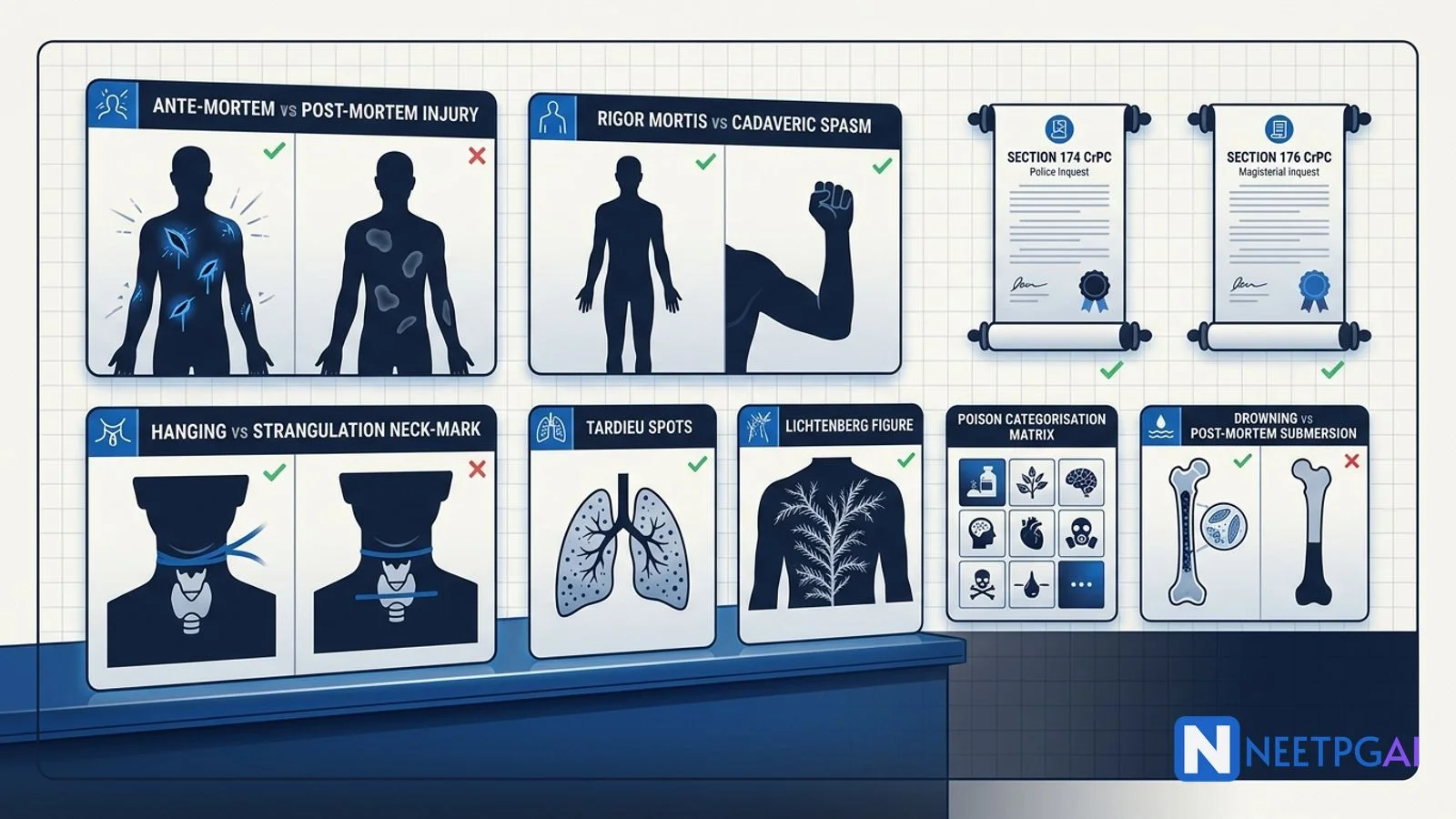
- Apply CrPC sections correctly — 174 (police inquest), 176 (magistrate inquest in dowry/custody/encounter deaths)
- Know POCSO Act 2012 protective provisions — gender-neutral child protection, mandatory reporting, in-camera trials, special courts
- Apply MTP Act 1971 with 2021 amendments correctly — up to 20 weeks single doctor opinion, 20-24 weeks two doctor opinion for special categories, no upper limit for fetal abnormality with Medical Board approval
- Master the 12 high-yield antidotes — organophosphate, methanol, cyanide, paracetamol, opioids, iron, heavy metals, warfarin, heparin, CCB, digoxin, benzodiazepines
- Classify wounds correctly — incised (clean), lacerated (irregular with tissue bridges), abrasion (epidermal), contusion (bruise), stab (deeper than wide), chop (heavy sharp)
- Distinguish entrance vs exit gunshot wounds — entrance inverted edges plus tattooing plus burning; exit everted edges plus larger
- Classify drowning types — typical fresh/salt, atypical dry/secondary, and immersion-related deaths
- Distinguish hanging vs ligature strangulation — hanging oblique above thyroid; ligature horizontal at/below thyroid
- Apply age estimation correctly — ossification centres (radiology), dental eruption (Schour-Massler chart)
- Know Daubert vs Frye standards for expert witness — relevance, reliability, peer review (Daubert); general acceptance (Frye)
- Use India-specific autopsy registries and centres correctly — NIMHANS forensic, Mahanagar/State autopsy registries, AIIMS Forensic
Why forensic medicine mistakes are costly
Forensic medicine sits at the intersection of clinical medicine, law, and toxicology. A single misremembered IPC section, a missed MTP timeline, or a wrong antidote dose can cost 1-2 marks on the paper and significant consequences in actual medico-legal practice. NEET PG, INI-CET, and FMGE examiners increasingly test forensic medicine through clinical-legal vignettes that probe the structured timeline of postmortem changes, the legal framework, and the specific pharmacology of antidotes.
The 15 mistakes below come from analysis of NEET PG 2019-2024 forensic questions and represent the most frequent error patterns.
Mistake 1: Confusing the rigor mortis stages and timing
Why students get it wrong: Multiple textbooks (Modi, Reddy, Krishan Vij) give slightly different timelines; students confuse onset with completion or persistence with disappearance.
How to remember it correctly:
| Stage | Timing | Body part affected |
|---|
| Onset | 1-3 hours after death | Eyelids, jaw, then neck (small muscles first) |
| Complete | 6-12 hours | Whole body rigid (descending Nysten's law) |
| Persists | 12-24 hours | Stable rigidity |
| Disappears | 24-36 hours | In the same order as onset (eyelids first) |
Mnemonic: 1-3-6-12-24-36 hours.
Factors accelerating rigor: high ambient temperature (tropical India), strenuous antemortem activity, convulsions (strychnine, electrocution, tetanus), heat stroke, high body temperature.
Factors delaying rigor: cold environment, cachexia, infancy, old age, corpse refrigeration.
Trap — cadaveric spasm (instantaneous rigor): Instantaneous stiffening of muscles used at the moment of death (gripping weapon, plants at drowning scene); continuous with rigor mortis with NO intervening flaccid phase; CANNOT be reproduced artificially; forensically very important.
Mistake 2: Mistaking livor mortis for antemortem bruise
Why students get it wrong: Both appear purple. The distinguishing features are different categories of observation.
How to remember it correctly:
| Feature | Livor mortis | Antemortem bruise |
|---|
| Cause | Gravitational settling of blood in unbroken vessels | Trauma rupturing vessels with extravasation into tissues |
| Onset | 30-60 min after death | Develops over minutes-hours after trauma |
| Location | Dependent parts only | Site of trauma (any location) |
| Blanching | Blanches on pressure in first 6 h | Does NOT blanch |
| Shifts with repositioning | Yes, before 6-12 h | No, fixed |
| Fixation | Fixed after 6-12 h | Already fixed |
| Colour stages | Uniform purple-red (or cherry red in CO/cyanide, brown in metHb, pink in cold) | Red - blue - green - yellow over days (Hb to bilirubin/biliverdin) |
| Incision findings | Blood in vessels only, washable | Extravasated blood in tissues, not washable |
Trap — colour of livor in poisonings:
- Cherry red — carbon monoxide (carboxyhaemoglobin), cyanide (oxyhaemoglobin retained)
- Brown / chocolate — methaemoglobinaemia (nitrites, sulfonamides)
- Pink — cold exposure, refrigeration (preserved oxyhaemoglobin)
- Dark blue / black — opioids, asphyxia, hydrogen sulphide
Mistake 3: Misapplying the Glaister formula for algor mortis
Why students get it wrong: The formula is empirical and has limitations that are often glossed over.
How to remember it correctly:
- Algor mortis = postmortem cooling of the body to ambient temperature
- Glaister formula (Fahrenheit, normal body temp 98.4 F, ambient 60-70 F):
- Time since death (hours) = (98.4 - rectal temp F) / 1.5 in the first 12 hours
- After 12 hours, cooling slows to approximately 1 F/hour
- Casper dictum — comparative putrefaction rates (1:2:8 — air : water : earth)
- Henssge nomogram — modern body-temperature-based PMI estimation incorporating ambient temperature and body weight; more accurate than the Glaister formula
- Limitations of the Glaister formula — assumes normal core temp at death (not valid in hyperpyrexia or hypothermia), assumes constant ambient temperature (not valid outdoor), assumes minimal clothing (not valid in heavily clothed bodies), assumes average body mass (varies in obese or cachectic)
Trap: Algor mortis is the LEAST reliable of the postmortem changes — use rigor and livor first; algor is supportive.
Mistake 4: Mixing up the high-yield IPC sections
Why students get it wrong: Long list of sections; many similar numbers (304 vs 304-A vs 304-B; 376 vs 376-A vs 376-E).
How to remember it correctly:
| Section | What it covers |
|---|
| IPC 84 | Act of a person of unsound mind (insanity defence — M'Naghten rule) — not punishable |
| IPC 299 | Culpable homicide not amounting to murder |
| IPC 300 | Murder definition |
| IPC 304 | Punishment for culpable homicide |
| IPC 304-A | Death by negligence (medical negligence flagship section) — up to 2 years imprisonment |
| IPC 304-B | Dowry death within 7 years of marriage |
| IPC 306 | Abetment of suicide |
| IPC 319 | Hurt definition |
| IPC 320 | Grievous hurt — 8 specific categories (emasculation, permanent privation of eyesight or hearing, fracture or dislocation of bone, permanent disfiguration of head/face, permanent severance of limb/joint, dangers to life over 20 days hospitalisation, etc.) |
| IPC 326 | Grievous hurt by dangerous weapons or means |
| IPC 375 | Rape definition |
| IPC 376 | Punishment for rape — 10 years to life |
| IPC 376-A to E | Aggravated forms (376-A intercourse with wife under 15, 376-B/C custodial rape, 376-D gang rape, 376-E repeat offender) — post-2013 Criminal Law (Amendment) Act after Nirbhaya case |
| IPC 420 | Cheating |
| IPC 498-A | Cruelty by husband or relatives (dowry harassment) |
Mnemonic for 320 (grievous hurt 8 categories): EFFLuent DPS — Emasculation, Fracture/dislocation, Face disfiguration, Limb severance, ultimate sight/hearing loss, engagement (over 20 days incapacity), nutritional/bone marrow involvement, teeth privation.
Mistake 5: Confusing CrPC inquest sections
Why students get it wrong: 174 vs 176 are often interchanged.
How to remember it correctly:
- CrPC 174 (Police Inquest) — police inquiry into suspicious, sudden, accidental, or unnatural deaths; routine inquest conducted by police sub-inspector or above; covers most unnatural deaths
- CrPC 176 (Magistrate Inquest) — magistrate inquiry for special categories:
- Dowry death (within 7 years of marriage, woman, by burns or unnatural causes)
- Custody death (police lockup, judicial custody)
- Encounter death (police firing)
- Death in mental hospital (psychiatric facility)
- CrPC 53 — medical examination of an arrested person at police request
- CrPC 53A — examination of an accused in a rape case
- CrPC 164A — medical examination of the rape victim, by a registered medical practitioner, within 24 hours of report, with consent
Trap: Dowry death needs BOTH 174 (police-initiated) and 176 (magistrate) inquest — magistrate inquest is mandatory due to the protected category.
Mistake 6: Misapplying POCSO Act 2012 provisions
Why students get it wrong: POCSO is gender-neutral and replaces older fragmented child protection provisions; many students still apply old rape law.
How to remember it correctly:
- POCSO Act 2012 (Protection of Children from Sexual Offences) — gender-neutral; protects all children under 18 years (males and females)
- Offences — penetrative sexual assault (Section 3-4), aggravated penetrative sexual assault (Section 5-6, e.g., by police, public servant, repeat offender), sexual assault (Section 7-8), aggravated sexual assault (Section 9-10), sexual harassment (Section 11-12), child pornography (Section 13-15)
- Mandatory reporting — Section 19 requires anyone with knowledge of an offence to report; failure to report is punishable (Section 21)
- Procedural protections — in-camera trial (Section 37), child-friendly procedures (Section 33), no aggressive cross-examination, identity protection (Section 23), special courts (Section 28), trial completion within 1 year (Section 35)
- Medical examination — by a registered medical practitioner; in private hospital if no government facility nearby; female doctor for female child preferred; informed consent from child if over 12 with capacity, else parental consent
- Presumption of guilt — Sections 29-30 shift the burden of proof to the accused once the prosecution establishes a prima facie case
- 2019 Amendment — increased punishment, added death penalty for aggravated penetrative sexual assault on children under 12
Trap: POCSO age cut-off is 18 years for all (gender-neutral); older IPC rape law had different cut-offs and was female-only — both apply now in many cases.
Mistake 7: Confusing MTP Act 1971 and 2021 amendment provisions
Why students get it wrong: The 2021 amendment significantly extended timelines; older textbooks may still cite the old 20-week single limit.
How to remember it correctly:
| Gestational age | Authorising opinion | Indications |
|---|
| Up to 20 weeks | Single registered medical practitioner | Any of the standard indications (continuation hazards life/grave injury to mother, substantial fetal abnormality, contraceptive failure for married couple AND unmarried woman — 2021 change, rape/incest pregnancy) |
| 20-24 weeks | Two registered medical practitioners | Special categories — survivor of sexual assault or rape, minor, change of marital status during ongoing pregnancy (widowhood, divorce), women with physical disabilities, mentally ill women including mental retardation, fetal malformation that would severely handicap the child, women in humanitarian settings or disaster/emergency situations declared by government |
| Beyond 24 weeks | Medical Board approval (constituted by state government) | Substantial fetal abnormalities diagnosed by Medical Board; the Board comprises a gynaecologist, paediatrician, radiologist/sonologist, and other expert as specified |
Key 2021 changes:
- Single doctor opinion sufficient up to 20 weeks (was 12 weeks earlier)
- Contraceptive failure extended to UNMARRIED women (was married only)
- 20-24 weeks extended for special categories
- No upper limit for fetal abnormality with Medical Board approval
- Confidentiality — identity of woman undergoing MTP shall not be revealed (Rule 19)
- Place — registered MTP centre (private hospital with MTP registration, government hospital)
Trap: PCPNDT Act (1994) prohibits sex determination and sex-selective abortion — DIFFERENT Act from MTP; MTP does not allow termination for sex selection.
Mistake 8: Mismatching poisoning antidotes
Why students get it wrong: 12 antidote pairs blur; students confuse which oxime, which chelator, which receptor antagonist.
How to remember it correctly:
| Poison | Antidote |
|---|
| Organophosphate (chlorpyrifos, malathion) | Atropine (anti-muscarinic — titrate to dry secretions, HR over 100, clear chest) + pralidoxime (PAM) (oxime regenerator of acetylcholinesterase — useful within 24-48 h before ageing) |
| Carbamate | Atropine only (no PAM — carbamate-AChE bond does not age) |
| Methanol | Fomepizole (preferred) or ethanol (competitive ADH inhibitors) + folate (accelerates formic acid breakdown) + haemodialysis |
| Ethylene glycol | Fomepizole or ethanol + thiamine (B1) + pyridoxine (B6) + haemodialysis |
| Cyanide | Hydroxocobalamin (preferred — binds CN, urinary excretion as cyanocobalamin) OR amyl nitrite + sodium nitrite (induces metHb) + sodium thiosulfate (sulfur donor for rhodanese to form thiocyanate) |
| Carbon monoxide | 100 percent oxygen (or hyperbaric oxygen for severe cases) |
| Paracetamol (acetaminophen) | N-acetylcysteine (NAC) — oral or IV; within 8-10 hours best |
| Opioids | Naloxone 0.4-2 mg IV, repeat every 2-3 min |
| Benzodiazepines | Flumazenil — cautious, can precipitate seizures in mixed overdose |
| Iron | Deferoxamine (chelator) |
| Lead (children) | DMSA (succimer) oral chelator |
| Lead (adults) | Calcium disodium EDTA + dimercaprol (BAL) in severe |
| Arsenic, mercury, gold | BAL (dimercaprol) + DMSA |
| Copper (Wilson) | D-penicillamine, trientine, zinc |
| Warfarin | Vitamin K + FFP or PCC |
| Heparin | Protamine sulphate |
| Beta-blockers | Glucagon + atropine + isoproterenol |
| Calcium channel blockers | Calcium gluconate/chloride + high-dose insulin euglycaemia therapy + glucagon |
Trap: Methanol-induced blindness is due to formic acid (not methanol itself) toxicity to the optic nerve and retina. Treat with ADH inhibitors plus folate.
Mistake 9: Misclassifying wound types
Why students get it wrong: 6 wound types blur; tissue bridge presence vs absence is the key discriminator that is often missed.
How to remember it correctly:
| Wound type | Causative agent | Edges | Tissue bridges | Depth |
|---|
| Incised (sharp force) | Sharp blade | Clean, regular, sharp | NONE | Length greater than depth |
| Lacerated (blunt force) | Blunt object | Irregular, ragged, abraded | PRESENT (intact connective tissue bridges across the wound) | Variable |
| Abrasion | Friction with rough surface | Superficial, epidermal only | Not applicable | Confined to epidermis (sometimes upper dermis) |
| Contusion (bruise) | Blunt force, vessel rupture | Intact skin; colour changes over days | Not applicable | Subcutaneous tissue or deeper |
| Stab (penetrating) | Pointed weapon | Variable | NONE | Depth greater than length |
| Chop | Heavy sharp weapon (axe, sword) | Sharp but with associated crushing | Usually none but blunt features | Deep, often with bone injury |
Key discriminators:
- Incised vs lacerated — tissue bridges (only in lacerated) and edge regularity
- Incised vs stab — length-to-depth ratio (incised longer than deep; stab deeper than long)
- Abrasion subtypes — graze (linear, parallel scratches), imprint (pattern abrasion replicating the contact surface), pressure (postmortem ligature mark), brush burn (high-velocity friction)
- Contusion vs livor — see Mistake 2
Trap — defence wounds: Cuts on the palms and ulnar borders of forearms (defending against attack); HIGH forensic value as proof of struggle.
Mistake 10: Confusing entrance vs exit gunshot wounds
Why students get it wrong: The entrance is smaller and the exit larger seems intuitive but the diagnostic features go beyond size.
How to remember it correctly:
| Feature | Entrance wound | Exit wound |
|---|
| Size | Smaller (typically smaller than bullet diameter due to elastic recoil of skin) | Larger (irregular, stellate in close range or fragmented bullet) |
| Shape | Round to oval | Irregular, stellate, slit-like |
| Edges | Inverted (driven inward) | Everted (pushed outward) |
| Abrasion collar (collar of contusion) | PRESENT (skin scrapped by spinning bullet) | Absent |
| Grease collar (collar of dirt) | PRESENT (bullet wipes lubricants and powder on skin) | Absent |
| Tattooing (stippling) | PRESENT in close-range (powder particles up to 60 cm) | Absent |
| Burning (singeing of hair, skin charring) | PRESENT in contact and very-close range | Absent |
| Soot deposition (smoke staining) | PRESENT in close range (up to 15-30 cm) | Absent |
| Bone defect (skull) | Internal bevelling (cratering inward) | External bevelling (cratering outward) |
Range estimation by entrance findings:
- Contact — singe of hair, charring, soot in wound track, muzzle imprint, cruciate tearing (gas under pressure)
- Close range (under 60 cm) — tattooing/stippling, soot deposition
- Intermediate range (60 cm - 2 m) — abrasion collar, grease collar only
- Distant (over 2 m) — abrasion collar only
Trap — bone bevelling rule: In skull, the entrance shows internal bevelling (cone opens inside) and the exit shows external bevelling (cone opens outside) — useful when soft tissue is decomposed.
Mistake 11: Misclassifying drowning types
Why students get it wrong: Multiple subtypes confused; the role of laryngospasm and electrolyte shifts is misremembered.
How to remember it correctly:
| Type | Mechanism | Forensic findings |
|---|
| Typical wet drowning (fresh water) | Water aspirated, surfactant washed out, alveolar collapse, dilutional haemolysis, hyperkalaemia, ventricular fibrillation | Pulmonary oedema, frothy fluid in airways, diatoms in lungs and distant organs (kidney, marrow) |
| Typical wet drowning (salt water) | Hypertonic seawater draws fluid into alveoli, pulmonary oedema, haemoconcentration, hypernatraemia | Marked pulmonary oedema, fluid-filled lungs |
| Atypical (dry) drowning | Laryngospasm prevents water entry; death from asphyxia | Minimal water in lungs; signs of asphyxia (cyanosis, petechiae) |
| Secondary (delayed) drowning | Delayed pulmonary oedema 1-72 hours after near-drowning | ARDS picture; treat aggressively |
| Immersion death | Cardiac arrest from cold-water shock (not drowning) | No water aspiration; cold-water cardiac dysrhythmia |
| Submersion in fluid other than water | Petrol, oil — chemical pneumonitis | Specific chemical features |
Diagnostic markers of antemortem drowning:
- Diatom test — diatoms (microscopic algae) in lungs AND distant organs (kidney, bone marrow) indicate antemortem aspiration with circulation; only in lungs suggests postmortem submersion
- Plankton, algae in stomach — antemortem swallowing
- Cadaveric spasm — gripping grass, weeds (suggests antemortem entry)
- Washerwoman's hands — wrinkled, bleached skin of palms and soles (immersion for hours, not specific to antemortem)
- Gettler test — chloride concentration in left vs right heart blood (higher chloride in left in salt-water drowning; opposite in fresh-water; no longer routinely used)
Trap: Diatom test alone is not infallible — pollution may give false-positive lungs; the SISTEMATIC presence in marrow is the key.
Mistake 12: Confusing hanging vs ligature strangulation marks
Why students get it wrong: Both leave a ligature mark; the position and angle are the discriminators.
How to remember it correctly:
| Feature | Hanging | Ligature strangulation |
|---|
| Mark position | Above thyroid cartilage, at/near angle of mandible | At/below thyroid cartilage |
| Mark direction | Oblique, sloping upward to the suspension point | Horizontal, encircling the neck |
| Mark depth | Maximum opposite the suspension point, fades toward it | Uniformly deep around |
| Knot impression | Single, at the suspension point | Variable, often absent |
| Bruising around mark | Minimal | Often marked |
| Hyoid fracture | Uncommon (10-20 percent, more in elderly) | Common (over 30 percent) |
| Thyroid cartilage fracture | Less common | More common |
| Petechiae (Tardieu spots) | Facial petechiae present, more in incomplete hanging | Marked facial petechiae and congestion |
| Salivary dribbling | Present (drooling from mouth on suspended side) | Absent |
| Postmortem lividity | Lower limbs (suspended position) | Usually back/dependent areas (supine position) |
| Tongue protrusion | Common, swollen, dry | Variable |
Trap — manual strangulation (throttling): Throat marks of fingers and thumbs (oval bruises, fingernail abrasions), often with hyoid and thyroid cartilage fracture, conjunctival and facial petechiae, internal bruising of strap muscles. Distinguished from ligature strangulation by absence of continuous ligature mark.
Mistake 13: Misapplying age estimation methods
Why students get it wrong: Multiple age estimation methods (ossification, dental eruption, secondary sex characters, suture closure); knowing which is best at which age is the key.
How to remember it correctly:
| Age range | Best method | Key markers |
|---|
| In utero | Ossification centres seen on X-ray (femur lower end at 36 wk, calcaneum 24 wk, talus 28 wk) | Lower end of femur (Beclard's centre) appears around 36 weeks |
| Birth to 6 months | Ossification (femur lower end already present), dental (no eruption yet), open fontanelles | Posterior fontanelle closes by 2-3 months, anterior by 18 months |
| 6 months to 2.5 years | Dental eruption (deciduous), ossification of carpal bones | First deciduous tooth (lower central incisor) at 6 months |
| 2.5 to 6 years | Complete deciduous dentition (20 teeth) | All 20 deciduous teeth by 2.5 years |
| 6 to 12 years | Mixed dentition phase, Schour-Massler chart | First permanent molar at 6 years (first to erupt) |
| 12 to 18 years | Permanent dentition completion (third molar 17-25 years), epiphyseal union (sternal end of clavicle 25-30, iliac crest 17-25) | Eruption of third molar variable |
| 18 to 25 years | Epiphyseal union timetable | Sternal end of clavicle last to unite |
| Over 25 years | Skull suture closure, vertebral degeneration, pubic symphysis | Sagittal suture closes 22-35 years internally |
Mnemonic — first permanent teeth (Schour-Massler):
- 6 years — first molar
- 7-8 years — central incisors
- 8-9 years — lateral incisors
- 9-10 years — canines (mandibular first), premolars
- 11-13 years — canines (maxillary), second premolar
- 12 years — second molar
- 17-25 years — third molar (wisdom)
Trap — adult age estimation is much less precise than child age estimation. In adults rely on epiphyseal union (limited to under 30 years), skull suture closure (variable), and dental wear (gross estimation only).
Mistake 14: Mixing up Daubert and Frye standards for expert witness
Why students get it wrong: These are US legal standards but appear in Indian medico-legal education and forensic textbooks.
How to remember it correctly:
| Standard | Origin | Key requirement |
|---|
| Frye standard (1923) | Frye v United States | "General acceptance" in the relevant scientific community — older, narrower |
| Daubert standard (1993) | Daubert v Merrell Dow Pharmaceuticals | Relevance and reliability judged by the trial judge as gatekeeper. Four factors: (1) testability and falsifiability of the technique; (2) peer review and publication; (3) known or potential error rate; (4) general acceptance (broader concept than Frye) |
Application:
- Daubert is now the federal standard in the US and most US states; broader admissibility
- Frye still applies in some US state courts
- Indian Evidence Act Section 45 governs expert opinion admissibility — broadly aligns with Daubert principles (relevance, reliability, qualification of the expert)
- Section 46 — grounds of expert opinion must be stated
- Section 32 — dying declaration as substantive evidence
Trap — dying declaration (Section 32): A statement made by a person about the cause of their death or the circumstances surrounding it, admissible as substantive evidence even though hearsay; weight depends on the declarant's mental clarity, absence of tutoring, and contemporaneous recording.
Mistake 15: Forgetting India-specific autopsy registries and centres
Why students get it wrong: Indian-context questions are increasing; students focus on Western forensic systems.
How to remember it correctly:
- Autopsy in India is conducted in government medical college mortuaries by trained forensic medicine specialists; in district hospitals by MBBS-qualified medical officers; in remote areas police inquest may be the only documentation
- AIIMS Forensic Medicine (Delhi) — leading academic and reference centre; provides expert opinion in high-profile cases (Aarushi Talwar, Nirbhaya, Sunanda Pushkar)
- NIMHANS Forensic Psychiatry (Bengaluru) — forensic psychiatry assessment for criminal responsibility (M'Naghten rule, IPC 84)
- Central Forensic Science Laboratories (CFSL) at Hyderabad, Kolkata, Chandigarh, Pune, Delhi — chemical, biological, ballistic, document examination
- State Forensic Science Laboratories (SFSL) in every state capital — first-line forensic analysis
- Mahanagar autopsy registries (Mumbai, Delhi, Bengaluru, Chennai) — high-volume MLI documentation
- Important Indian forensic acts and legislations — IPC 1860, CrPC 1973, Indian Evidence Act 1872, Identification of Prisoners Act 1920 (replaced by Criminal Procedure (Identification) Act 2022 — biometrics and DNA), Narcotic Drugs and Psychotropic Substances Act 1985 (NDPS), Prevention of Atrocities Act 1989 (SC/ST), Domestic Violence Act 2005, Protection of Children from Sexual Offences Act 2012 (POCSO), MTP Act 1971 (amended 2021), PCPNDT Act 1994, Mental Healthcare Act 2017, Transplantation of Human Organs and Tissues Act 1994 (amended 2011), Surrogacy (Regulation) Act 2021
- Indian Society of Forensic Medicine and Toxicology — academic body; Journal of Indian Academy of Forensic Medicine (JIAFM)
Trap — Bharatiya Nyaya Sanhita (BNS) 2023: Replaced IPC from 1 July 2024; key section numbers have changed (e.g., IPC 302 murder is now BNS 103; IPC 376 rape is now BNS 64; IPC 304-A is now BNS 106). NEET PG questions may still use IPC sections, and some may use both — read the question carefully. Both must now be known.
How to study forensic medicine for NEET PG
- Build a timeline chart for postmortem changes — rigor, livor, algor, putrefaction on one A4 page; review daily for 7 days
- Make a "section sheet" — IPC (84, 304-A, 320, 375-376, 498-A), CrPC (174, 176, 53, 53A, 164A), Evidence Act (32, 45, 46), special Acts (POCSO, MTP 2021, PCPNDT)
- Master the 12-antidote ladder — write the poison-antidote pairs as a chart; review with practice MCQs
- Pair wound photos with descriptions — incised vs lacerated, entrance vs exit gunshot; visual recall is much faster
- Use spaced repetition — 1d, 3d, 7d, 14d, 30d for the section numbers and antidote pairs
- Practice in the question bank — NEETPGAI offers a tagged forensic set; do 15-20 questions per day for 2 weeks
- Read the BNS 2023 transition table — at least know that IPC 302 = BNS 103, IPC 376 = BNS 64, IPC 304-A = BNS 106
- Memorise dental eruption (Schour-Massler chart) — at least the first permanent tooth (6 y first molar), third molar (17-25 y)
Key takeaways
- Forensic medicine and toxicology contributes 8-10 NEET PG marks
- Rigor mortis timeline 1-3-6-12-24-36 hours; descending Nysten's law
- Livor mortis fixes after 6-12 hours; colour variations in poisonings
- IPC 84 insanity, 304-A negligence, 320 grievous hurt, 375-376 rape, 498-A dowry cruelty
- CrPC 174 police inquest, 176 magistrate inquest (dowry, custody, encounter, mental hospital deaths)
- POCSO gender-neutral child protection (under 18); mandatory reporting
- MTP Act 2021 — up to 20 weeks single doctor; 20-24 weeks two doctors for special categories; no upper limit with Medical Board for fetal abnormality
- 12 high-yield antidote pairs (organophosphate, methanol, cyanide, paracetamol, opioids, iron, heavy metals, warfarin, heparin, CCB, digoxin, snake bite)
- 6 wound types — incised, lacerated, abrasion, contusion, stab, chop; tissue bridges in lacerated only
- Entrance vs exit gunshot — inverted vs everted edges, abrasion and grease collars, tattooing, soot
- Hanging mark oblique above thyroid; ligature strangulation horizontal at/below thyroid
- Age estimation — ossification for under 6 years; dental eruption (Schour-Massler) 6-25 years; epiphyseal union 17-30 years
- Daubert four factors — testability, peer review, error rate, general acceptance
- Bharatiya Nyaya Sanhita 2023 replaces IPC — know both section numbers
Frequently Asked Questions
How many forensic medicine questions appear in NEET PG and what are the highest-yield topics?
Forensic medicine and toxicology contributes 8-10 questions per NEET PG paper (2021-2024 paper analysis), making it a higher-yield subject than its perceived volume in coaching. High-yield topic clusters are postmortem changes (rigor, livor, algor mortis stages and their forensic interpretation), Indian medico-legal sections (IPC 84, 304-A, 320, 376, 420, 498-A; CrPC 174, 176; Indian Evidence Act sections 32, 45), POCSO Act 2012, MTP Act 1971 with 2021 amendments, common poisonings and antidotes (organophosphate, methanol, cyanide, paracetamol, opioids), wound types (incised, lacerated, abrasion, contusion, stab, chop), entrance vs exit gunshot wounds, drowning types, hanging vs ligature strangulation, age estimation (ossification, dental eruption), and expert witness standards (Daubert vs Frye). The 15 mistakes in this guide cover roughly 70-80 percent of typical forensic question failures.
What is the timeline of rigor mortis and what factors affect it?
Rigor mortis is the postmortem stiffening of skeletal and cardiac muscles due to ATP depletion preventing actin-myosin cross-bridge dissociation. The classical timeline at an ambient temperature of approximately 20-25 degrees Celsius is — onset 1-3 hours after death (starts in the smaller muscles first — eyelids, jaw, then neck, then upper limbs, trunk, lower limbs — descending Nysten's law), complete by 6-12 hours (whole body rigid), persists for 12-24 hours, and disappears in the same order as onset by 24-36 hours due to muscle protein breakdown by autolysis and putrefaction. Factors that accelerate rigor onset and disappearance include high ambient temperature (tropical India), strenuous activity or convulsions before death (e.g., strychnine poisoning, electrocution, tetanus), high muscle ATP depletion at death, and high body temperature at death (e.g., heat stroke). Factors that delay rigor include cold ambient temperature, cachexia, infancy and old age (small muscle mass), and corpse refrigeration. Cadaveric spasm (instantaneous rigor) is a separate phenomenon — instantaneous stiffening of the muscles being used at the moment of death (gripping a weapon, grass at a drowning scene), continuous with rigor mortis without an intervening flaccid phase, and is forensically important because it cannot be reproduced artificially. NEET PG tests the 1-3-6-12-24-36 timeline frequently.
What is the difference between livor mortis and antemortem bruise?
Livor mortis (postmortem lividity, hypostasis) is the purple-red discolouration that develops in dependent parts of the body after death due to gravitational settling of blood in unbroken vessels. It begins 30-60 minutes after death, becomes maximal at 6-12 hours, and becomes fixed (does not blanch on pressure and does not shift with repositioning) after 6-12 hours due to haemoconcentration and progressive vascular leak. The distinguishing features from antemortem bruise (contusion) are — livor blanches on pressure in the first 6 hours (bruise does not blanch); livor shifts with body repositioning before fixation (bruise stays fixed); livor occurs only in dependent areas (bruise occurs at the site of trauma regardless of dependency); livor is uniformly purple-red (bruise has stages — red, blue, green, yellow over days due to haemoglobin breakdown into bilirubin and biliverdin); livor incision shows blood in vessels only (bruise incision shows extravasated blood in tissues that cannot be washed away); livor occurs in pale dependent areas where the body is compressed (e.g., pressure pallor on the back where it rests on the ground); the colour can differ in some poisonings — cherry red in carbon monoxide and cyanide, brown in methaemoglobinaemia, pink in cold exposure. NEET PG tests the blanching and fixation timing and the colour variations.
What are the key Indian medico-legal sections that every NEET PG aspirant must know?
The high-yield Indian medico-legal sections cluster into four areas. (1) Indian Penal Code (IPC) — Section 84 (act of a person of unsound mind, the M'Naghten rule in Indian law), Section 299 (culpable homicide not amounting to murder), Section 300 (murder), Section 304 (punishment for culpable homicide), Section 304-A (death by negligence — landmark for medical negligence), Section 304-B (dowry death within 7 years), Section 306 (abetment of suicide), Section 319 (hurt), Section 320 (grievous hurt — 8 specific categories), Section 326 (grievous hurt by dangerous weapons), Section 375 (rape — definition), Section 376 (punishment for rape), Section 376A-E (various aggravated forms post-2013 amendment), Section 420 (cheating), Section 498-A (cruelty by husband or relatives, dowry harassment). (2) Code of Criminal Procedure (CrPC) — Section 53 (medical examination of arrested person), Section 53A (rape victim medical examination), Section 164A (medical examination of rape victim, registered medical practitioner), Section 174 (police inquest), Section 176 (magistrate inquest in dowry death, custody death, encounter death). (3) Indian Evidence Act — Section 32 (dying declaration), Section 45 (expert witness opinion), Section 46 (grounds of expert opinion). (4) Special Acts — POCSO Act 2012, MTP Act 1971 (amended 2021), PCPNDT Act 1994, Narcotic Drugs and Psychotropic Substances Act 1985 (NDPS), Mental Healthcare Act 2017, Transplantation of Human Organs and Tissues Act 1994 (amended 2011). NEET PG tests sections 84, 304-A, 320, 375-376, 498-A from IPC; 174 and 176 from CrPC; and POCSO and MTP most heavily.
What are the most important poisoning antidotes for NEET PG?
Twelve poisoning antidote pairs constitute over 90 percent of NEET PG toxicology questions. (1) Organophosphate (chlorpyrifos, malathion, parathion — common Indian agrarian suicides) — atropine (anti-muscarinic, titrated to dry secretions, heart rate over 100, clear chest) plus pralidoxime (oxime reactivator of acetylcholinesterase, useful in the first 24-48 hours before ageing). (2) Methanol or ethylene glycol — fomepizole (preferred) or ethanol (competitive inhibition of alcohol dehydrogenase), plus folate (for methanol — accelerates formic acid breakdown), plus thiamine and pyridoxine (for ethylene glycol). (3) Cyanide — hydroxocobalamin (preferred — binds cyanide forming cyanocobalamin, excreted in urine) OR amyl nitrite plus sodium nitrite plus sodium thiosulfate (induces methaemoglobin which binds cyanide; thiosulfate provides sulphur for rhodanese to convert cyanide to thiocyanate). (4) Paracetamol — N-acetylcysteine (NAC, oral 140 mg/kg loading then 70 mg/kg every 4 h, or IV Prescott regimen 150-50-100 mg/kg over 21 hours; works within 8 hours of ingestion). (5) Opioids — naloxone (0.4-2 mg IV, repeated every 2-3 min). (6) Benzodiazepines — flumazenil (use cautiously, can precipitate seizures in mixed overdose). (7) Iron — deferoxamine (chelator). (8) Heavy metals — BAL (British anti-Lewisite, dimercaprol) for arsenic, mercury, gold; D-penicillamine for copper (Wilson); DMSA for lead in children; EDTA (calcium disodium) for lead in adults. (9) Warfarin — vitamin K plus FFP or PCC. (10) Heparin — protamine sulphate. (11) Beta-blockers and calcium channel blockers — glucagon (beta-blockers), calcium plus high-dose insulin euglycaemia therapy (CCBs). (12) Digoxin — Digibind (digoxin-specific Fab fragments). NEET PG tests organophosphate (commonest Indian agrarian poisoning), paracetamol, methanol, cyanide, and opioids most heavily.
This content is for educational purposes for NEET PG exam preparation. It is not a substitute for professional medical advice, diagnosis, or treatment. Clinical information has been reviewed by qualified medical professionals.
Written by: NEETPGAI Editorial Team
Reviewed by: Pending SME Review
Last reviewed: May 2026