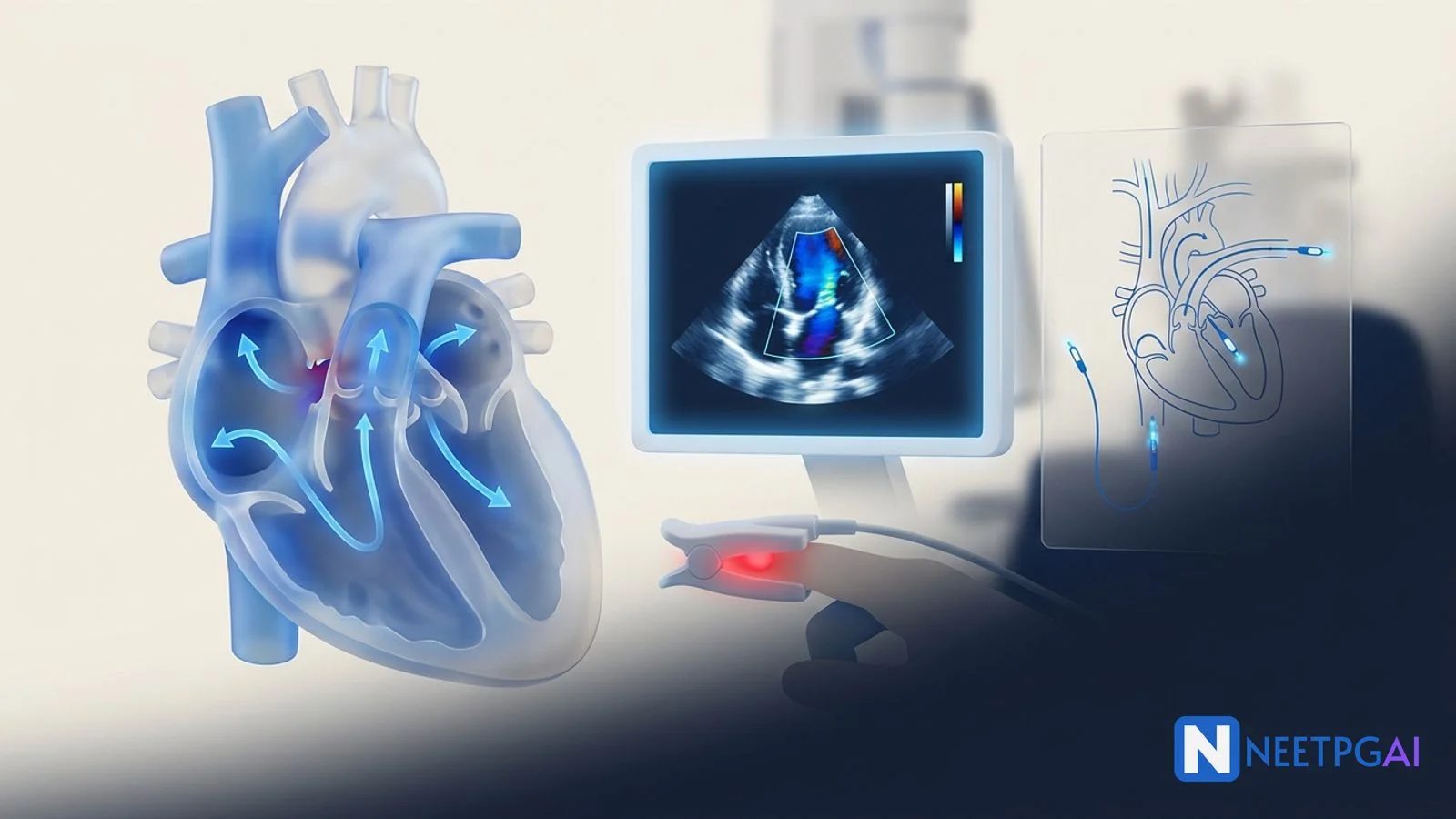
Congenital Heart Diseases for NEET PG — Complete Guide 2027
Master congenital heart diseases for NEET PG 2027: acyanotic vs cyanotic classification, VSD, ASD, PDA, coarctation, TOF, TGA, Eisenmenger syndrome, CXR and ECG findings, and surgical management.
NEETPGAI EditorialPublished 5 Jan 2026Updated 29 Sept 202617 min read
Share this article
This content is for educational purposes for NEET PG exam preparation. It is not a substitute for professional medical advice, diagnosis, or treatment. Clinical information has been reviewed by qualified medical professionals.
Ready to put this into practice?
Start practicing NEET PG MCQs with AI-powered explanations.
NEET PG paediatric case on Tetralogy of Fallot and hypercyanotic spell: knee-chest positioning, oxygen, morphine, fluid bolus, beta-blocker, emergency BT shunt vs primary complete repair.
Congenital heart disease contributes 3–5 questions per NEET PG paper. Master these 8 high-yield areas:
Classification — acyanotic (left-to-right shunt: VSD, ASD, PDA, AVSD) vs cyanotic (right-to-left shunt: TOF, TGA, truncus arteriosus, TAPVR, tricuspid atresia). The 5 T's of cyanotic CHD: Tetralogy of Fallot, Transposition, Truncus arteriosus, Total anomalous pulmonary venous return, Tricuspid atresia.
VSD — most common CHD (25–30%), perimembranous type most common, pansystolic murmur at left lower sternal border, small VSDs close spontaneously
ASD — ostium secundum (70%, fixed split S2, incomplete RBBB), ostium primum (Down syndrome, left axis deviation, cleft mitral valve)
PDA — continuous machinery murmur at left infraclavicular area, indomethacin/ibuprofen for closure in premature neonates, prostaglandin E1 keeps PDA open when needed
TOF — most common cyanotic CHD, 4 features (VSD + overriding aorta + pulmonary stenosis + RVH), boot-shaped heart on CXR, tet spell management with knee-chest position
TGA — most common cyanotic CHD in neonates, egg-on-a-string CXR, Rashkind balloon atrial septostomy (emergency), arterial switch operation (definitive)
Eisenmenger syndrome — irreversible pulmonary hypertension from chronic left-to-right shunt, shunt reversal, surgery contraindicated once established
Congenital heart disease (CHD) is a structural abnormality of the heart or great vessels present at birth — occurring in 8–10 per 1,000 live births and representing the most common category of birth defects. In NEET PG, CHD questions span pediatrics (clinical presentation, management), medicine (adult survivors with Eisenmenger), surgery (operative approaches), and radiology (CXR patterns). The student who can classify every lesion by hemodynamics (shunt direction, cyanosis, pulmonary blood flow) and recognize the classic imaging patterns will capture marks across multiple subjects.
This guide covers the complete spectrum of CHDs with the hemodynamic explanations, clinical clues, and imaging findings that NBE tests. Pair this with practice on the Pediatrics subject hub and cross-reference high-yield pediatrics topics for additional neonatal and childhood cardiology content.
Classification — acyanotic vs cyanotic
Congenital heart disease classification divides lesions into acyanotic (no cyanosis at presentation) and cyanotic (cyanosis present) based on the direction and nature of intracardiac shunting — this is the foundational framework for every CHD question.
Category
Shunt direction
Pulmonary blood flow
Examples
Acyanotic — left-to-right shunt
Left → Right (oxygenated blood recirculates through lungs)
Increased
VSD, ASD, PDA, AVSD
Acyanotic — obstructive
No shunt
Normal or reduced
Coarctation of aorta, aortic stenosis, pulmonary stenosis
Key hemodynamic principle: Left-to-right shunts initially cause volume overload of the pulmonary circulation (pulmonary plethora on CXR, heart failure in infants). Over years, the chronic volume overload causes pulmonary vascular remodeling → fixed pulmonary hypertension → Eisenmenger syndrome (shunt reversal).
VSD — the most common CHD
Ventricular septal defect (VSD) is an abnormal opening in the interventricular septum allowing left-to-right shunting of blood — accounting for 25–30% of all congenital heart defects and being the single most common CHD.
VSD types
Type
Location
Frequency
Key feature
Perimembranous
Membranous septum, below aortic valve
70–80%
Most common type overall
Muscular
Muscular septum
10–15%
Highest rate of spontaneous closure
Outlet (supracristal)
Below pulmonary valve
5–8%
Common in Asian populations, associated with aortic regurgitation
Failure to thrive, recurrent pneumonia, severe CHF
Surgical closure before 6 months (to prevent Eisenmenger)
NBE trap: The loudest VSD murmur comes from the SMALLEST VSD (the pressure gradient across a small restrictive defect is high). A large VSD may have a soft murmur because the equalized pressures create minimal gradient. "Quiet VSD" = large VSD = urgently needs surgery.
Associated finding: Maladie de Roger — an isolated, small, perimembranous VSD with a loud pansystolic murmur but no hemodynamic significance.
ASD — the septal defect with fixed split S2
Atrial septal defect (ASD) is an abnormal opening in the interatrial septum — the second most common CHD, often asymptomatic until adulthood.
ASD types
Type
Location
Frequency
ECG
Association
Ostium secundum
Fossa ovalis (mid-septum)
70%
Incomplete RBBB, right axis deviation
Most common type, isolated
Ostium primum
Lower septum (above AV valves)
15–20%
Left axis deviation, incomplete RBBB
Down syndrome, cleft mitral valve, AVSD
Sinus venosus
Near SVC or IVC entry
5–10%
P-wave axis abnormality
Anomalous pulmonary vein drainage (PAPVR)
Coronary sinus
Unroofing of coronary sinus
<1%
Variable
Persistent left SVC
Clinical features
Fixed splitting of S2 — the hallmark physical finding. In ASD, the right ventricle has constant volume overload regardless of respiration, so A2-P2 splitting does not vary with breathing. (Normal splitting varies: widens on inspiration, narrows on expiration.)
Ejection systolic murmur at upper left sternal border — relative pulmonary stenosis (increased flow across normal pulmonary valve)
Mid-diastolic rumble at lower left sternal border — increased flow across tricuspid valve (only with significant shunts)
ECG: Incomplete RBBB + right axis deviation (secundum) or left axis deviation (primum)
Treatment: Device closure (catheter-based) for secundum ASD with adequate rims. Surgical closure for primum ASD, sinus venosus ASD, and large secundum ASDs without adequate rims.
PDA — the ductus that should have closed
Patent ductus arteriosus (PDA) is the persistence of the fetal connection between the aorta and pulmonary artery beyond 72 hours of birth — normally closing functionally within 10–15 hours of birth in response to increased oxygen tension and falling prostaglandin levels.
Anatomy: Connects the aortic isthmus (just distal to left subclavian artery) to the left pulmonary artery.
Clinical features:
Continuous "machinery" murmur — best heard at the left infraclavicular area (below left clavicle). The murmur is continuous because the aortic pressure exceeds PA pressure throughout both systole and diastole.
Bounding (water-hammer) pulses — wide pulse pressure from aortic diastolic runoff into the PA
Premature neonates: Pharmacological closure with indomethacin or ibuprofen (prostaglandin synthesis inhibitors). Paracetamol (acetaminophen) is an emerging alternative.
Term infants and children: Device closure (catheter-based, transcatheter coil or Amplatzer device) or surgical ligation
When to keep PDA open: Duct-dependent lesions (TGA, pulmonary atresia, coarctation, HLHS) — use prostaglandin E1 (alprostadil) IV infusion to maintain ductal patency
NBE trap: Indomethacin closes the PDA (inhibits prostaglandins). Prostaglandin E1 opens/maintains the PDA. Know when each is needed.
Master pediatrics with AI-powered practice — adaptive MCQs with instant explanations.
Coarctation of the aorta is a discrete narrowing of the aorta, typically at the level of the ligamentum arteriosum (just distal to the left subclavian artery) — presenting as upper limb hypertension with weak or absent femoral pulses.
Two presentations:
Feature
Infantile (preductal)
Adult (postductal)
Age
Neonatal period
Older children/adults
Location
Proximal to ductus arteriosus
At or distal to ligamentum arteriosum
Duct dependency
Yes (PDA provides lower body flow)
No
Presentation
Heart failure, shock when PDA closes
Upper limb hypertension, headaches, claudication
Association
Turner syndrome, VSD
Bicuspid aortic valve (85%), berry aneurysms
CXR
Cardiomegaly
Rib notching (inferior surface, ribs 3–8 from collateral intercostal arteries), "3" sign or reverse "E" sign
Classic clinical finding: Blood pressure gradient — upper limb BP >20 mmHg higher than lower limb BP. Radiofemoral delay (femoral pulse delayed compared to radial pulse).
Treatment: Balloon angioplasty with stenting (catheter-based) or surgical repair (resection with end-to-end anastomosis).
TOF — the most common cyanotic CHD
Tetralogy of Fallot (TOF) is the most common cyanotic congenital heart disease — comprising four anatomical abnormalities resulting from a single embryological defect: anterocephalad deviation of the outlet (infundibular) septum.
Right ventricular hypertrophy (consequence of RVOTO)
Clinical features:
Cyanosis (severity depends on degree of RVOTO)
Tet spells (hypercyanotic spells) — sudden episodes of severe cyanosis with irritability, hyperpnea, and possible syncope. Triggered by crying, feeding, straining.
Squatting — older children instinctively squat during tet spells (increases SVR → reduces right-to-left shunt → improves pulmonary blood flow)
Clubbing — from chronic cyanosis
Investigations:
CXR: Boot-shaped heart (coeur en sabot) — upturned apex from RVH + concave pulmonary artery segment (absent main PA shadow). Oligemic lung fields (reduced pulmonary blood flow).
ECG: Right axis deviation, right ventricular hypertrophy
Tet spell management (stepwise)
Knee-chest position (infant) or squatting (child) — increases SVR
Oxygen — 100% by face mask
IV morphine — reduces respiratory drive and systemic oxygen consumption
IV phenylephrine — pure alpha-agonist, increases SVR directly
IV fluids — volume expansion
IV sodium bicarbonate — corrects metabolic acidosis
IV propranolol — for prevention of recurrent spells (relaxes infundibular muscle spasm)
Emergency BT shunt — if medical management fails (Blalock-Taussig shunt: subclavian → pulmonary artery)
Transposition of the great arteries (TGA) is the most common cyanotic CHD presenting in the neonatal period — characterized by the aorta arising from the right ventricle and the pulmonary artery from the left ventricle, creating two parallel circuits.
Hemodynamics: Systemic and pulmonary circulations run in parallel rather than in series. Without mixing (through ASD, VSD, or PDA), the condition is incompatible with life.
Clinical features:
Severe cyanosis within hours of birth (progressive as PDA closes)
Cyanosis NOT responding to oxygen (fixed right-to-left physiology)
May be surprisingly well-appearing initially if mixing sites are adequate
Investigations:
CXR: "Egg-on-a-string" (or egg-on-its-side) — narrow mediastinum (great vessels are parallel rather than crossing) + cardiomegaly with increased pulmonary vascularity
ECG: Right axis deviation, RVH (normal for a neonate — not helpful for diagnosis)
Rashkind balloon atrial septostomy — catheter-based creation of an ASD to allow mixing at atrial level (emergency palliative)
Arterial switch operation (Jatene procedure) — definitive surgery, ideally within first 2 weeks. The great arteries are transected and reconnected to the correct ventricles. Coronary arteries are reimplanted.
NBE point: The arterial switch must be performed within 2–3 weeks in simple TGA. After this, the left ventricle (pumping against low-pressure pulmonary circulation) loses muscle mass and cannot sustain systemic pressures after the switch.
Other cyanotic CHDs
Truncus arteriosus
Truncus arteriosus is a single arterial trunk arising from both ventricles, giving rise to the aorta, pulmonary arteries, and coronary arteries — always associated with a VSD.
Treatment: Complete repair in the neonatal period (Rastelli procedure)
Total anomalous pulmonary venous return (TAPVR)
TAPVR is a condition where all four pulmonary veins drain into the systemic venous system instead of the left atrium — an ASD is mandatory for survival (the only pathway for oxygenated blood to reach the left side).
Types: Supracardiac (drains to SVC via vertical vein — most common), cardiac (drains to coronary sinus), infracardiac (drains below diaphragm to IVC/portal vein — worst prognosis due to obstruction), mixed.
CXR: "Snowman sign" (figure-of-8) — supracardiac type only. The dilated vertical vein, innominate vein, and SVC form the upper "snowball," and the heart forms the lower.
Treatment: Surgical — redirect pulmonary veins to left atrium + close ASD.
Eisenmenger syndrome
Eisenmenger syndrome is the irreversible reversal of a left-to-right shunt to right-to-left due to fixed pulmonary hypertension — the dreaded long-term complication of any large unrepaired left-to-right shunt (VSD, ASD, PDA, AVSD).
Pathophysiology:
Large left-to-right shunt → pulmonary overcirculation
Key NBE point: Once Eisenmenger syndrome is established, surgical closure of the original defect is CONTRAINDICATED — removing the "pop-off" valve (the shunt) in the face of fixed pulmonary hypertension causes acute right heart failure and death.
Phlebotomy only if symptomatic hyperviscosity (Hct >65%)
Avoid: pregnancy (30–50% maternal mortality), dehydration, high altitude, general anesthesia
Heart-lung transplant: only definitive option (rarely performed due to organ scarcity)
Diagnostic approach — CXR, ECG, and Echo findings
The diagnostic investigation findings per CHD lesion are tested directly — often as a "match the finding to the diagnosis" question.
CXR patterns
CXR finding
Diagnosis
Mechanism
Boot-shaped heart
Tetralogy of Fallot
RVH (upturned apex) + absent main PA segment
Egg-on-a-string
TGA
Narrow mediastinum (parallel great vessels)
Snowman sign (figure-of-8)
TAPVR (supracardiac)
Dilated vertical vein + innominate vein + SVC
Rib notching
Coarctation of aorta
Collateral intercostal arteries eroding ribs
Pulmonary plethora + cardiomegaly
Large VSD, ASD, PDA
Volume overload from left-to-right shunt
Oligemic lung fields
TOF, pulmonary atresia
Reduced pulmonary blood flow
Box-shaped heart
Ebstein anomaly
Massive right atrial enlargement
ECG patterns
ECG finding
Diagnosis
Right axis deviation + RVH
TOF, ASD (secundum), pulmonary stenosis
Left axis deviation
Primum ASD, AVSD, tricuspid atresia
Left ventricular hypertrophy
Large VSD (volume overload), coarctation, aortic stenosis
Superior QRS axis
AVSD (endocardial cushion defect)
Surgical management overview
Lesion
Palliative procedure
Definitive surgery
Timing
VSD
PA banding (rarely, for multiple muscular VSDs)
Direct VSD closure
3–6 months if symptomatic
ASD
Not needed
Device closure or surgical
3–5 years (elective)
PDA
Not applicable
Device closure or surgical ligation
When diagnosed
Coarctation
PGE1 (neonatal)
Resection + end-to-end anastomosis
When diagnosed
TOF
BT shunt (if symptomatic neonate)
Complete intracardiac repair
3–6 months
TGA
Rashkind balloon septostomy
Arterial switch (Jatene)
Within 2 weeks
TAPVR
PGE1, balloon septostomy
Pulmonary vein redirection + ASD closure
Neonatal (emergency if obstructed)
Truncus arteriosus
Not applicable
Rastelli procedure
Neonatal
Sources and references
Ghai Essential Pediatrics, 10th Edition (Paul et al., 2024) — Congenital heart disease classification, clinical features, and management protocols.
Nelson Textbook of Pediatrics, 22nd Edition (Kliegman et al., 2023) — Detailed embryology and hemodynamic descriptions of CHDs.
Park's Pediatric Cardiology for Practitioners, 7th Edition (Park, 2021) — ECG and CXR interpretation in congenital heart disease.
Harrison's Principles of Internal Medicine, 21st Edition (Loscalzo et al., 2022) — Adult congenital heart disease and Eisenmenger syndrome.
Sabiston Textbook of Surgery, 21st Edition (Townsend et al., 2022) — Surgical approaches for CHD correction.
Frequently asked questions
How many congenital heart disease questions appear in NEET PG?
Congenital heart disease contributes 3-5 questions per NEET PG paper across pediatrics, medicine, and surgery. The most tested topics are TOF (tet spell management), VSD (most common CHD), ASD (ostium secundum type), PDA (continuous machinery murmur), and Eisenmenger syndrome. CXR patterns like boot-shaped heart and egg-on-a-string are classic image-based questions.
What is the most common congenital heart disease?
Ventricular septal defect (VSD) is the most common congenital heart disease, accounting for 25-30% of all CHDs. The perimembranous (membranous) type is the most common VSD subtype. Small restrictive VSDs often close spontaneously by age 2 years. Large unrestrictive VSDs require surgical closure to prevent Eisenmenger syndrome.
What is the most common cyanotic congenital heart disease?
Tetralogy of Fallot (TOF) is the most common cyanotic congenital heart disease overall. TGA (transposition of great arteries) is the most common cyanotic CHD presenting in the neonatal period (first few days of life). The distinction between 'most common cyanotic CHD' (TOF) and 'most common cyanotic CHD in neonates' (TGA) is a classic exam trap.
How do I manage a tet spell in TOF?
Tet spell (hypercyanotic spell) management follows a stepwise approach: knee-chest position (increases SVR, reduces right-to-left shunting), oxygen supplementation, IV morphine (reduces respiratory drive and agitation), IV phenylephrine (increases SVR), IV fluids, IV sodium bicarbonate for acidosis. Propranolol is used for prevention of recurrent spells. Emergency surgery if medical management fails.
What is Eisenmenger syndrome?
Eisenmenger syndrome is the reversal of a left-to-right shunt to right-to-left due to pulmonary hypertension from chronic volume overload. Any large unrepaired left-to-right shunt (VSD, ASD, PDA) can cause Eisenmenger syndrome. Once established, surgical correction is contraindicated (the pulmonary vascular disease is irreversible). Treatment is medical: pulmonary vasodilators (sildenafil, bosentan). Heart-lung transplant is the only definitive option.
How do I differentiate ASD types in NEET PG?
Ostium secundum ASD (70% of ASDs) is at the fossa ovalis, causes fixed splitting of S2, and shows incomplete RBBB on ECG. Ostium primum ASD is an endocardial cushion defect associated with Down syndrome, causes left axis deviation on ECG, and often has a cleft mitral valve with MR. Sinus venosus ASD is near the SVC entry and is associated with anomalous right pulmonary vein drainage.
What CXR findings are tested for congenital heart diseases?
Boot-shaped heart (coeur en sabot) is TOF. Egg-on-a-string appearance is TGA. Snowman sign (figure-of-8) is TAPVR (supracardiac type). Box-shaped heart is Ebstein anomaly. Rib notching is coarctation of aorta (older children). Cardiomegaly with pulmonary plethora suggests large left-to-right shunt (VSD, PDA). Oligemic lung fields suggest reduced pulmonary blood flow (TOF, pulmonary atresia).
What is the role of prostaglandin E1 in congenital heart disease?
Prostaglandin E1 (alprostadil) maintains the patent ductus arteriosus open in duct-dependent lesions. It is life-saving in neonates with duct-dependent pulmonary circulation (TOF, pulmonary atresia, tricuspid atresia) where PDA provides pulmonary blood flow, and duct-dependent systemic circulation (coarctation, interrupted aortic arch, HLHS) where PDA provides systemic blood flow.
Build your CHD pattern recognition through daily MCQ practice. The CXR patterns and clinical clues you memorize now are the marks you capture on exam day.
See our pricing plans for unlimited access and use our AI tutor for real-time doubt resolution on any CHD concept.
This content is for educational purposes for NEET PG exam preparation. It is not a substitute for professional medical advice, diagnosis, or treatment. Clinical information has been reviewed by qualified medical professionals.
Written by: NEETPGAI Editorial Team
Reviewed by: Pending SME Review
Last reviewed: March 2026
This article is reviewed by qualified medical professionals for clinical accuracy and exam relevance. For corrections or updates, contact the editorial team.