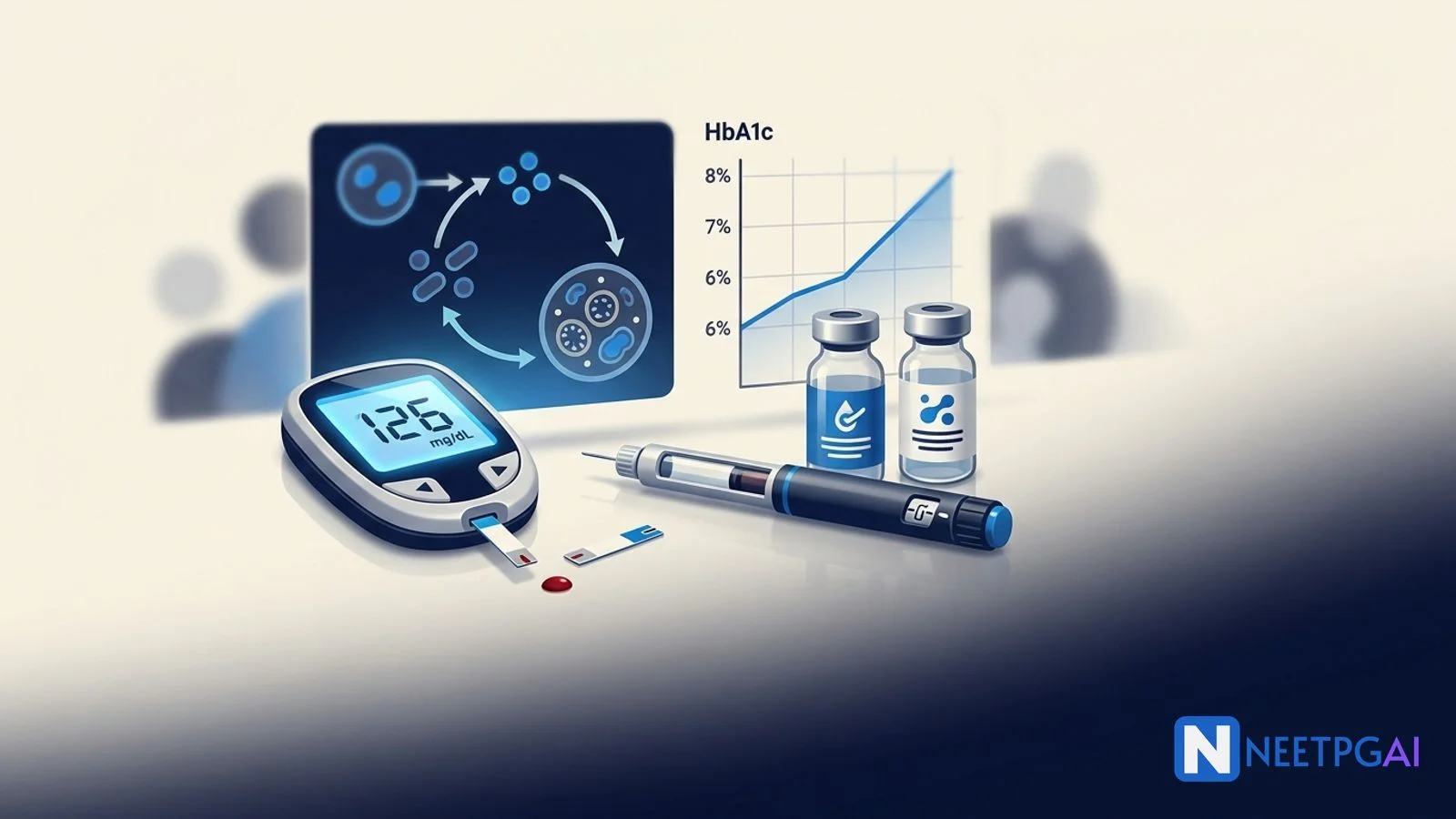
Diabetes Mellitus for NEET PG — Complete Guide 2027
Master diabetes mellitus for NEET PG 2027: classification (Type 1, Type 2, GDM, MODY), diagnostic criteria, complications, insulin regimens, oral hypoglycemics, DKA vs HHS, and management in special populations.
NEETPGAI EditorialPublished 29 Dec 2025Updated 29 Sept 202619 min read
Share this article
This content is for educational purposes for NEET PG exam preparation. It is not a substitute for professional medical advice, diagnosis, or treatment. Clinical information has been reviewed by qualified medical professionals.
Ready to put this into practice?
Start practicing NEET PG MCQs with AI-powered explanations.
Comparison of the authorities that shape NEET PG, INI-CET, FMGE, and Indian medical education: NMC (regulator), NBEMS (exam conductor), MCC (AIQ counseling), DGHS (health services), AIIMS (INI-CET), plus state councils and FMG pathway — clarifies who does what.
DKA — Type 1, glucose 250–600, pH <7.3, ketones positive, anion gap metabolic acidosis, Kussmaul breathing
HHS — Type 2, glucose >600, pH >7.3, minimal ketones, severe dehydration, altered sensorium
Hypoglycemia — Whipple triad, glucose <70 mg/dL, treat with 15g glucose, recheck at 15 minutes
Special populations — pregnancy (insulin preferred), CKD (dose adjustment for all renally cleared drugs), elderly (relaxed HbA1c targets <8%)
Diabetes mellitus is a group of metabolic disorders characterized by chronic hyperglycemia resulting from defects in insulin secretion, insulin action, or both. It is the single most tested endocrinology topic in NEET PG, appearing not just in medicine but crossing into pharmacology (oral hypoglycemics), obstetrics (gestational diabetes), ophthalmology (diabetic retinopathy), and surgery (diabetic foot). The student who masters DM classification, diagnostic criteria, and emergency management has covered the foundation for at least 3–5 marks across multiple papers.
This guide covers every testable aspect of diabetes — from the molecular pathophysiology that explains clinical features to the drug tables and emergency protocols that NBE tests as standalone questions. Pair this with daily MCQ practice on the Medicine subject hub and cross-reference the high-yield medicine topics overview for context on how diabetes fits into the broader endocrinology testing pattern.
Classification of diabetes mellitus
Diabetes classification is the systematic categorization of diabetes subtypes based on etiology and pathophysiology — and it forms the foundation for every clinical question on DM in NEET PG.
Type 1 diabetes mellitus
Type 1 DM is autoimmune destruction of pancreatic beta cells, leading to absolute insulin deficiency. It accounts for 5–10% of all diabetes cases and typically presents in childhood or adolescence, though adult-onset Type 1 (LADA — Latent Autoimmune Diabetes in Adults) is increasingly recognized.
Presentation: Polyuria, polydipsia, weight loss, DKA as initial presentation in 25–30% of children
Type 2 diabetes mellitus
Type 2 DM is a combination of insulin resistance and progressive beta-cell dysfunction — responsible for 90% of diabetes globally and the vast majority of questions in NEET PG.
Pathophysiology (the "ominous octet" — DeFronzo):
Decreased insulin secretion (beta-cell failure)
Increased hepatic glucose production
Decreased peripheral glucose uptake (muscle)
Increased lipolysis (adipose tissue)
Decreased incretin effect (gut)
Increased glucagon secretion (alpha cells)
Increased renal glucose reabsorption
Neurotransmitter dysfunction (brain)
Risk factors: Obesity (BMI >=25 in Asians), family history, sedentary lifestyle, polycystic ovary syndrome, history of GDM, impaired glucose tolerance.
Gestational diabetes mellitus (GDM)
GDM is glucose intolerance with onset or first recognition during pregnancy. It affects 7–14% of pregnancies in India (higher than the global average of 6–9%).
Screening: Universal screening at 24–28 weeks. DIPSI (Diabetes in Pregnancy Study Group of India) recommends a single-step 75g OGTT with a 2-hour glucose cutoff of >=140 mg/dL.
Risk to the fetus: Macrosomia, neonatal hypoglycemia, respiratory distress syndrome, shoulder dystocia, increased risk of childhood obesity and Type 2 DM later in life.
MODY (Maturity-Onset Diabetes of the Young)
MODY is a monogenic form of diabetes with autosomal dominant inheritance, presenting before age 25 in a non-obese individual with a strong family history spanning three generations.
Most common MODY, progressive, glycosuria at low glucose threshold
Sulfonylureas (very sensitive)
MODY 5
HNF-1 beta
Renal cysts + diabetes (renal cysts and diabetes syndrome)
Insulin
NBE exam point: MODY 3 is the most common type overall. MODY 2 is the mildest and often diagnosed incidentally. The key differentiator from Type 1 is: autosomal dominant family history, absence of autoantibodies, and detectable C-peptide.
Diagnostic criteria for diabetes mellitus
Diagnostic criteria for diabetes are the laboratory thresholds established by ADA and WHO to confirm hyperglycemia — and these exact numbers are tested repeatedly in NEET PG.
Test
Normal
Prediabetes
Diabetes
Fasting plasma glucose
<100 mg/dL
100–125 mg/dL (IFG)
>=126 mg/dL
2-hour OGTT (75g)
<140 mg/dL
140–199 mg/dL (IGT)
>=200 mg/dL
HbA1c
<5.7%
5.7–6.4%
>=6.5%
Random plasma glucose
—
—
>=200 mg/dL + symptoms
Rules for confirmation:
Any single abnormal test must be confirmed by a repeat test on a different day (except random glucose with classic symptoms)
Two different tests on the same sample both meeting criteria also confirms diagnosis
HbA1c is unreliable in: hemoglobinopathies (sickle cell, thalassemia), hemolytic anemia, iron deficiency anemia, recent transfusion, CKD stages 4–5, pregnancy
GDM diagnostic criteria (IADPSG/WHO 2013): 75g OGTT — fasting >=92 mg/dL, 1-hour >=180 mg/dL, or 2-hour >=153 mg/dL. Any ONE abnormal value confirms GDM.
Complications of diabetes mellitus
Diabetic complications are the end-organ damage resulting from chronic hyperglycemia — categorized into microvascular (retinopathy, nephropathy, neuropathy) and macrovascular (CAD, stroke, PVD) based on the vessel size affected.
Microvascular complications
Diabetic retinopathy — the leading cause of blindness in adults aged 20–74 years:
4-2-1 rule: hemorrhages in 4 quadrants, venous beading in 2 quadrants, IRMA in 1 quadrant
Consider panretinal photocoagulation
Proliferative DR
Neovascularization (disc or elsewhere), vitreous hemorrhage, tractional RD
Panretinal laser photocoagulation, anti-VEGF
Diabetic macular edema
Macular thickening, hard exudates at macula
Anti-VEGF intravitreal injection (first-line)
NBE trap: The 4-2-1 rule defines SEVERE NPDR, not proliferative. Neovascularization is the hallmark of proliferative retinopathy.
Diabetic nephropathy — the leading cause of end-stage renal disease worldwide:
Earliest sign: Microalbuminuria (30–300 mg/day or albumin-creatinine ratio 30–300 mg/g)
Progression: Microalbuminuria → macroalbuminuria → declining GFR → ESRD
Screening: Annual urine albumin-creatinine ratio starting 5 years after Type 1 diagnosis or at diagnosis in Type 2
Treatment: ACE inhibitor or ARB (even in normotensive patients with microalbuminuria), SGLT2 inhibitor (proven renal benefit — CREDENCE trial), blood pressure target <130/80 mmHg
Diabetic neuropathy — the most common complication of diabetes:
Distal symmetric polyneuropathy: Stocking-glove distribution, loss of vibration sense first (large fiber), burning pain (small fiber). Treatment: pregabalin or duloxetine for neuropathic pain, NOT opioids.
Mononeuropathy: CN III palsy with pupil sparing (diabetic third nerve palsy — vs posterior communicating artery aneurysm which causes pupil dilation)
Macrovascular complications
Cardiovascular disease is the leading cause of death in Type 2 diabetes. The risk is 2–4 times higher than in non-diabetic individuals.
Coronary artery disease: Silent MI is more common in diabetics (autonomic neuropathy masks chest pain). Screen with stress testing in high-risk patients.
Stroke: Both ischemic and hemorrhagic risk increased. Blood pressure control is critical.
Peripheral vascular disease: Claudication, non-healing ulcers, gangrene. Diabetic foot — a combined neuropathic + vascular pathology — is the most common cause of non-traumatic lower limb amputation.
Master endocrinology with AI-powered practice — adaptive MCQs with instant explanations.
Insulin therapy is the exogenous replacement of endogenous insulin — mandatory in Type 1 and required in advanced Type 2 when oral agents fail to achieve glycemic targets.
Insulin type
Examples
Onset
Peak
Duration
Clinical use
Rapid-acting
Lispro, Aspart, Glulisine
10–15 min
1–2 hr
3–5 hr
Pre-meal bolus
Short-acting
Regular (soluble)
30 min
2–4 hr
6–8 hr
Pre-meal, DKA IV infusion
Intermediate
NPH (isophane)
1–2 hr
4–12 hr
12–18 hr
Basal (twice daily)
Long-acting
Glargine, Detemir
1–2 hr
Peakless
20–24 hr
Basal (once daily)
Ultra-long
Degludec
30–90 min
Peakless
>42 hr
Basal (flexible timing)
Premixed
70/30 (NPH/Regular)
30 min
Dual
12–18 hr
Simplified regimen
Basal-bolus regimen: Long-acting (once daily) + rapid-acting before each meal. This is the physiologic replacement that best mimics normal insulin secretion. Most commonly tested regimen in NEET PG.
Key NBE points:
Only regular insulin can be given IV (used in DKA management)
Insulin glargine is clear (not cloudy like NPH) — cannot be mixed with other insulins
Insulin lispro has the fastest onset — best for postprandial control
Most important side effect of insulin: Hypoglycemia. Weight gain is the second most common.
Lipodystrophy (lipoatrophy or lipohypertrophy) occurs with repeated injection at the same site — rotate injection sites
Oral hypoglycemic agents
Oral hypoglycemics are non-insulin pharmacological agents used to manage Type 2 diabetes — and their classification, mechanism, and adverse effects constitute one of the most heavily tested pharmacology topics in NEET PG.
EMPA-REG trial: Empagliflozin reduces cardiovascular mortality in Type 2 DM with established CVD
CREDENCE trial: Canagliflozin slows CKD progression in diabetic nephropathy
DAPA-HF trial: Dapagliflozin reduces heart failure hospitalization — even in non-diabetic patients
Euglycemic DKA: SGLT2 inhibitors can cause ketoacidosis with near-normal blood glucose — a unique exam trap
DKA vs HHS — the critical comparison
Diabetic ketoacidosis (DKA) and hyperosmolar hyperglycemic state (HHS) are the two acute metabolic emergencies of diabetes — and their comparison is one of the most predictable NEET PG questions.
Feature
DKA
HHS
Typical patient
Type 1 (or Type 2 in severe stress)
Type 2 (elderly, often newly diagnosed)
Blood glucose
250–600 mg/dL
>600 mg/dL (often >1000)
Arterial pH
<7.3
>7.3
Serum bicarbonate
<18 mEq/L
>18 mEq/L
Serum ketones
Strongly positive
Absent or trace
Anion gap
Elevated (>12)
Normal or mildly elevated
Serum osmolality
Variable (usually <320)
>320 mOsm/kg
Mental status
Alert to obtunded
Stupor to coma
Dehydration
Moderate (3–6 L deficit)
Severe (8–10 L deficit)
Kussmaul breathing
Present
Absent
Mortality
<5% with treatment
10–20% (higher)
DKA management protocol
IV fluids first: 0.9% normal saline, 1 L/hr for first 1–2 hours, then adjust based on hydration status
Insulin: Regular insulin IV bolus (0.1 U/kg) followed by continuous infusion (0.1 U/kg/hr). Start ONLY after confirming serum potassium >3.3 mEq/L
Potassium: If K+ <3.3 — hold insulin, replace potassium first. If K+ 3.3–5.3 — add 20–40 mEq KCl to each liter of IV fluid. If K+ >5.3 — do not add potassium, recheck in 2 hours
Bicarbonate: Only if pH <6.9 (not routinely used)
Switch to dextrose: When glucose reaches 200 mg/dL, switch to D5 0.45% NS and reduce insulin rate — do not stop insulin until ketoacidosis resolves
Resolution criteria: Glucose <200 mg/dL AND at least two of: bicarbonate >=15, venous pH >7.3, anion gap <=12.
HHS management
Same principles as DKA but with key differences:
Fluid replacement is MORE aggressive (greater deficit)
Insulin dose is often LOWER (patients are more insulin-sensitive)
Search for and treat the precipitating cause (infection in 40–60% of cases)
Hypoglycemia management
Hypoglycemia is defined as blood glucose <70 mg/dL (ADA) — the most common acute complication of insulin therapy and sulfonylurea use, and a frequent NEET PG question.
Whipple triad (defines true hypoglycemia):
Symptoms of hypoglycemia (tremor, sweating, palpitations, confusion)
Low plasma glucose at the time of symptoms
Resolution of symptoms with glucose administration
Level 3: Severe event requiring assistance of another person (altered mental status, seizure)
Management:
Conscious patient: 15–20 g oral glucose (glucose tablets, juice), recheck at 15 minutes (Rule of 15)
Unconscious patient: IV dextrose (25 mL of 50% dextrose = 12.5 g) or IM glucagon (1 mg)
Sulfonylurea-induced hypoglycemia: prolonged monitoring required (24–48 hours) because sulfonylureas have long half-lives — octreotide can be used for refractory cases
Monitoring and glycemic targets
Glycemic monitoring is the systematic tracking of blood glucose and HbA1c to guide therapy — with target values that vary by patient population.
Parameter
General target
Elderly/comorbid
Pregnancy
HbA1c
<7.0%
<8.0%
<6.0% (Type 1/2), <6.5% (GDM)
Fasting glucose
80–130 mg/dL
100–180 mg/dL
<95 mg/dL
Postprandial (2-hr)
<180 mg/dL
<200 mg/dL
<120 mg/dL
Pre-meal
80–130 mg/dL
100–150 mg/dL
<95 mg/dL
HbA1c reflects the average blood glucose over the preceding 8–12 weeks (red blood cell lifespan). A 1% decrease in HbA1c reduces microvascular complications by approximately 37% (UKPDS) and MI risk by 14%.
Continuous glucose monitoring (CGM): Measures interstitial glucose every 5 minutes. Time in range (TIR) of 70–180 mg/dL for >70% of the day correlates with HbA1c <7%. Increasingly tested in recent NEET PG papers.
Diabetes in special populations
Diabetes in pregnancy
Pre-gestational diabetes (Type 1 or Type 2 entering pregnancy):
Switch all oral agents to insulin before conception (except metformin, which has safety data)
Target HbA1c <6.5% before conception to reduce congenital malformations
Congenital anomalies with poorly controlled DM: caudal regression syndrome (sacral agenesis — most specific), neural tube defects, cardiac defects (TGA, VSD), small left colon syndrome
Folic acid 5 mg/day (higher dose than standard 0.4 mg)
Gestational diabetes management:
Medical nutrition therapy and exercise (2 weeks trial)
If targets not met: insulin (first-line pharmacological agent)
Delivery: elective induction at 39–40 weeks if well-controlled, 37–39 weeks if suboptimal control or macrosomia
Postpartum: 75g OGTT at 6–12 weeks to reclassify (40–60% develop Type 2 within 10 years)
Diabetes in CKD
eGFR (mL/min)
Drug adjustment
>45
All drugs can be used
30–45
Reduce metformin dose by 50%, avoid glyburide (active metabolites)
15–30
Stop metformin, SGLT2 inhibitors for renal protection only (not glucose lowering), insulin dose often DECREASES (reduced renal clearance)
<15 / dialysis
Insulin is the primary agent, dose decreases by 25–50%
NBE trap: Insulin requirements DECREASE in advanced CKD — the kidneys normally clear 30–80% of circulating insulin. As renal function declines, insulin accumulates. Do not increase insulin dose in a diabetic patient with worsening kidney function who develops recurrent hypoglycemia.
Sources and references
American Diabetes Association — Standards of Care in Diabetes 2024 (Diabetes Care, Vol. 47, Supplement 1) — the global reference for diagnostic criteria, targets, and treatment algorithms.
Harrison's Principles of Internal Medicine, 21st Edition (Loscalzo et al., 2022) — Chapter on Diabetes Mellitus: pathophysiology, classification, and complications.
Williams Textbook of Endocrinology, 14th Edition (Melmed et al., 2020) — detailed molecular pathogenesis of Type 1 and Type 2 diabetes.
UKPDS Group — Lancet 1998; 352:837-853 — landmark trial establishing tight glycemic control reduces microvascular complications.
DeFronzo RA — "From the triumvirate to the ominous octet" (Diabetes 2009; 58:773-795) — the pathophysiologic framework for Type 2 DM.
API Textbook of Medicine, 11th Edition (Munjal et al., 2019) — Indian-context management protocols including DIPSI guidelines for GDM screening.
Frequently asked questions
How many diabetes questions appear in NEET PG?
Diabetes mellitus contributes 3-5 direct questions per NEET PG paper across medicine, pharmacology, and obstetrics. DKA vs HHS differentiation, insulin types, and oral hypoglycemic mechanisms are the three most frequently tested subtopics based on 2019-2025 pattern analysis.
What is the HbA1c cutoff for diagnosing diabetes?
HbA1c of 6.5% or higher on two separate occasions confirms diabetes (ADA 2024). Values of 5.7-6.4% indicate prediabetes. HbA1c is unreliable in hemoglobinopathies, hemolytic anemias, and chronic kidney disease — use fasting plasma glucose or OGTT instead.
How do I differentiate DKA from HHS in a clinical vignette?
DKA presents with Type 1 diabetes, blood glucose 250-600 mg/dL, arterial pH below 7.3, positive serum ketones, and Kussmaul breathing. HHS presents with Type 2 diabetes, glucose often above 600 mg/dL, pH above 7.3, absent or trace ketones, and severe dehydration with altered sensorium.
Which insulin has the longest duration of action?
Insulin degludec (ultra-long acting) has the longest duration at over 42 hours with a flat, peakless profile. Insulin glargine U-300 lasts about 36 hours. Both are used as basal insulins. Regular insulin peaks at 2-4 hours and lasts 6-8 hours — the most commonly tested insulin in NEET PG.
What is the first-line drug for Type 2 diabetes?
Metformin is the universal first-line drug for Type 2 diabetes (ADA 2024). It works by inhibiting hepatic gluconeogenesis and improving peripheral insulin sensitivity. It does not cause hypoglycemia or weight gain. Contraindicated when eGFR falls below 30 mL/min due to lactic acidosis risk.
What are MODY types most tested in NEET PG?
MODY 3 (HNF-1 alpha, most common overall) and MODY 2 (glucokinase, mildest form requiring no treatment) are the two most tested types. MODY is autosomal dominant, presents before age 25, and is non-insulin-dependent initially — these three features distinguish it from Type 1 diabetes in exam vignettes.
How is gestational diabetes managed?
First-line management is medical nutrition therapy and exercise. If targets are not met within 1-2 weeks, insulin is the preferred pharmacological agent. Metformin is sometimes used but crosses the placenta. Glyburide has fallen out of favor. Target: fasting glucose below 95 mg/dL, 1-hour postprandial below 140 mg/dL.
What is the most dangerous complication of DKA treatment?
Cerebral edema is the most dangerous complication, occurring primarily in children during DKA correction. It results from rapid fluid administration and too-fast correction of hyperglycemia. Treatment is IV mannitol. Other complications include hypokalemia from insulin therapy and hypoglycemia from overtreatment.
Which oral hypoglycemic causes the most weight gain?
Thiazolidinediones (pioglitazone, rosiglitazone) cause the most weight gain among oral hypoglycemics through PPAR-gamma activation and adipocyte differentiation. Sulfonylureas also cause weight gain via insulin secretion. In contrast, metformin is weight-neutral and SGLT2 inhibitors cause weight loss.
What is the target HbA1c for most diabetes patients?
The general HbA1c target is below 7.0% for most adults (ADA 2024). More stringent targets of below 6.5% apply to newly diagnosed young patients without complications. Relaxed targets of below 8.0% are acceptable for elderly patients, those with limited life expectancy, or extensive comorbidities.
Ready to test your diabetes knowledge? The best way to convert this guide into exam marks is active recall through MCQ practice.
Explore our pricing plans for unlimited practice across all 19 subjects, AI-powered doubt resolution, and personalized study plans.
This content is for educational purposes for NEET PG exam preparation. It is not a substitute for professional medical advice, diagnosis, or treatment. Clinical information has been reviewed by qualified medical professionals.
Written by: NEETPGAI Editorial Team
Reviewed by: Pending SME Review
Last reviewed: March 2026
This article is reviewed by qualified medical professionals for clinical accuracy and exam relevance. For corrections or updates, contact the editorial team.