Quick Answer
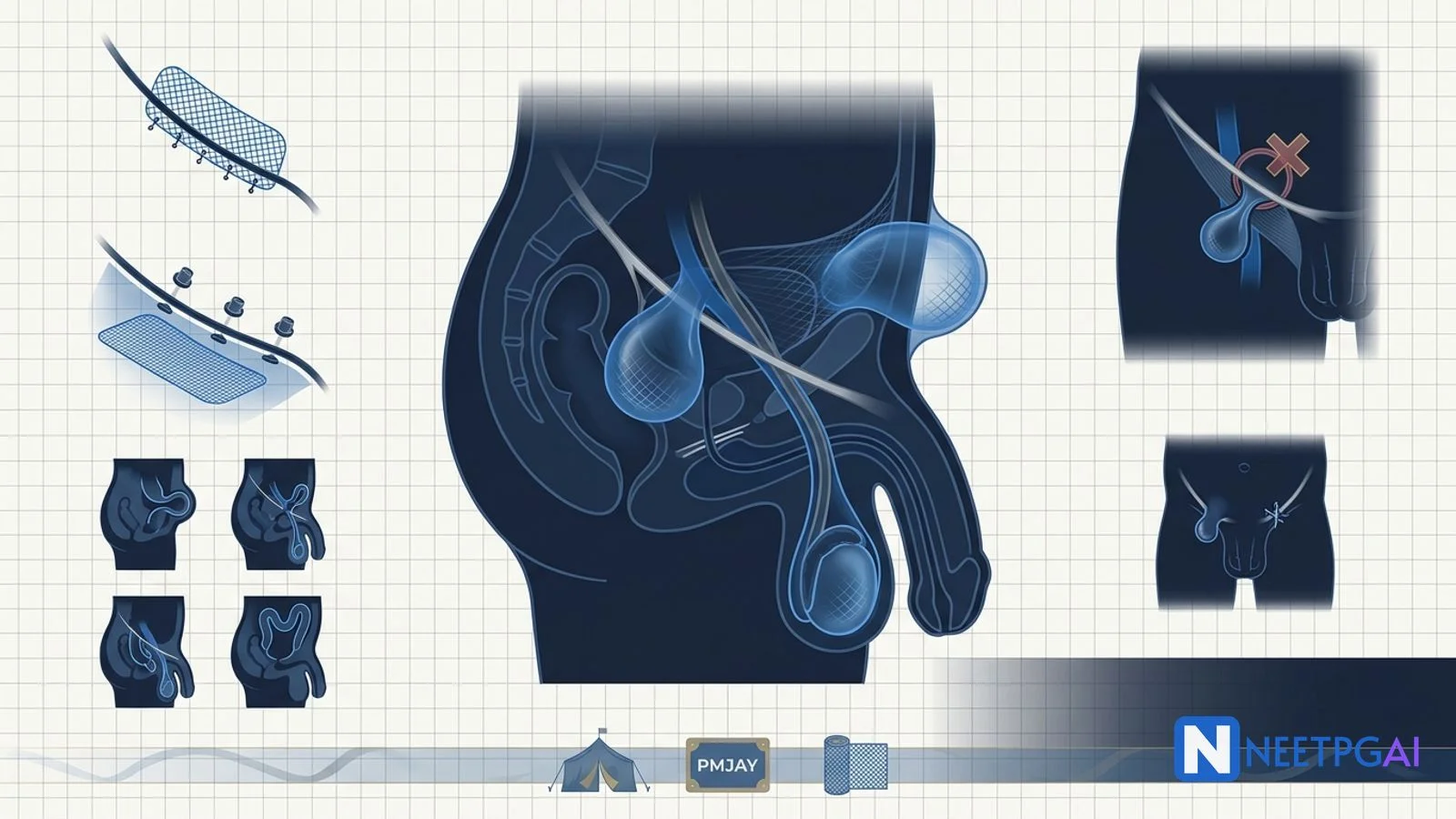
Hernias deliver 2 to 3 NEET PG questions per year across general surgery. Lock these:
- Indirect — through deep ring, lateral to inferior epigastric vessels; congenital patent processus vaginalis in kids.
- Direct — through Hesselbach triangle, medial to inferior epigastric vessels; acquired in elderly.
- Femoral — below inguinal ligament; women; 40 percent strangulation risk — always repair.
- Adult repair — tension-free Lichtenstein mesh (open) or TEP/TAPP (laparoscopic).
- Pediatric repair — herniotomy only (no mesh); high ligation of sac.
- Rare — Richter (partial-wall, no obstruction), Littre (Meckel), Amyand (appendix).
- Deep-ring test — occlude mid-inguinal point; indirect stays reduced, direct bulges.
Hernias are surgery's inexhaustible MCQ well — anatomy at the myopectineal orifice, six eponyms for rare types, three classifications for inguinal and one each for ventral and perihilar, and a shifting repair landscape from Bassini to Lichtenstein to laparoscopic TEP. The NEET PG examiner's favourite traps are the deep-ring occlusion test, the strangulation-heavy femoral hernia, and the Richter hernia that strangulates without bowel obstruction.
This NEETPGAI deep dive walks through every clinically relevant hernia — inguinal (direct, indirect, sliding, pantaloon), femoral, umbilical, incisional, and the rare eponyms — with contents assessment, examination, classifications and the tension-free mesh algorithms that dominate modern practice. India-specific — community-camp hernia programmes and the burden of neglected obstructed hernias — closes the loop.
Anatomy — myopectineal orifice
The myopectineal orifice of Fruchaud is the muscular gap in the lower anterior abdominal wall through which every groin hernia (direct, indirect, femoral) protrudes. Boundaries — superior by the internal oblique and transversus, medial by the rectus, lateral by the iliopsoas, and inferior by the pectineal ligament. The inguinal ligament divides it into the inguinal region (above) and the femoral region (below).
- Hesselbach triangle — inferior epigastric artery (lateral), rectus (medial), inguinal ligament (inferior). Direct hernias protrude through this triangle.
- Deep (internal) inguinal ring — at the mid-inguinal point (1.25 cm above the femoral pulse), transversalis fascia opening. Indirect hernias enter here, following the spermatic cord/round ligament.
- Femoral canal — bounded by inguinal ligament (anterior), pectineal (Cooper) ligament (posterior), lacunar (Gimbernat) ligament (medial), femoral vein (lateral). Femoral hernias protrude here.
Inguinal hernia — types
Indirect vs direct
| Feature | Indirect | Direct |
|---|
| Route | Through deep ring, following cord | Through Hesselbach triangle |
| Cause | Congenital — patent processus vaginalis | Acquired — abdominal wall weakness |
| Age | Any (children, young adults) | Elderly, chronic straining |
| Sac relation to IEV | Lateral | Medial |
| Descent into scrotum | Common | Rare |
| Deep-ring occlusion | Stays reduced | Still bulges |
| Strangulation risk | Higher (narrow neck) | Lower (wide neck) |
Sliding hernia
A viscus (sigmoid on the left, caecum on the right, bladder inferomedially) forms part of the wall of the sac itself, not just its contents. Recognised intra-operatively — do not attempt to strip the viscus off, or perforation results.
Pantaloon hernia
Simultaneous direct and indirect components straddling the inferior epigastric vessels like a pair of pantaloons — one sac medial, one lateral.
Classifications
- Nyhus — I (indirect with normal deep ring), II (indirect with enlarged deep ring), IIIA (direct), IIIB (indirect large or direct with floor blowout), IIIC (femoral), IV (recurrent).
- European Hernia Society (EHS) — grid using L (lateral = indirect), M (medial = direct), F (femoral) plus size 1 (under 1.5 cm), 2 (1.5-3 cm), 3 (over 3 cm), plus P (primary) or R (recurrent).
Femoral hernia
- Below the inguinal ligament, through the femoral canal.
- Women > men (wider pelvis, small femoral canal). Overall still less common than inguinal in absolute numbers.
- 40 percent strangulation risk — the highest of any hernia.
- Classical presentation — small tender lump below and lateral to the pubic tubercle (versus inguinal, above and medial).
- All femoral hernias require prompt repair, even if asymptomatic. Approaches — Lockwood (low, below inguinal ligament), Lotheissen (through inguinal canal), McEvedy (high, retroperitoneal — preferred if strangulated).
Femoral vs inguinal — relative to the pubic tubercle, an inguinal hernia lies above-and-medial, a femoral hernia lies below-and-lateral. This is the classical bedside distinguisher.
Other abdominal wall hernias
Umbilical
- Pediatric — patent umbilical ring; most close spontaneously by 5 years; repair if persistent after 5, symptomatic, or over 1.5 cm.
- Adult — acquired paraumbilical, associated with obesity, ascites, multiparity; higher strangulation risk than pediatric; primary or mesh repair.
Incisional (ventral)
- Follows about 10 to 20 percent of laparotomies; higher after emergency surgery, obesity, wound infection, poor closure technique.
- Chevrel classification — location (midline vs lateral), width (W1 under 4 cm, W2 4-10 cm, W3 over 10 cm), recurrence status.
- Repair — component separation (Ramirez), retromuscular (Rives-Stoppa) mesh, or laparoscopic IPOM for smaller defects.
Epigastric
- Small defect in the linea alba between xiphisternum and umbilicus, often containing pre-peritoneal fat only.
Spigelian
- Through the Spigelian aponeurosis — the linea semilunaris at the lateral border of rectus, below the arcuate line. Often interparietal (between layers) and easy to miss clinically; USG or CT confirms.
Obturator
- Through the obturator foramen, into the medial thigh. Elderly emaciated women ("little old lady's hernia"). Classical Howship-Romberg sign — medial thigh pain radiating to knee on hip extension/adduction (obturator nerve compression). High strangulation risk.
Lumbar
- Petit (inferior lumbar triangle) or Grynfeltt (superior lumbar triangle). Rare.
Rare eponyms — high-yield NEET PG
- Richter hernia — partial-wall (antimesenteric border only) trapped; strangulates without complete obstruction. Classical in femoral hernias and lap port sites.
- Littre hernia — hernial sac contains a Meckel diverticulum.
- Amyand hernia — hernial sac contains the appendix (in inguinal hernia).
- Maydl hernia — "W"-shaped loop of bowel in the sac; the strangulated segment is inside the abdomen, not in the sac ("hernia in W").
- Sciatic hernia — through greater or lesser sciatic foramen.
- Perineal hernia — through pelvic floor, usually post-abdominoperineal resection.
Clinical assessment
Symptoms
- Reducible — bulges on standing/coughing, disappears on lying down; asymptomatic or vague drag.
- Incarcerated — irreducible, no strangulation; may be painful, no obstruction.
- Obstructed — bowel obstruction (cramping pain, vomiting, distension, absolute constipation).
- Strangulated — irreducible + tenderness + skin colour change + systemic toxicity; surgical emergency.
Examination
- Cough impulse — palpable expansile impulse on cough with the hernia reduced. Absent in strangulation.
- Finger invagination test — invaginate scrotal skin along the cord into the external ring; feel for impulse.
- Deep-ring occlusion test — reduce hernia, occlude deep ring, ask patient to cough. Indirect stays reduced; direct bulges.
Investigations
- Uncomplicated groin lump — clinical diagnosis, no imaging.
- Occult or recurrent — high-frequency ultrasound of the groin.
- Complex, incisional, sportsman's hernia — CT abdomen with Valsalva.
- Femoral versus inguinal in obese patient — USG or CT clarifies.
Repair — modern algorithm
Watchful waiting
Reasonable for minimally symptomatic males with primary reducible inguinal hernia; crossover to surgery in about 70 percent at 10 years, most for symptoms not for emergency. All women with an inguinal-region hernia are offered laparoscopic repair to exclude an occult femoral component.
Adult tension-free mesh repair
| Approach | Details | Best for |
|---|
| Open Lichtenstein | Polypropylene mesh sutured over floor via oblique groin incision | Primary unilateral inguinal, low-resource, day-care |
| TEP (totally extraperitoneal) | Laparoscopic, mesh in preperitoneal space, no peritoneal breach | Bilateral, recurrent-after-open, female inguinal |
| TAPP (transabdominal preperitoneal) | Laparoscopic, mesh via peritoneal flap | Complex, incarcerated but reducible, easy anatomic assessment |
| Robotic (rTAPP) | Robot-assisted TAPP | Complex, obese, recurrent — expanding at Indian tertiary centres |
Pure tissue repairs — Bassini (transversalis to inguinal ligament), Shouldice (four-layer imbrication) — are reserved for contaminated fields or mesh-contraindicated patients. Recurrence rates 5 to 15 percent (Bassini), 1 to 3 percent (Shouldice) — versus under 2 percent for Lichtenstein.
Pediatric repair
- Herniotomy only — high ligation of the patent processus vaginalis at the deep ring; no mesh.
- Timing — repair at diagnosis in symptomatic infants and children under 1 year; semi-elective in older asymptomatic children.
- Bilateral exploration considered in girls under 2 and preterm infants (higher metachronous rate).
Complications
- Early — seroma, haematoma, urinary retention, wound infection (higher with mesh).
- Late — chronic groin pain (10-15 percent — ilioinguinal, iliohypogastric or genital branch of genitofemoral entrapment), recurrence (under 2 percent), mesh infection (rare), erectile dysfunction, chronic testicular pain.
NEET PG MCQ traps
- Direct — through Hesselbach triangle, medial to inferior epigastric vessels.
- Indirect — through deep ring, lateral to inferior epigastric vessels; follows cord.
- Deep-ring occlusion test — indirect stays reduced, direct bulges.
- Pediatric inguinal = almost always indirect (patent processus vaginalis).
- Pediatric repair = herniotomy only — no mesh.
- Adult repair = tension-free mesh (Lichtenstein or laparoscopic TEP/TAPP).
- Femoral hernia — below inguinal ligament, high strangulation risk (40 percent), women.
- Femoral vs inguinal — femoral is below-and-lateral to pubic tubercle, inguinal above-and-medial.
- Richter hernia — partial-wall strangulation, no bowel obstruction, classic in femoral.
- Littre hernia — Meckel diverticulum in the sac.
- Amyand hernia — appendix in the sac.
- Maydl hernia — W-shaped loop, strangulated segment is intra-abdominal.
- Obturator hernia — Howship-Romberg sign; elderly emaciated women.
- Spigelian hernia — linea semilunaris; interparietal; often missed clinically.
- Sliding hernia — viscus forms part of sac wall; do not strip.
- Pantaloon hernia — direct and indirect straddling epigastric vessels.
- Nyhus IIIC = femoral hernia in Nyhus system.
- Chevrel classification — for incisional hernias.
- Bassini repair — pure tissue (transversalis to inguinal ligament); higher recurrence than mesh.
- Shouldice repair — four-layer imbrication; best pure-tissue results.
- TEP versus TAPP — TEP stays extraperitoneal (no peritoneal breach), TAPP goes through peritoneum.
- Chronic groin pain after repair — ilioinguinal, iliohypogastric or genital-branch entrapment.
- All female inguinal hernias — offer laparoscopic repair to exclude occult femoral component.
Recent updates and India context
- HerniaSurge 2018 and EHS 2018 guidelines — tension-free mesh is standard adult repair; pure tissue repairs are second-line. Laparoscopy is favoured for bilateral, recurrent after open, and female inguinal hernias.
- India specific — camp-based inguinal hernia surgery — programmes like the Association of Surgeons of India rural camps, Operation Access Foundation and various state medical college outreach schemes address the neglected-obstructed-hernia burden in rural India, especially in agrarian belts where late presentation is common. Estimated 300,000 to 500,000 uncorrected inguinal hernias in India at any time.
- Ayushman Bharat / PMJAY panels cover mesh hernia repair (open and laparoscopic) at empanelled hospitals with fixed package rates.
- Neglected obstructed hernia — India accounts for a disproportionate share of the global bowel-obstruction burden from delayed hernia repair; obstructed inguinal hernia carries 5 to 20 percent mortality when it presents late.
- Robotic hernia repair (rTAPP) — expanding at Indian tertiary centres (Apollo, Fortis, Medanta, AIIMS); outcomes match TAPP with higher costs and longer setup times.
- Sportsman's hernia (athletic pubalgia) — no true hernia; posterior wall weakness or adductor tendinopathy; managed by dedicated pelvic-floor rehab plus surgery in refractory cases.
- Mesh choice — lightweight polypropylene (Vypro, Ultrapro) reduces chronic groin pain vs heavyweight, but recurrence comparable in most trials.
Frequently asked questions
How do you tell a direct from an indirect inguinal hernia clinically?
The deep-ring occlusion test is the classical clinical distinguisher. Reduce the hernia in the supine position, occlude the deep inguinal ring (mid-inguinal point, 1.25 cm above the femoral pulse) with a finger, and ask the patient to cough or stand. An indirect hernia stays reduced (blocked at the deep ring where it enters), while a direct hernia bulges medially (through Hesselbach triangle, medial to the inferior epigastric vessels). Intra-operatively, an indirect sac lies lateral to the inferior epigastric artery, a direct sac medial — but modern practice is that the classification only matters academically, since tension-free mesh repair covers both.
Why does the femoral hernia have such a high strangulation risk?
The femoral canal is a narrow, unyielding space bordered anteriorly by the inguinal ligament, posteriorly by the pectineal (Cooper) ligament, medially by the lacunar (Gimbernat) ligament and laterally by the femoral vein — all rigid structures. A loop of bowel entering the canal can be quickly caught, obstructed, and rendered ischaemic, with strangulation rates 40 percent versus about 3 percent for inguinal. Femoral hernias are more common in women (wider pelvis, small femoral canal) and elderly patients. All femoral hernias, even asymptomatic, are repaired promptly — usually via low approach (Lockwood) or high approach (McEvedy) with mesh.
What is a Richter hernia and why is it dangerous?
A Richter hernia is a partial-wall herniation in which only the antimesenteric border of the bowel is caught in the hernial sac — not the full circumference. It is dangerous because bowel strangulation can occur without complete luminal obstruction; the patient has no vomiting or absolute constipation to signal the emergency, but the partial-wall segment necroses and perforates. Richter hernias are classically femoral (narrow neck) and can also occur at laparoscopic port sites and obturator canals. Any pinch of bowel wall in a small-neck hernia should be reduced or resected — do not miss it because the classical bowel-obstruction picture is absent.
What is the current gold-standard repair for adult inguinal hernia?
The tension-free mesh repair is the adult gold standard, with three main approaches — open Lichtenstein (polypropylene mesh sutured over the posterior wall), laparoscopic TEP (totally extraperitoneal) and laparoscopic TAPP (transabdominal preperitoneal). Lichtenstein has the lowest recurrence (under 2 percent) and is favoured for uncomplicated unilateral primary hernias, especially in low-resource settings. TEP/TAPP are preferred for bilateral, recurrent (after a previous open repair) or female inguinal hernias where an occult femoral component can be checked. Guidelines (EHS 2018, HerniaSurge 2018) recommend against pure tissue repairs (Bassini, Shouldice) except when mesh is contraindicated.
Why is mesh contraindicated in pediatric inguinal hernia?
Pediatric inguinal hernias are almost all indirect, caused by a patent processus vaginalis — a congenital, not acquired, defect. Simple herniotomy (high ligation of the sac at the deep ring) is curative because there is no true muscle-wall weakness to reinforce. Mesh is contraindicated because a growing child's abdominal wall will remodel around a static mesh, causing chronic pain, migration and infertility risk in males (mesh near the vas deferens). Timing — repair at diagnosis in symptomatic infants and children under 1 year (to prevent incarceration), semi-elective within weeks for older asymptomatic children. Bilateral exploration is no longer routine but should be considered in girls under 2 and preterms.
This content is for educational purposes for NEET PG exam preparation. It is not a substitute for professional medical advice, diagnosis, or treatment. Clinical information has been reviewed by qualified medical professionals.
Written by: NEETPGAI Editorial Team
Reviewed by: Pending SME Review
Last reviewed: July 2026