Version 1.0 — Published May 2026
Quick Answer
NEET PG is the most stressful examination most Indian doctors will face. Eight months of intense preparation, 180 questions in 3.5 hours (the revised pattern NBEMS introduced in 2026, expected to continue for NEET PG 2027 until NBEMS publishes the 2027 information bulletin), and a single result that determines residency, specialty, and career trajectory. The difference between a 600 and a 650 score is rarely knowledge — it is mental state.
This guide covers seven evidence-based pillars to keep stress productive and prevent it from sabotaging the score you have earned through months of work:
- Understand the neurobiology — adrenaline-cortisol axis, Yerkes-Dodson curve, the difference between productive and destructive anxiety
- Distinguish test anxiety from clinical anxiety disorder — know when self-help is enough and when to seek professional help
- Master cognitive-behavioral techniques — cognitive restructuring, breathing, progressive muscle relaxation
- Protect sleep ruthlessly — 7-8 hours nightly, fixed schedule, no screens 60 min pre-bed, no caffeine after 2 PM
- Build exercise into daily routine — 20-30 minutes of moderate activity is the most reliable anxiolytic available without prescription
- Optimise nutrition — balanced home-cooked meals, hydration, caffeine ceiling, avoid sleep-disrupting late-night snacks
- Build a social-support and help-seeking plan — family, peers, professional helplines, college counsellor
Mental health is not optional for high-stakes exam preparation — it is the substrate on which all knowledge work happens.
Why this guide exists
Indian medical students have one of the highest rates of depression, anxiety, and suicide of any student population in the world. Multi-centre studies report depression prevalence between 25 and 51 percent among MBBS students, with rates climbing during NEET PG preparation. The Ministry of Health and the National Medical Commission have repeatedly highlighted the issue; college mental health cells and helplines have expanded; yet stigma, shame, and misconceptions about 'weakness' continue to keep students away from care.
This guide is not a replacement for professional support. It is the evidence-based first line of self-help, and a roadmap to know when to escalate. Read it once at the start of your NEET PG preparation, again at the 30-day mark, and once on the morning of the exam.
The neurobiology of acute exam stress
When you walk into the exam centre, your body activates the hypothalamic-pituitary-adrenal (HPA) axis and the sympathetic nervous system. Within seconds:
- The hypothalamus releases CRH → ACTH from anterior pituitary → cortisol from adrenal cortex
- Sympathetic nerves release noradrenaline; adrenal medulla releases adrenaline
- Heart rate rises, blood pressure rises, respiratory rate rises, palms sweat
- Blood is shunted from gut to skeletal muscle (the 'butterflies' sensation)
- Pupils dilate; salivary flow drops (dry mouth)
- Glycogenolysis and gluconeogenesis are triggered; glucose rises
In moderate amounts, this is helpful. The Yerkes-Dodson curve describes an inverted-U relationship between arousal and performance: low arousal produces inattention and missed details; moderate arousal produces sharp attention and rapid pattern recognition; high arousal collapses working memory, increases re-reading errors, and consumes time on familiar questions.
The skill is keeping anxiety in the productive zone. Three principles drive every technique in this guide:
- Sleep, exercise, and nutrition shift the curve rightward — you can tolerate more arousal before performance falls
- Breathing and relaxation techniques pull peak arousal leftward in the moment — preventing crossing the inflection point
- Cognitive restructuring redefines what counts as 'arousal' vs 'threat' — the same physical sensations interpreted as 'I'm ready' vs 'I'm in danger' produce different outcomes
Test anxiety vs clinical anxiety disorder
Test anxiety is universal and partially productive. Clinical anxiety disorder is a distinct condition that requires treatment. Confusing the two leads to either under-treatment (missing a diagnosable disorder) or over-pathologising (medicalising normal exam stress).
| Feature | Normal test anxiety | Clinical anxiety disorder |
|---|
| Trigger | Specific to exam, mocks, performance situations | Pervasive across many contexts |
| Duration | Hours to days around the trigger | Most days for over 6 months |
| Sleep disruption | 1-2 nights before mock or exam | Persistent insomnia for weeks to months |
| Appetite | Mild changes around exam day | Sustained loss or binge eating |
| Physical symptoms | Brief — palpitations, sweating, GI | Persistent or recurrent panic with somatic features |
| Function | Maintains self-care, social contact, study | Withdraws, neglects hygiene, can't work for hours |
| Mood | Frustrated but hopeful | Persistent low mood, hopelessness |
| Suicidal thoughts | Absent | May be present |
Red-flag features that mandate professional consultation:
- Sleep disruption for more than 2 weeks
- Weight loss or gain over 5 percent unintended
- Persistent panic attacks unrelated to identifiable triggers
- Persistent physical symptoms despite negative medical workup
- Inability to study for several hours despite trying
- Persistent thoughts that 'I'd be better off dead' or active suicidal ideation
- Self-harm behaviours
- Hallucinations or delusions
If any red flag is present, contact a professional within 24 hours. India-specific helplines are listed at the end of this article.
Cognitive-behavioral techniques (the toolkit)
Cognitive Behavioural Therapy (CBT) techniques are the most evidence-supported self-help strategies for exam anxiety. Three components: cognitive restructuring, breathing and relaxation, and graded exposure / behavioural rehearsal.
Cognitive restructuring — challenging anxious thoughts
Anxious thoughts during NEET PG prep typically follow recognisable distortions. Identify the distortion, name it, and replace it with a more accurate alternative.
| Distortion | Anxious thought | Alternative thought |
|---|
| Catastrophising | "If I don't crack NEET PG this year, my life is over" | "If I don't crack this year, I have specific options — re-attempt next year, do a non-clinical fellowship, switch streams, work clinically while preparing" |
| All-or-nothing | "Either AIIMS top 100 or nothing" | "I have a range of acceptable outcomes; specialty-college pairs that match my interest exist at many percentile bands" |
| Mind-reading | "Everyone in my batch will outperform me" | "I have no data on others' actual performance; comparing my insides to their outsides is unreliable" |
| Fortune-telling | "I'm going to forget everything on exam day" | "I have evidence from mocks that I retain 70-80 percent under timed conditions" |
| Overgeneralisation | "I got 130/300 on this mock — I'll never crack the real exam" | "Mock scores fluctuate; this is one data point in a trajectory" |
Practice this restructuring during your study breaks. Catch a thought, name the distortion, write the alternative. Over weeks the alternative becomes the default.
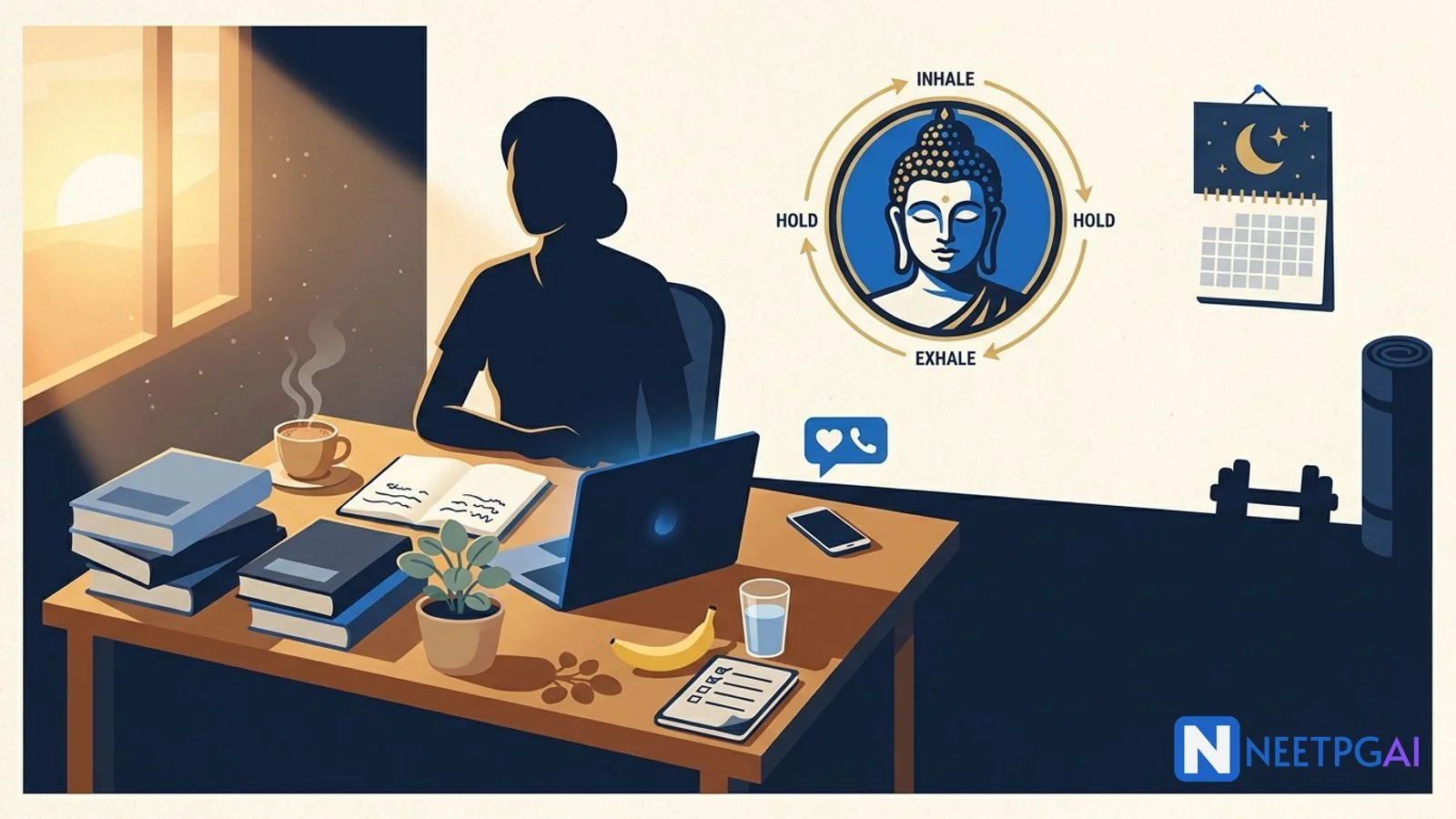
Box breathing (square breathing)
The most evidence-based acute-anxiety technique. Five minutes of box breathing measurably reduces salivary cortisol, slows heart rate by 10-20 percent, and reduces subjective anxiety.
Technique:
- Inhale slowly through the nose for 4 seconds
- Hold the breath for 4 seconds
- Exhale slowly through the mouth for 4 seconds
- Hold empty for 4 seconds
- Repeat for 5 minutes
Use it before each study session, before each mock, and on exam morning before entering the centre. Practice for 2 weeks before relying on it on exam day — only over-rehearsed routines work under acute stress.
4-7-8 breathing for sleep
A longer-exhalation variant from Andrew Weil. Particularly useful for sleep onset and panic-attack abortion.
- Inhale through nose for 4 seconds
- Hold for 7 seconds
- Exhale slowly through mouth for 8 seconds
- Repeat for 4 cycles initially; build up to 8
The long exhalation activates the parasympathetic nervous system more powerfully than equal-time techniques.
Progressive muscle relaxation (PMR)
Tense and relax muscle groups in sequence. Effective for both acute anxiety and chronic muscle tension that builds up over months of study.
A 10-minute Jacobson PMR sequence:
- Hands and forearms — clench fists for 5 seconds, release for 10 seconds
- Upper arms — bend elbows, tense biceps; release
- Face — squeeze eyes shut, scrunch face; release
- Jaw — clench teeth; release
- Shoulders and neck — shrug to ears; release
- Chest and back — squeeze shoulder blades together; release
- Abdomen — tighten as if expecting punch; release
- Hips and glutes — squeeze; release
- Thighs — straighten legs and tense; release
- Calves and feet — point toes, then flex; release
Do this once daily, preferably before bed. Over weeks the body learns the contrast between tension and relaxation.
Behavioural rehearsal — exam-day simulation
Anxiety thrives on novelty. The single most powerful long-term intervention is rehearsing the exam day so thoroughly that the actual day feels familiar.
- Take 6-10 full-length mock tests in real test-centre conditions before the exam
- Use the same wristwatch, same stationery, same clothes you plan to wear
- Sit at the same time of day as the actual exam
- Mimic the routine — wake-up time, breakfast, travel, breathing, settling in
- Apply the first-pass / mark-and-skip / time-budget strategy
- After each mock: 90-minute debrief, not endless rumination
By the actual exam morning, the routine should be so familiar that anxiety has nothing new to attach to.
Sleep — the single most important variable
Sleep is the substrate on which memory consolidation happens. Cutting sleep does not buy you study time; it cancels the previous day's study. The cognitive science is unambiguous:
- 8 hours of sleep — baseline cognitive performance for adults aged 18-35
- 6 hours — working memory drops 20-30 percent, pattern recognition 15-25 percent, emotional regulation 30-50 percent
- 5 hours or less for several nights — equivalent to legal alcohol intoxication on attention tasks
Sleep hygiene non-negotiables
| Rule | Detail |
|---|
| Fixed schedule | Same bedtime and wake time, ±30 min, including weekends |
| No screens 60 min pre-bed | Blue light suppresses melatonin; if unavoidable use night-shift mode and minimal brightness |
| No caffeine after 2 PM | Half-life 5-6 hours; 200 mg at 4 PM still active at midnight |
| No alcohol pre-bed | Disrupts REM sleep; even one drink reduces sleep quality |
| Cool, dark, quiet room | 18-20 C, blackout curtains, eye mask if needed, ear plugs if noisy |
| Bedroom is for sleep | No studying in bed; preserves the cue association |
| Wind-down ritual | 30-min routine — shower, light reading, journal, breathing |
| Get sun in morning | 10-15 min daylight exposure within 1 hour of waking sets circadian rhythm |
| Exercise — but not in evening | Morning or afternoon; avoid intense exercise within 2 hours of bedtime |
| No late dinners | Finish dinner 2-3 hours before bed |
When you can't sleep
Lying in bed unable to sleep amplifies anxiety. The CBT-I (CBT for insomnia) rule:
- If you can't sleep within 20 minutes, get up
- Read a low-stimulation book or do PMR for 10-15 minutes
- Return to bed when sleepy
- Repeat as needed
- Wake at your fixed time regardless of how poorly you slept
This rebuilds the bed-equals-sleep association.
Power naps
A 20-30 minute afternoon nap improves cognition without disrupting nighttime sleep. Avoid naps over 30 minutes (sleep inertia) or after 4 PM.
Exercise — the most reliable anxiolytic available
Aerobic exercise has effect sizes comparable to SSRIs for mild-to-moderate anxiety and depression in randomised trials. It is also free, side-effect-free (within reason), and immediately available.
Mechanisms: raised brain-derived neurotrophic factor (BDNF), increased endorphins, downregulated HPA axis, improved sleep architecture, normalisation of circadian rhythm, and a sense of mastery and routine.
Practical prescription for NEET PG aspirants:
- Aim for 150 minutes of moderate aerobic activity per week (e.g., 30 min × 5 days) — brisk walking, jogging, cycling, swimming
- Or 75 minutes of vigorous activity if time-constrained
- Add 2 days of resistance training — bodyweight (push-ups, squats, planks) is fine
- Yoga and pranayama count and have additional cognitive and stress benefits — randomised trials show reduced exam anxiety in medical students
- Schedule it as study sessions — non-negotiable, calendar block, before or after a 90-minute study block as a transition
Even 10-minute walks between Q-banks measurably improve attention and reduce cortisol. The minimum effective dose is much lower than 'I have to start the gym tomorrow' — start with 10 minutes.
Nutrition during NEET PG prep
You cannot out-study a junk diet. Your brain is metabolically expensive — 20 percent of body energy in 2 percent of body mass. The simple rules:
Daily eating principles
- Eat regular home-cooked Indian meals — three meals plus 1-2 light snacks; avoid skipping
- Plate composition — half vegetables, quarter complex carbs (rice, roti, oats, millets), quarter protein (dal, eggs, chicken, fish, paneer), small healthy fat (ghee, nuts, seeds)
- Hydration — 2-3 L water per day; check urine colour (pale straw = adequate)
- Avoid extreme diets during exam preparation — keto, intermittent fasting, drastic calorie cuts can disrupt cognition and mood
- Limit ultra-processed foods — chips, biscuits, sugary drinks, instant noodles cause blood sugar spikes and crashes that worsen attention
Caffeine management
Caffeine is a useful tool when used carefully and a problem when abused.
- Effective dose: 100-200 mg (1-2 cups of coffee or strong tea) gives a measurable cognitive boost without sleep disruption
- Ceiling: 400 mg per day total — beyond this, anxiety and palpitations worsen
- Cutoff: no caffeine after 2 PM (half-life 5-6 hours; the 4 PM coffee is still active at midnight)
- Avoid energy drinks — high caffeine, sugar, and additives; cardiac side effects in young adults
- Don't load up before exam — sudden caffeine increase can cause GI urgency, palpitations, and panic-like symptoms during the exam itself
- Don't suddenly stop the day before the exam — caffeine withdrawal causes headache and fatigue; maintain your usual amount
Foods that genuinely help
- Omega-3 rich foods — fatty fish (salmon, mackerel, Indian sardines), walnuts, flaxseeds, chia
- Complex carbohydrates — millets, oats, brown rice, whole-wheat roti — sustained glucose
- Protein at every meal — supports neurotransmitter synthesis
- Dark leafy greens — folate, magnesium
- Berries and fruits — antioxidants, vitamin C
- Curd / yogurt — gut-brain axis benefits
- Dark chocolate (70 percent +) — flavanols, mood lift; small amounts
Foods to limit
- Excess sugar — energy crashes
- Trans fats and deep-fried foods — chronic inflammation
- Alcohol — sleep disruption, mood effects
- Excess salt — blood pressure, sleep
- Late-night heavy meals — reflux, sleep disruption
Social support — humans need humans
Isolation amplifies stress. Social connection is one of the most reliable predictors of resilience under high-stress exam preparation.
Concrete actions:
- Maintain 1-2 close peer relationships — study partners or simply friends to talk to weekly; 30 minutes of honest conversation reduces cortisol
- Stay connected with family — daily 10-minute call with parents/siblings; they know you well and can spot warning signs you can't see
- Avoid toxic comparison environments — WhatsApp groups full of 'I scored 280 on Marrow Grand' messages serve no purpose; mute or leave them in the final 6 weeks
- Limit social media — Instagram and Twitter scrolling in study breaks worsens mood, distorts comparison, and destroys focus. 30 min/day cap with app limits
- Find one trusted person to confide in — therapist, mentor, senior, faculty member
- Help others occasionally — explaining a concept to a junior, teaching a topic to a peer, brief volunteer work — boosts self-efficacy and mood
If you live alone, make calls, video meals, or weekly outings non-negotiable.
When to seek professional help
Self-help is the first line. Professional help is the second line, and there is nothing weak or shameful about needing it. Indian medical students have higher rates of depression and suicide than the general population; early professional support is life-saving.
Seek professional support if any of the following are present:
- Persistent low mood, hopelessness, or anhedonia for over 2 weeks
- Sleep disruption (insomnia or hypersomnia) for over 2 weeks despite sleep hygiene
- Appetite or weight changes over 5 percent
- Inability to concentrate for any sustained period
- Recurring panic attacks
- Persistent physical symptoms with negative medical workup
- Withdrawal from family and friends
- Use of alcohol or other substances to cope
- Self-harm behaviour
- Any thoughts of suicide or self-harm — contact a helpline TODAY
India-specific resources
| Resource | Number / link | Notes |
|---|
| iCALL helpline (TISS Mumbai) | 9152987821 | 8 AM-10 PM, multilingual, free, anonymous |
| Vandrevala Foundation | 1860-2662-345 | 24x7, free, anonymous |
| NIMHANS Bengaluru helpline | 080-46110007 | NIMHANS is the apex mental health institute in India |
| AASRA | 9820466726 | 24x7 suicide prevention, anonymous |
| Snehi | 91-22-2772 6771 | Mumbai-based, 24x7, multilingual |
| Sneha India (Chennai) | 044-2464 0050 | 24x7, suicide prevention |
| Sumaitri (Delhi) | 011-2338 9090 | 2-10 PM |
| Manas Foundation (Delhi NCR) | 011-26864488 | Online and offline therapy |
| Your college MBBS / faculty counsellor | Check your institute's mental health cell | Free for students; many institutes now have dedicated cells |
| Practo, Manastha, BetterLYF, YourDOST, Wysa, Mfine | Apps and websites | Online therapy, often subsidised for students |
Many state governments now have helplines (Tele-MANAS — national mental health helpline 14416 / 1-800-891-4416, 24x7, multilingual).
Reducing stigma — what to remember
Asking for help is a clinical decision, not a character judgement. Doctors are at higher risk because we work in high-stress environments and are trained to be 'strong'. Recognising your own limits is professional maturity. Seeking help models good behaviour for your future patients. None of this goes on your medical record or affects residency selection.
Mistakes aspirants make with their mental health
Mistake 1: Using anxiety as a 'study fuel'. Anxiety produces a temporary spike in attention but degrades retention and increases burnout risk. Sustainable studying is not anxiety-driven — it is routine-driven.
Mistake 2: Skipping sleep, exercise, or meals to 'study more'. Each of these has the largest effect size on cognitive performance of any intervention. Cutting them is not a discount; it's a deficit.
Mistake 3: Comparing mock scores publicly. WhatsApp leaderboards, study-group rankings, and Instagram countdowns inflate anxiety with zero learning benefit. Mute or leave.
Mistake 4: Self-medicating with alcohol, cannabis, or unprescribed sedatives. Alpha-blockers, benzodiazepines, propranolol — these are sometimes used by students for exam-day anxiety. Do not self-prescribe. If beta-blockade is appropriate, discuss with a physician.
Mistake 5: Isolating from family and friends. 'I'll talk to people after the exam' is a recipe for spiralling rumination. Stay connected.
Mistake 6: Ignoring early warning signs. Two weeks of poor sleep, appetite loss, or persistent low mood is the time to seek help, not 'wait and see'. Early intervention works far better than crisis intervention.
Mistake 7: Believing 'real doctors don't need therapy'. Many of the most successful clinicians use therapy as a routine career tool. It is professional development, not weakness.
A daily mental-health protocol you can copy
A practical routine that takes <30 minutes per day and front-loads resilience:
| Time | Action |
|---|
| 6:30 AM | Wake; 10 min sunlight + 5 min box breathing |
| 7:00 AM | Balanced breakfast (eggs/poha/upma + fruit + tea/coffee) |
| 7:30 AM-12:00 PM | Study block 1 — 90-min Pomodoro with 10-min walking breaks |
| 12:30 PM | Lunch (home-cooked) + 15 min family / friend call |
| 1:00 PM | 20-min nap (optional, before 4 PM) |
| 2:00-6:00 PM | Study block 2 — Q-bank focused; 10-min movement breaks every 90 min |
| 6:00 PM | 30-min exercise (run / cycle / yoga) |
| 7:00 PM | Shower + dinner (light, balanced, before 8 PM ideally) |
| 8:00-9:30 PM | Study block 3 — revision and high-yield notes |
| 9:30 PM | Wind down — no screens, journal 5 min, 5 min PMR |
| 10:00 PM | Lights out — aim for 8 hours (wake 6:30 AM) |
Build in one weekly half-day off — outdoor activity, family meal, time with friends, or simply rest. Consistent recovery prevents the burnout that sabotages the final month.
Exam-day mental-health protocol
The single most important day. The night before:
- Stop studying by 6-7 PM
- Pack admit card, ID, stationery, bottle of water, light snack
- Light dinner; avoid new foods
- 5 min box breathing + 10 min PMR
- Lights out by 10:30 PM; aim for 8 hours
Exam morning:
- Wake on schedule; do not snooze
- 10 min sunlight, 5 min box breathing
- Balanced familiar breakfast 90-120 min before reporting (oats, parathas, idlis, banana)
- Reach centre 60-75 min early
- 5 min box breathing before entering hall
- Glance at one high-yield one-pager you have read 50 times — for confidence, not learning
- Settle, take 3 box breaths, begin
During the exam:
- Apply pre-rehearsed first-pass + mark-and-skip + time-budget strategy — but remember the revised-pattern paper is split into 5 sections (Group A–E), 36 questions each, with a fixed 42-minute timer per section. Each section locks permanently when its 42 minutes run out, so budget ~70 seconds per question inside each block and finish everything you can before the timer closes it — there is no returning to an earlier section
- If anxiety spikes: close eyes for 90 seconds, slow breathing, then return
- Do NOT discuss questions between sections — peer-induced doubt is a big mark-loser
- Hydrate sips, not gulps
After the exam:
- Step away from result discussion for at least 24 hours
- Eat, sleep, talk to family
- Don't run question recall sessions on the same day — retrieval distortion is high
The marathon perspective
NEET PG is one race in a long career. Your specialty, college, and future are partially shaped by this exam — but not solely defined by it. Many doctors who didn't crack their preferred branch first attempt now lead the specialties they did crack. Many who didn't get their preferred college are doing brilliant work where they trained. The exam matters, but it is not the only data point in your career trajectory.
Protect your mental health like you would protect your patients' — proactively, systematically, without shame. Sleep, eat, move, breathe, connect, and seek help when needed. Your knowledge, your future patients, and your future self will thank you for it.
Frequently Asked Questions
Is some exam anxiety actually helpful for NEET PG performance?
Yes — moderate anxiety improves performance through the inverted-U relationship described by the Yerkes-Dodson law. A small adrenaline-driven arousal sharpens attention, accelerates pattern recognition, and improves recall under time pressure. The problem is when anxiety crosses the inflection point and becomes counterproductive — physical symptoms dominate, working memory crashes, and re-reading the same MCQ stem three times consumes time without comprehension. The skill is not to eliminate anxiety but to keep it in the productive zone through breathing, sleep, and pre-rehearsed routines.
How do I tell test anxiety apart from clinical anxiety disorder needing professional help?
Test anxiety is situation-specific, time-limited, and resolves after the exam. Clinical anxiety disorder persists across contexts (not just exams), causes physical symptoms most days for over six months, interferes with sleep and appetite outside exam periods, includes panic attacks unrelated to specific triggers, or is associated with persistent low mood, hopelessness, or suicidal thoughts. Red-flag features that mandate professional consultation: sleep disruption for over two weeks, weight loss over 5 percent, persistent palpitations or chest pain, suicidal ideation, derealisation, or inability to study for hours despite trying. If any of these are present, contact a counsellor, psychiatrist, or a helpline (iCALL 9152987821, Vandrevala 1860-2662-345, NIMHANS 080-46110007) within 24 hours.
What breathing exercise is most effective for acute exam anxiety?
Box breathing (also called square breathing) is the simplest evidence-based technique used by special-forces operators and tested in randomised trials of pre-exam anxiety. Inhale slowly through the nose for 4 seconds, hold the breath for 4 seconds, exhale slowly through the mouth for 4 seconds, hold empty for 4 seconds, then repeat. Five minutes of box breathing reduces salivary cortisol, lowers heart rate by 10-20 percent, and reduces self-reported anxiety. The longer-exhalation 4-7-8 technique (4 in, 7 hold, 8 out) activates parasympathetic tone more strongly and is particularly useful for sleep onset. Practice the technique daily for two weeks before relying on it on exam day — under acute stress, only over-rehearsed routines work.
How much sleep do I really need during NEET PG preparation?
Adults aged 18-35 need 7-9 hours of sleep nightly, with 8 hours being the consistent finding from cognitive performance studies. Sleep is not 'time off study' — it is when memory consolidation, neural pruning, and prefrontal restoration happen. Cutting from 8 to 6 hours reduces working memory by 20-30 percent, pattern recognition by 15-25 percent, and emotional regulation by even more — every one of which translates directly into exam-day marks. The myth of 'one hour less sleep equals one hour more study' is false: at the 6-hour level, every additional hour of study yields lower retention than the same hour spent sleeping. Protect your sleep schedule like you would protect your DNS server.
When should an Indian medical student seek professional mental health support during NEET PG prep?
Seek professional support if you experience any of these for more than two weeks: persistent low mood or hopelessness, sleep disruption (insomnia or hypersomnia), appetite or weight changes over 5 percent, inability to concentrate for any sustained period, panic attacks, persistent physical symptoms (palpitations, headache, GI), withdrawal from family and friends, or any thoughts of self-harm or suicide. Initial support options in India: campus mental health cell or college counsellor (free for students); iCALL helpline at TISS Mumbai (9152987821, 8 AM-10 PM); Vandrevala Foundation (1860-2662-345, 24x7); NIMHANS Bengaluru helpline (080-46110007); private psychiatrist via apps like Practo, Manastha, YourDOST. Online therapy through platforms like BetterLYF and Wysa is increasingly affordable. There is no stigma in seeking help — Indian medical students have one of the highest rates of depression and suicide globally; early intervention is life-saving.
This content is for educational purposes for NEET PG exam preparation. It is not a substitute for professional medical advice, diagnosis, or treatment. Clinical information has been reviewed by qualified medical professionals.
Written by: NEETPGAI Editorial Team
Reviewed by: Pending SME Review
Last reviewed: May 2026