Version 1.0 — Published February 2026
Quick Answer
Inflammatory bowel disease contributes 2–3 NEET PG questions per paper. Master these 10 high-yield anchors:
- Definition — IBD = chronic, relapsing, immune-mediated intestinal inflammation; two entities: Crohn's disease (CD) and ulcerative colitis (UC)
- Crohn's vs UC — CD: any site (terminal ileum most common), transmural, skip, granulomas (30%), smoking worsens; UC: colon only, continuous from rectum, mucosa/submucosa, smoking protective
- Workup — colonoscopy + ileoscopy + biopsies; fecal calprotectin >250 mcg/g; stool C. difficile + culture; MRE > CTE for small bowel CD; capsule endoscopy if ileoscopy + MRE negative
- UC severity — Truelove-Witts — severe = >=6 bloody stools + 1 systemic (Temp >37.8, HR >90, Hb <10.5, ESR >30); admit + IV steroids
- CD severity — CDAI / HBI — remission CDAI <150; HBI is simplified bedside version
- Mayo score — UC endoscopic + clinical; widely used in trials
- Medical therapy — UC: 5-ASA first-line (oral + topical); CD: mesalamine ineffective; steroids induction; thiopurines / MTX maintenance; biologics: anti-TNF (infliximab, adalimumab), anti-integrin (vedolizumab — gut-selective), anti-IL-12/23 (ustekinumab), anti-IL-23 (risankizumab); JAKi (tofacitinib, upadacitinib)
- Surgery — UC: curative (IPAA or end ileostomy) for failed meds, toxic megacolon, dysplasia, cancer; CD: NOT curative — reserved for complications (stricture, fistula, abscess, obstruction); preserve bowel length
- Extraintestinal — erythema nodosum, pyoderma gangrenosum, episcleritis, uveitis, arthritis, PSC (UC), nephrolithiasis (CD), VTE
- CRC surveillance — colonoscopy 8–10 years after onset (or from PSC diagnosis); every 1–3 years; chromoendoscopy with targeted biopsies
IBD is a classic NEET PG testing ground — compare-and-contrast tables (CD vs UC), severity scores (Truelove-Witts, CDAI), drug mechanisms (anti-TNF vs anti-integrin vs anti-IL-23), and surgical indications. This guide walks through the diagnostic workup, severity stratification, medical ladder, surgical principles, and CRC surveillance. Pair with the medicine subject hub, the medicine high-yield topics overview, and the common mistakes in medicine guide.
Crohn's vs ulcerative colitis — the core comparison
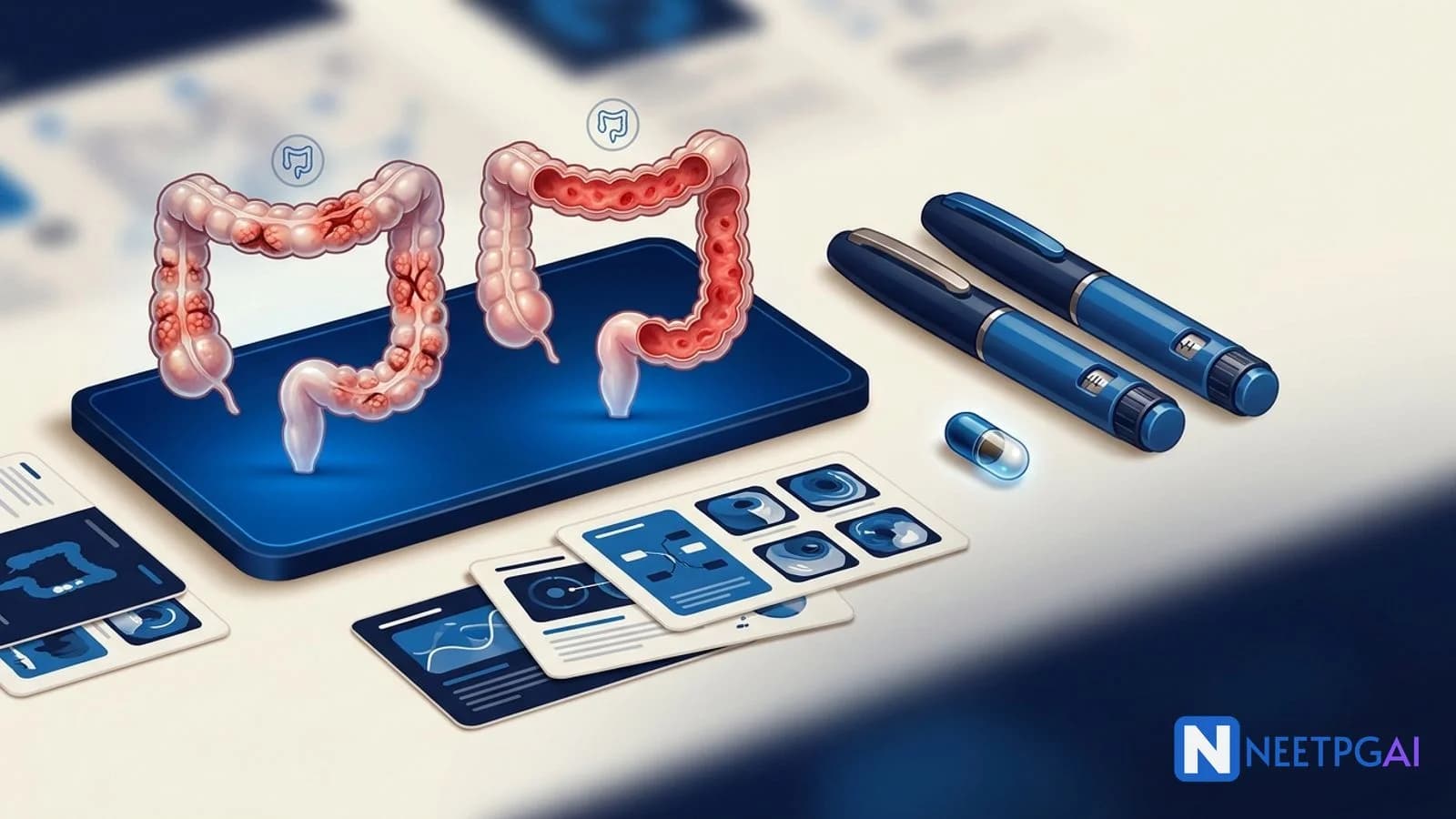
Inflammatory bowel disease is a chronic immune-mediated inflammatory condition of the GI tract comprising Crohn's disease (CD) and ulcerative colitis (UC) — the single most tested NEET PG concept is the feature-by-feature comparison.
| Feature | Crohn's disease (CD) | Ulcerative colitis (UC) |
|---|
| Distribution | Mouth → anus; terminal ileum most common (50%); ileocolonic, small bowel, colonic, perianal | Colon only, from rectum upward; proctitis → left-sided → pancolitis |
| Pattern | Skip lesions, patchy | Continuous, uninterrupted |
| Depth | Transmural (full thickness) | Mucosa and submucosa only |
| Histology | Non-caseating granulomas (30%), crypt distortion, lymphoid aggregates | Crypt abscesses, cryptitis, Paneth cell metaplasia (left colon), mucin depletion |
| Endoscopy | Cobblestone mucosa, aphthous ulcers, linear ulcers, strictures, fistulae | Erythema, loss of vascular pattern, friability, continuous ulceration, pseudopolyps |
| Rectum | Often spared | Always involved (except with topical therapy) |
| Smoking | Worsens (relative risk ~2) | Protective (new diagnoses often post-smoking cessation) |
| Appendectomy | No effect | Protective if done for appendicitis before age 20 |
| Fistula | Common (20–40%) | Rare (except rectovaginal after severe disease) |
| Strictures | Common | Rare (suspect dysplasia/cancer if present) |
| Perianal disease | Common (skin tags, fissures, fistulae, abscess) | Rare |
| Antibodies | ASCA + (60%), p-ANCA − | p-ANCA + (70%), ASCA − |
| Malabsorption | Yes (ileal disease/resection) — B12, bile salts, fat | No (colon only) |
| Nephrolithiasis | Oxalate stones (fat malabsorption → free oxalate absorbed) | Uncommon |
| Cholelithiasis | Increased (ileal bile salt malabsorption) | Normal |
| Primary sclerosing cholangitis | Rare | 3–5% of UC (strong association) |
| Colorectal cancer | Increased in Crohn's colitis | Increased with extent and duration |
Indian epidemiology:
- IBD incidence is rising in India (estimated 1–2 per 100,000 per year for UC; slightly lower for Crohn's)
- Distinguishing Crohn's from intestinal tuberculosis is a crucial NEET PG differential in India
Crohn's vs intestinal TB:
| Feature | Crohn's disease | Intestinal TB |
|---|
| Site | Terminal ileum + colon | Ileocaecal (caecum most common) |
| Ulcers | Longitudinal, aphthous, deep | Transverse, circumferential ("napkin-ring") |
| Granuloma | Non-caseating, small | Caseating, large, confluent |
| AFB | Negative | Positive (~20–30%); PCR, IGRA/Mantoux helpful |
| Chest findings | None | Old TB lesions often |
| ATT trial | No response | Response in 6–8 weeks (diagnostic and therapeutic) |
Diagnostic workup
Diagnosis of IBD is a clinical, endoscopic, histological, and radiological synthesis — no single test is pathognomonic, so multi-modality workup is the standard of care.
Stepwise workup:
- Clinical history and examination — chronic diarrhea (+/− blood), abdominal pain, weight loss, extraintestinal features
- Basic labs — CBC (anaemia of chronic disease / iron deficiency), CRP / ESR, electrolytes, albumin, LFT, TSH
- Stool studies — culture, C. difficile toxin, ova and parasites, fecal calprotectin (>250 mcg/g suggests IBD; <50 usually IBS)
- Serology — ANCA / ASCA (supportive not diagnostic); celiac screening (tTG-IgA)
- Ileocolonoscopy with biopsies — gold standard; multiple biopsies from each segment (2 from terminal ileum, 2 from rectum and each colonic segment, including normal-appearing mucosa for histological skip)
- Upper GI endoscopy — if upper GI symptoms; may reveal upper CD
- Small bowel imaging:
- MR enterography (MRE) — preferred (no radiation, repeatable, equivalent or superior to CTE for strictures, active inflammation, fistulae)
- CT enterography (CTE) — faster, useful acutely (perforation, abscess)
- Capsule endoscopy — mucosal detail in mid-small bowel; contraindicated in suspected stricture unless patency capsule passed first
- Small bowel ultrasound — bedside, no radiation, operator-dependent
- Perianal disease — MRI pelvis; examination under anesthesia (EUA) for fistula mapping
Differential diagnoses to exclude:
- Infectious colitis (Shigella, Salmonella, Yersinia, amoebiasis, CMV, C. difficile)
- Intestinal TB
- Ischaemic colitis
- Radiation colitis
- Microscopic colitis
- Diverticular disease
- Behcet's disease
- Lymphoma
Severity scoring — Truelove-Witts, CDAI, HBI, Mayo
Severity scoring guides setting of care (outpatient vs admission), drug choice, and response monitoring — each disease has validated indices for research and practice.
Truelove-Witts criteria for UC severity (1955 — still in every guideline):
| Parameter | Mild | Moderate | Severe |
|---|
| Bloody stools/day | <4 | 4–6 | >=6 |
| Pulse (bpm) | <90 | <=90 | >90 |
| Temperature (°C) | <37.5 | <=37.8 | >37.8 |
| Hemoglobin (g/dL) | >=11 | 10.5–11 | <10.5 |
| ESR (mm/h) | <20 | <=30 | >30 |
| CRP | Normal | Normal / raised | Raised |
Severe UC — meets stool criterion + at least 1 systemic criterion — requires hospitalisation.
Mayo score for UC (0–12) — clinical + endoscopic — widely used in trials. Includes stool frequency, rectal bleeding, endoscopic findings, physician global assessment (each 0–3).
CDAI (Crohn's Disease Activity Index):
- 7 variables over 7 days: stool frequency, abdominal pain, general wellbeing, extraintestinal, abdominal mass, antidiarrheal use, haematocrit, weight
- <150 remission; 150–220 mild; 220–450 moderate; >450 severe
- Complex; used primarily in clinical trials
Harvey-Bradshaw Index (HBI) — simplified:
| Parameter | Score |
|---|
| General wellbeing | 0 (very well) to 4 (terrible) |
| Abdominal pain | 0 (none) to 3 (severe) |
| Liquid stools/day | Number (1 point each) |
| Abdominal mass | 0 none, 1 dubious, 2 definite, 3 with tenderness |
| Complications (each scored 1) | Arthralgia, uveitis, EN, PG, aphthous ulcer, anal fissure, new fistula, abscess |
- <5 remission; 5–7 mild; 8–16 moderate; >16 severe
- HBI is preferred bedside index
Medical therapy — induction and maintenance
IBD medical therapy is a stepped ladder from aminosalicylates → steroids → immunomodulators → biologics → small molecules — with induction and maintenance regimens customised to disease type and severity.
Ulcerative colitis medical therapy
Mild-moderate UC (outpatient):
| Extent | First-line |
|---|
| Proctitis | Topical mesalamine 1 g suppository OD (more effective than oral); add oral mesalamine if inadequate |
| Left-sided | Topical mesalamine enema 4 g + oral mesalamine 2.4–4.8 g/day |
| Extensive / pancolitis | Oral mesalamine 2.4–4.8 g/day + topical |
| Refractory to 5-ASA | Budesonide MMX 9 mg/day × 8 weeks |
Moderate-severe UC outpatient:
- Oral prednisolone 40–60 mg/day tapered over 8 weeks (induction; never for maintenance)
- Failed steroids or steroid-dependent → biologics
Severe UC (Truelove-Witts severe — inpatient):
- IV hydrocortisone 100 mg every 6 h OR methylprednisolone 60 mg/day
- VTE prophylaxis (IBD flare doubles VTE risk)
- Oxford criteria at day 3: >8 stools/day OR 3–8 stools/day with CRP >45 → 85% colectomy risk → initiate rescue
- Rescue: infliximab 5 mg/kg (can repeat) OR cyclosporine 2 mg/kg/day IV (bridge to thiopurine)
- Surgery if rescue fails or clinical deterioration
UC maintenance:
- 5-ASA (oral ± topical) for 5-ASA-responsive
- Thiopurines (azathioprine 2–2.5 mg/kg) for steroid-dependent
- Biologics / JAK inhibitors for biologic-responsive
Crohn's disease medical therapy
Important NEET PG principle: mesalamine is largely ineffective in Crohn's disease — do not rely on 5-ASA.
Mild-moderate CD:
- Budesonide 9 mg/day × 8 weeks for ileocaecal CD (first-line — less systemic steroid burden)
- Prednisolone for more extensive disease
Moderate-severe CD:
- Oral prednisolone for induction (not maintenance — high relapse)
- Thiopurines or methotrexate 25 mg/week SC for maintenance
- Biologics early in high-risk features: young age at onset, perianal disease, deep ulcers, stricturing or penetrating behavior, extensive small bowel involvement
Fistulising CD:
- Infliximab is first-line biologic
- Combined with antibiotics (ciprofloxacin + metronidazole), seton placement for perianal fistulae
- Surgery for non-healing
Biologics and small molecules — the modern arsenal:
| Class | Agent | Mechanism | Use |
|---|
| Anti-TNF alpha | Infliximab, adalimumab, golimumab (UC only), certolizumab (CD only) | Neutralise TNF | First biologic in CD and UC; fistulising CD |
| Anti-integrin (α4β7) | Vedolizumab | Gut-selective lymphocyte trafficking block | Safer infection profile; slower onset; UC and CD |
| Anti-IL-12/23 (p40) | Ustekinumab | Blocks shared p40 subunit | CD, UC, psoriasis |
| Anti-IL-23 (p19) | Risankizumab, guselkumab | Blocks p19 specifically | Moderate-severe CD and UC (new, favourable safety) |
| JAK inhibitors | Tofacitinib, upadacitinib | Oral small molecule | UC (tofacitinib, upadacitinib); CD (upadacitinib) |
| S1P modulator | Ozanimod | Oral; sequesters lymphocytes | Moderate-severe UC |
| Anti-integrin (α4) | Natalizumab | Non-selective; PML risk (JCV) | CD rarely used |
Pre-biologic screening:
- TB screen (Mantoux/IGRA + CXR)
- Hepatitis B serology (HBsAg, anti-HBc, anti-HBs)
- Hepatitis C
- HIV
- Varicella immunity
- Vaccinations updated (live vaccines contraindicated on biologics)
Thiopurine safety:
- Check TPMT activity or genotype before starting azathioprine (deficiency risks severe myelosuppression)
- Monitor CBC and LFT
- Risk of lymphoma (especially hepatosplenic T-cell lymphoma in young males on thiopurine + anti-TNF)
- Non-melanoma skin cancer risk
Surgical indications and approaches
IBD surgery differs fundamentally between UC and Crohn's — UC surgery is curative, Crohn's surgery is never curative and is reserved for complications.
Ulcerative colitis surgery
Indications:
- Medical refractoriness (failed biologics and steroids)
- Toxic megacolon
- Perforation
- Uncontrolled haemorrhage
- High-grade dysplasia (flat or non-resectable visible)
- Adenocarcinoma
- Steroid dependency
Approaches:
| Procedure | Notes |
|---|
| Total proctocolectomy + end ileostomy | Definitive; single operation; older patients / poor sphincter function / low rectal cancer |
| Total proctocolectomy + IPAA (ileal pouch-anal anastomosis) | Gold standard; usually 2- or 3-stage (with loop ileostomy cover and later closure); preserves continence |
| Subtotal colectomy + end ileostomy | Emergency (toxic megacolon, severe colitis) — faster, safer; second-stage completion later |
IPAA complications:
- Pouchitis — most common long-term complication (40% at 10 years); treat with metronidazole 400 mg TID × 2 weeks or ciprofloxacin; chronic refractory → biologics
- Pelvic sepsis, anastomotic leak
- Cuffitis (residual rectal cuff inflammation)
- Female infertility (increased ~3-fold after pelvic surgery)
- Poor nocturnal continence
Crohn's disease surgery
Indications (complications only):
- Stricturing disease with obstruction
- Enterocutaneous, enterovesical, enteroenteric fistulae causing symptoms
- Intra-abdominal abscess
- Perforation
- Uncontrolled haemorrhage
- Intractable perianal disease
- Medically refractory disease
- Dysplasia or cancer
Principles:
- Preserve bowel length — resect only macroscopically involved segments; positive microscopic margins are acceptable
- Strictureplasty — for short (<10 cm) or multiple strictures, especially in duodenum and jejunum — preserves length
- Laparoscopic preferred when feasible
- Post-operative recurrence at anastomosis is ~70% endoscopic recurrence within 1 year, ~50% clinical recurrence at 10 years
- Post-op prophylaxis: high-risk (smoker, perforating behavior, short disease, >1 prior resection) — anti-TNF or thiopurine; repeat colonoscopy at 6–12 months to guide
Short bowel syndrome — a major concern after multiple Crohn's resections; <200 cm small bowel may cause malabsorption, steatorrhoea, fluid/electrolyte loss, vitamin deficiencies.
Colorectal cancer surveillance in IBD
IBD of the colon (both UC and Crohn's colitis) elevates colorectal cancer risk — surveillance with chromoendoscopy-targeted biopsies is the standard of care, starting 8–10 years after symptom onset.
Risk:
- UC: ~2% at 10 years, ~8% at 20 years, ~18% at 30 years (Eaden meta-analysis 2001)
- Risk rises with: disease duration, extent (pancolitis > left-sided > proctitis), severity of inflammation, family history of CRC, primary sclerosing cholangitis (highest individual risk), post-inflammatory pseudopolyps, stricture
Surveillance:
| Group | Start | Frequency |
|---|
| UC or Crohn's colitis >=1/3 of colon | 8–10 years after symptom onset | Every 1–3 years (risk-based) |
| UC/Crohn's with PSC | At PSC diagnosis | Annual |
| UC proctitis only | — | Not required (no increased risk) |
Technique:
- High-definition white light colonoscopy + chromoendoscopy (indigo carmine or methylene blue dye-spray)
- Targeted biopsies of visible abnormalities
- OR random biopsies (4-quadrant every 10 cm; ~33 biopsies)
- Do surveillance during remission
Findings and response:
| Finding | Action |
|---|
| Low-grade dysplasia (flat, confirmed by 2 GI pathologists) | Colectomy preferred; intensified surveillance (3–6 months) acceptable in select cases |
| High-grade dysplasia | Colectomy |
| Adenocarcinoma | Colectomy (oncological resection) |
| Visible dysplastic lesion, resectable | Endoscopic resection + close surveillance |
| Stricture | Biopsy; cannot exclude malignancy → often colectomy |
Chemoprevention:
- 5-ASA maintenance in UC — observational data suggest reduced CRC risk
- Ursodeoxycholic acid in UC + PSC — controversial (higher doses may harm)
- Folate supplementation — limited evidence
Sources and references
- Harrison's Principles of Internal Medicine, 21st Edition (Loscalzo et al., 2022) — Chapter on Inflammatory Bowel Disease.
- Sleisenger and Fordtran's Gastrointestinal and Liver Disease, 11th Edition (Feldman, Friedman, Brandt, Eds., 2020) — IBD chapters.
- Rubin DT et al. ACG Clinical Guideline: Ulcerative colitis in adults. Am J Gastroenterol 2019; 114:384-413.
- Lichtenstein GR et al. ACG Clinical Guideline: Management of Crohn's disease in adults. Am J Gastroenterol 2018; 113:481-517.
- Eaden JA, Abrams KR, Mayberry JF. The risk of colorectal cancer in ulcerative colitis: a meta-analysis. Gut 2001; 48:526-535.
- Oxford criteria — Travis SP et al. Predicting outcome in severe ulcerative colitis. Gut 1996; 38:905-910.
Frequently asked questions
How many IBD questions appear in NEET PG?
Inflammatory bowel disease contributes 2-3 direct questions per NEET PG paper across medicine, gastroenterology, surgery and pathology. The most tested subtopics are Crohn's vs UC comparison (distribution, depth, granulomas, smoking), Truelove-Witts severity, biologics (anti-TNF, anti-integrin, anti-IL-23), extraintestinal manifestations, toxic megacolon, and colorectal cancer surveillance based on 2019-2025 pattern analysis.
What are the key differences between Crohn's disease and ulcerative colitis?
Crohn's disease affects any part of the GI tract from mouth to anus (terminal ileum most common), is transmural with skip lesions, shows non-caseating granulomas in 30 percent, and is worsened by smoking. Complications include fistulae, strictures, perianal disease. Ulcerative colitis is limited to the colon with continuous inflammation starting from the rectum, confined to mucosa and submucosa (no granulomas), and smoking is protective. Complications include toxic megacolon, colorectal cancer, primary sclerosing cholangitis association. ANCA is positive in 70 percent of UC; ASCA is positive in 60 percent of Crohn's.
What is the diagnostic workup for IBD?
Diagnosis is clinical plus endoscopic plus histological. Colonoscopy with ileal intubation and multiple biopsies is the cornerstone. Fecal calprotectin greater than 250 mcg/g is a sensitive non-invasive marker of intestinal inflammation. Stool culture plus C. difficile toxin rule out infection. For Crohn's small bowel assessment: MR enterography (MRE — preferred — no radiation, good for strictures and fistulae) or CT enterography (CTE — faster, more radiation). Capsule endoscopy for suspected small bowel Crohn's with negative ileoscopy and MRE — contraindicated in suspected stricture unless patency capsule first. UGI endoscopy for upper GI Crohn's.
What is the Truelove-Witts severity for UC?
Truelove-Witts criteria define ulcerative colitis severity based on 6 parameters. Severe UC requires all of: greater than or equal to 6 bloody stools per day, plus at least one systemic sign — temperature greater than 37.8 C, heart rate greater than 90, hemoglobin less than 10.5 g/dL, or ESR greater than 30 mm/h. Severe UC mandates hospital admission, IV hydrocortisone 100 mg every 6 h (or methylprednisolone), VTE prophylaxis, and rescue therapy with infliximab or cyclosporine if no response by day 3 (Oxford criteria — greater than 8 stools/day or CRP greater than 45 at day 3 predicts 85 percent colectomy rate). Colectomy is the definitive rescue.
What are CDAI and Harvey-Bradshaw indices?
Crohn's Disease Activity Index (CDAI) is a complex 7-parameter score incorporating daily stool count, abdominal pain, general wellbeing, extraintestinal findings, abdominal mass, anti-diarrheal use, hematocrit, and weight — remission less than 150, mild 150-220, moderate 220-450, severe greater than 450. Harvey-Bradshaw Index (HBI) is a simplified 5-parameter modification (wellbeing, abdominal pain, liquid stools, abdominal mass, complications) — remission less than 5, mild 5-7, moderate 8-16, severe greater than 16. HBI correlates with CDAI but is quicker for bedside / clinic use. Both inform treatment response.
What are the medical therapy options for IBD?
Mild-moderate UC: 5-ASA (mesalamine — oral plus topical in left-sided) is first-line; topical mesalamine is most effective for proctitis. Budesonide MMX for mild-moderate. Moderate-severe: systemic steroids for induction; thiopurines (azathioprine 2-2.5 mg/kg, 6-MP 1-1.5 mg/kg) for maintenance; biologics (anti-TNF — infliximab, adalimumab, golimumab for UC; vedolizumab — anti-integrin gut-selective; ustekinumab — anti-IL-12/23; risankizumab — anti-IL-23; JAK inhibitors — tofacitinib, upadacitinib). Crohn's: mesalamine ineffective; steroids for induction; thiopurines or methotrexate 25 mg/week SC for maintenance; biologics as above. Methotrexate is effective in Crohn's, ineffective in UC.
What are the surgical indications in IBD?
Ulcerative colitis surgery is curative — proctocolectomy with ileal pouch-anal anastomosis (IPAA) or end ileostomy. Indications: failed medical therapy, toxic megacolon, uncontrolled bleeding, perforation, high-grade dysplasia, or adenocarcinoma. Pouchitis is the most common late complication (40 percent at 10 years) — treat with metronidazole or ciprofloxacin. Crohn's surgery is NOT curative (disease recurs at anastomosis) — reserved for complications: stricturing (strictureplasty or resection — preserve bowel length), fistulizing, abscess, perforation, obstruction, perianal disease. Avoid prophylactic wide resection. Post-resection recurrence at anastomosis occurs in 70 percent within 10 years; anti-TNF is used for post-op prophylaxis in high-risk patients.
What is the colorectal cancer surveillance in IBD?
IBD patients have elevated colorectal cancer (CRC) risk — UC risk rises with duration (2 percent at 10 years, 8 percent at 20 years, 18 percent at 30 years) and with extent (pancolitis highest). Crohn's colitis carries similar risk. Start surveillance colonoscopy with chromoendoscopy 8-10 years after symptom onset (or from PSC diagnosis), then every 1-3 years based on risk (active inflammation, family history, PSC, strictures). Use high-definition white light with chromoendoscopy (dye-spray) targeted biopsies OR random biopsies (4-quadrant every 10 cm). High-grade dysplasia or invisible low-grade dysplasia favors colectomy; visible dysplasia may be endoscopically resected.
What are the extraintestinal manifestations of IBD?
Extraintestinal manifestations affect 25-40 percent of IBD patients. Musculoskeletal: peripheral arthritis (type 1 large joints parallels bowel activity; type 2 small joints independent), sacroiliitis, ankylosing spondylitis (HLA-B27 associated). Cutaneous: erythema nodosum (parallels activity), pyoderma gangrenosum (independent). Ocular: episcleritis (parallels), uveitis (independent). Hepatobiliary: primary sclerosing cholangitis (5 percent of UC; strongest association — cholangiocarcinoma risk), fatty liver, gallstones (ileal Crohn's). Renal: nephrolithiasis (oxalate stones in Crohn's due to fat malabsorption), amyloidosis. Hematological: iron deficiency anemia, VTE risk doubled during flare — prophylax hospitalized patients.
How is toxic megacolon managed?
Toxic megacolon is severe colitis with colonic dilation greater than 6 cm on plain film plus systemic toxicity (fever, tachycardia, hypotension, leukocytosis, altered mentation). Mortality is 15-20 percent. Initial management includes ICU admission, bowel rest with NG decompression, aggressive IV fluids and electrolytes (especially K+), IV steroids (hydrocortisone 100 mg every 6 h), broad-spectrum IV antibiotics (piperacillin-tazobactam), VTE prophylaxis, stop anti-motility agents and narcotics. Surgical consult from the start. If no improvement in 24-48 hours or clinical deterioration, emergency total or subtotal colectomy with end ileostomy is required. Infliximab or cyclosporine rescue may be considered in select stable patients but should not delay surgery.
Convert this into NEET PG marks — revise the medicine high-yield topics overview, cross-check your blind-spots with common mistakes in medicine, and use the AI tutor for biologic MOA drills.
Start practicing IBD MCQs free →
Explore our pricing plans for unlimited practice across all 19 subjects, AI-powered doubt resolution, and personalized study plans.
This content is for educational purposes for NEET PG exam preparation. It is not a substitute for professional medical advice, diagnosis, or treatment. Clinical information has been reviewed by qualified medical professionals.
Written by: NEETPGAI Editorial Team
Reviewed by: Pending SME Review
Last reviewed: February 2026
This article is reviewed by qualified medical professionals for clinical accuracy and exam relevance. For corrections or updates, contact the editorial team.