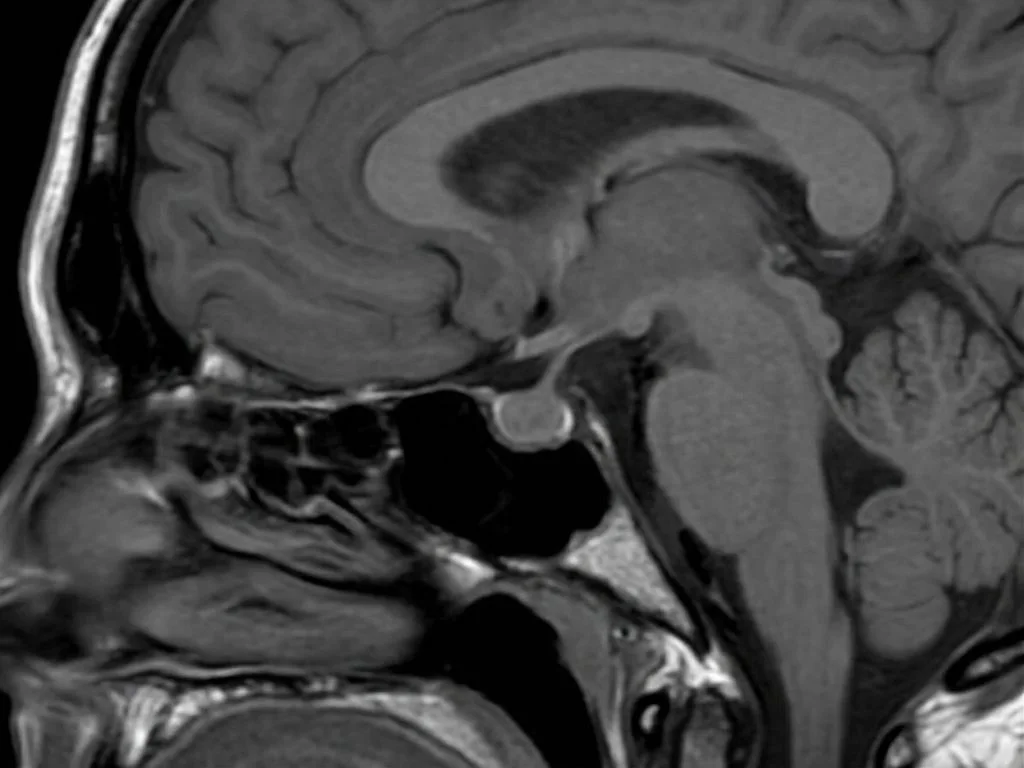
Correct Answer: C. Pituitary DI
The clinical presentation of polyuria (7 L/24 hr), nocturia, enuresis with dilute urine (osmolarity 260 mOsm/L) and low ADH (0.8 pg/ml) points to central (pituitary) diabetes insipidus. The critical discriminator is the absent bright spot on T1-weighted MRI—this represents loss of the posterior pituitary's normal hyperintense signal, indicating ADH-secreting neuron damage or destruction. In pituitary DI, the hypothalamic-pituitary axis fails to produce adequate ADH despite appropriate osmotic stimulus, resulting in nephrogenic unresponsiveness to endogenous hormone. The low ADH level (normal 1–5 pg/ml) confirms inadequate secretion rather than renal resistance. The polyuric, dilute urine pattern with suppressed ADH distinguishes this from nephrogenic DI (where ADH would be elevated as kidneys fail to respond). The absent posterior pituitary bright spot is pathognomonic for central DI caused by pituitary/hypothalamic pathology—trauma, tumour (craniopharyngioma, pituitary adenoma), infiltration (sarcoidosis, histiocytosis), or autoimmune destruction. This finding is the gold standard for confirming the central origin of DI in Indian clinical practice and aligns with Harrison and Robbins classification of DI subtypes.
Why the other options are wrong
A. Mannitol infusion — Mannitol causes osmotic diuresis and polyuria, but it is an acute iatrogenic cause, not a diagnosis explaining chronic symptoms. The absent posterior pituitary bright spot and low ADH level indicate a structural/functional defect in ADH production, not osmotic load. Mannitol infusion would not produce the MRI finding of absent bright spot—this is a trap for students who confuse osmotic diuresis with DI pathophysiology. B. Nephrogenic DI — In nephrogenic DI, the kidneys fail to respond to ADH, so ADH levels would be markedly elevated (>10 pg/ml) as the body attempts to compensate. This patient's ADH is low (0.8 pg/ml), ruling out nephrogenic DI. Additionally, the absent posterior pituitary bright spot indicates a central lesion, not renal pathology. This is a classic NBE trap pairing polyuria with DI without checking ADH levels. D. Primary polydipsia — Primary polydipsia (psychogenic) causes polyuria and dilute urine, but ADH should be suppressed to <1 pg/ml or undetectable due to chronic volume expansion. While this patient's ADH is low, the absent bright spot on MRI is incompatible with primary polydipsia, which has normal pituitary anatomy. The structural finding of absent posterior pituitary signal definitively excludes a purely behavioural/psychiatric diagnosis.
High-Yield Facts
- Posterior pituitary bright spot on T1-weighted MRI is the normal hyperintense signal from ADH-containing neurosecretory granules; its absence indicates central DI.
- ADH <1 pg/ml in polyuric state = central DI; ADH >10 pg/ml in polyuric state = nephrogenic DI.
- 24-hour urine osmolarity <300 mOsm/L with polyuria (>3 L/day) is diagnostic of DI; primary polydipsia typically maintains urine osmolarity >600 mOsm/L.
- Desmopressin (DDAVP) response test: central DI shows urine osmolarity rise >50% after DDAVP; nephrogenic DI shows <10% rise.
- Common causes of central DI in India: pituitary adenoma, craniopharyngioma, head trauma, neurosarcoidosis, lymphocytic hypophysitis.
Mnemonics
DI Diagnosis by ADH Level LOW ADH + Polyuria = Central DI (pituitary problem). HIGH ADH + Polyuria = Nephrogenic DI (kidney problem). Suppressed ADH + Polyuria = Primary polydipsia (behavioural). Use this to rapidly exclude nephrogenic DI when ADH is low. Posterior Pituitary Bright Spot (PPBS) PPBS Present = Normal ADH production possible. PPBS Absent = Central DI (structural lesion). This MRI finding is the single most specific test for confirming pituitary origin of DI.
NBE Trap
NBE pairs polyuria with dilute urine and expects students to reflexively choose nephrogenic DI without checking ADH levels. The trap is that both central and nephrogenic DI present with identical symptoms; the discriminator is ADH level + MRI finding, not clinical presentation alone.
Clinical Pearl
In Indian practice, pituitary DI from craniopharyngioma or pituitary adenoma is common in children and young adults presenting with polyuria and growth failure. The absent bright spot on MRI is the bedside-to-imaging correlation that immediately confirms central origin and guides neurosurgical referral, avoiding unnecessary desmopressin trials in nephrogenic DI where it would be futile.
_Reference: Harrison Ch. 375 (Disorders of the Hypothalamus and Pituitary); Robbins Ch. 24 (Endocrine System)_