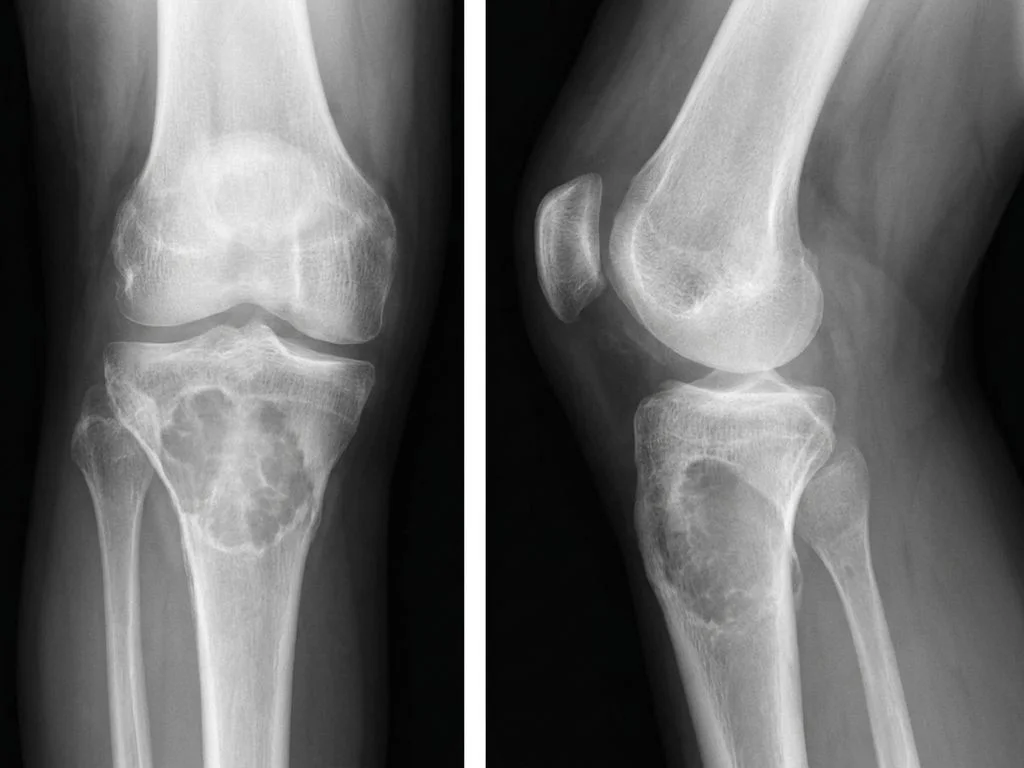
Correct Answer: D. Extended curettage and bone grafting
The clinical presentation of an 18-year-old with painful swelling below the knee joint, combined with radiological findings consistent with a benign aggressive bone lesion (most likely giant cell tumor of bone, given the age and location), mandates extended curettage with bone grafting. This is the gold standard treatment for giant cell tumors of the distal femur or proximal tibia in young patients. Extended curettage involves aggressive removal of the lesion with a wider margin of surrounding bone (typically 1–2 cm), followed by careful inspection of the cavity and burring of the walls to eliminate residual tumor cells. Bone grafting (autograft or allograft) is then performed to restore structural integrity and promote healing. This approach balances tumor control with limb preservation, achieving local recurrence rates of 10–15% in Indian orthopedic practice. Simple curettage alone carries unacceptably high recurrence rates (40–50%), while radical excision (wide or marginal resection) is reserved for aggressive or recurrent lesions, as it sacrifices significant bone stock and functional capacity in a young patient where limb preservation is paramount. The extended technique is recommended by the Indian Orthopedic Association and aligns with international guidelines for benign aggressive tumors in skeletally mature adolescents.
Why the other options are wrong
A. Radiofrequency ablation — This is wrong because radiofrequency ablation is not an established primary treatment for giant cell tumors of bone. While it may have a role in select soft-tissue tumors or as an adjunct in recurrent lesions, it lacks sufficient evidence in Indian orthopedic practice for primary management of benign aggressive bone tumors. The technique does not provide adequate tumor control or structural restoration in this age group. B. Radical excision — This is wrong because radical excision (wide or marginal resection) is unnecessarily aggressive for a benign tumor in a skeletally mature adolescent. Although it offers the lowest recurrence rate, it sacrifices significant bone stock, compromises limb function, and may necessitate reconstruction or prosthetic intervention—unacceptable morbidity in a young patient. Radical excision is reserved for malignant lesions or recurrent giant cell tumors refractory to extended curettage. C. Simple curettage and bone grafting — This is wrong because simple curettage alone, even with bone grafting, carries unacceptably high local recurrence rates (40–50%) due to incomplete removal of tumor cells from the cavity walls. Extended curettage with burring and careful inspection is superior, reducing recurrence to 10–15%. The NBE trap here is that students may conflate 'curettage + grafting' with adequate treatment, missing the critical distinction that extension and meticulous technique are essential.
High-Yield Facts
- Giant cell tumor of bone typically presents in patients aged 20–40 years with a predilection for the distal femur and proximal tibia (epiphyseal/metaphyseal region).
- Extended curettage (aggressive curettage with 1–2 cm margin and burring of cavity walls) is the preferred treatment for benign aggressive bone tumors in young patients, achieving 10–15% local recurrence rates.
- Simple curettage alone has 40–50% recurrence; radical excision is reserved for malignant lesions or recurrent/aggressive tumors refractory to extended curettage.
- Bone grafting (autograft preferred in India due to cost; allograft if unavailable) restores structural integrity and promotes healing after curettage.
- Limb preservation is the primary goal in adolescents and young adults; functional outcome and quality of life take precedence over marginal recurrence rate reduction.
Mnemonics
CURE for GCT Curettage (extended, not simple) + Under vision (burring) + Reconstruction (bone graft) + Examine (inspect cavity). Use this when deciding between simple and extended curettage—extension and meticulous technique are non-negotiable. RADICAL only if RECURRENT RADICAL excision is reserved for RECURRENT or aggressive lesions; benign first-presentation tumors in young patients get EXTENDED curettage. Helps students avoid over-treating and sacrificing limb function unnecessarily.
NBE Trap
NBE pairs 'curettage + bone grafting' across options to trap students who do not distinguish between simple and extended curettage. The cognitive error is assuming that any curettage-based approach with grafting is equivalent, missing the critical technical distinction that extension, burring, and meticulous inspection are what reduce recurrence from 40–50% to 10–15%.
Clinical Pearl
In Indian orthopedic centers, extended curettage with bone grafting for giant cell tumors has become the standard because it preserves limb function in young patients while maintaining acceptable recurrence rates. A 25-year-old with a recurrent lesion after simple curettage may then require radical excision—but the first-line approach in adolescents is always extended curettage with meticulous technique.
_Reference: Bailey & Love Ch. 39 (Orthopedic Oncology); Rockwood & Green's Fractures in Adults (Giant Cell Tumor section)_