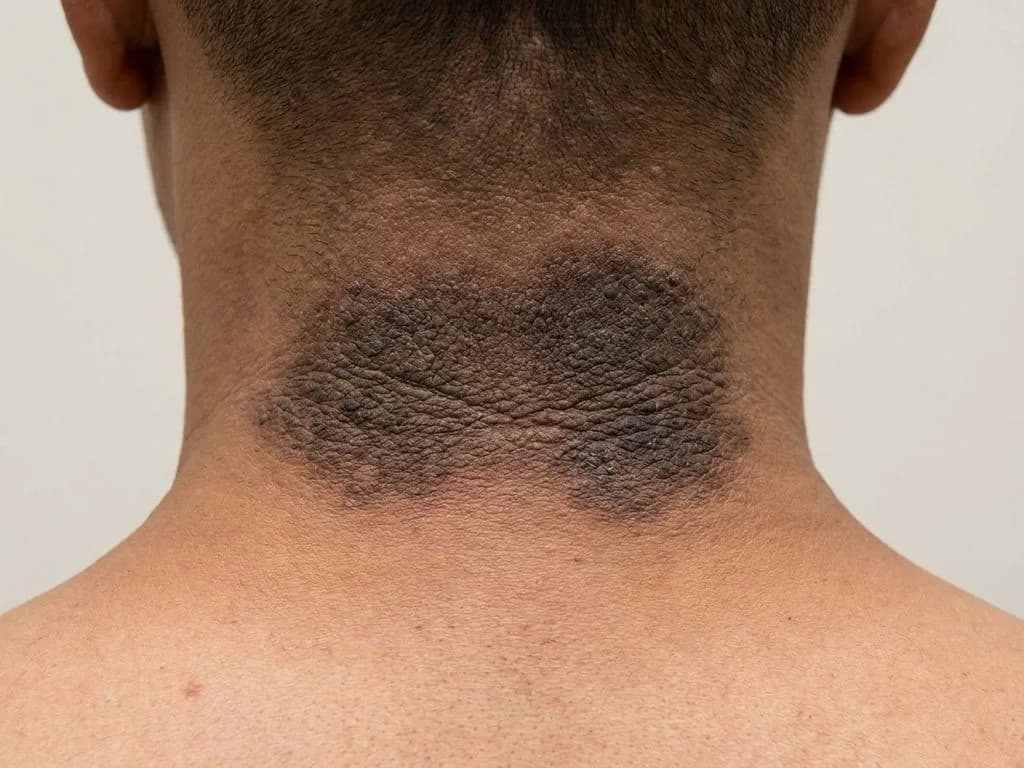
Correct Answer: D. Acanthosis nigrican
Acanthosis nigricans is a paraneoplastic syndrome characterized by velvety, hyperpigmented, thickened skin typically affecting intertriginous areas (neck, axillae, groin, inframammary folds). The pathognomonic feature is the velvety texture with exaggerated dermatoglyphics and dark brown to black discoloration. In India, acanthosis nigricans is most commonly associated with gastric adenocarcinoma (particularly diffuse type), followed by lung, breast, and ovarian malignancies. It can also occur with benign insulin resistance (obesity, PCOS, type 2 diabetes). The condition results from hyperkeratosis and papillomatosis of the epidermis with increased melanin deposition. Histologically, there is acanthosis (thickening of stratum spinosum), papillomatosis, and hyperpigmentation. The presence of acanthosis nigricans in a patient warrants urgent malignancy screening, particularly upper GI endoscopy in the Indian context where gastric cancer prevalence is high. Early recognition can lead to earlier cancer diagnosis and better prognosis.
Why the other options are wrong
A. Dermatomyositis — Dermatomyositis presents with heliotrope rash (purple discoloration of eyelids) and Gottron papules (scaly erythematous papules over knuckles), not velvety hyperpigmentation in intertriginous areas. While both are paraneoplastic, dermatomyositis has characteristic photodistributed erythema and muscle involvement (myositis), absent in acanthosis nigricans. The clinical presentation and distribution are entirely different. B. Melasma — Melasma presents as symmetric brown to gray-brown patches on the face (cheeks, bridge of nose, forehead, upper lip), triggered by UV exposure, hormonal factors (pregnancy, OCP), and genetic predisposition. It lacks the velvety texture, papillomatosis, and intertriginous distribution characteristic of acanthosis nigricans. Melasma is purely cosmetic and has no malignancy association, making it clinically distinct. C. Pityriasis rotunda — Pityriasis rotunda presents as round or oval hyperpigmented patches with fine scale, typically on trunk and extremities, and is associated with malignancy, liver disease, or tuberculosis. However, it lacks the velvety texture, exaggerated dermatoglyphics, and characteristic intertriginous distribution of acanthosis nigricans. The morphology (scaly patches vs. velvety thickening) and distribution pattern are distinctly different.
High-Yield Facts
- Acanthosis nigricans = velvety, hyperpigmented, thickened skin in intertriginous areas (neck, axillae, groin) with exaggerated dermatoglyphics
- Malignancy association in India: gastric adenocarcinoma (most common), followed by lung, breast, ovarian cancers; warrants urgent screening
- Benign causes: insulin resistance, obesity, PCOS, type 2 diabetes, acromegaly — account for ~90% of cases
- Histology: acanthosis (epidermal thickening), papillomatosis, hyperpigmentation; NOT inflammatory
- Paraneoplastic acanthosis nigricans occurs in ~5-10% of gastric cancer patients in India; associated with poor prognosis if malignancy-related
Mnemonics
VELVETY NECK = Acanthosis Nigricans Velvety texture, Exaggerated dermatoglyphics, Large dark patches, Very common in intertriginous areas, Endocrine/malignancy link, Thickened skin, Yellow-brown to black color. Use when you see 'velvety hyperpigmented intertriginous skin' in the stem. GASTRIC CANCER CLUE In India, acanthosis nigricans = think gastric adenocarcinoma first. If a patient presents with velvety neck/axillary skin + GI symptoms, order upper GI endoscopy. This is the highest-yield association in the Indian context.
NBE Trap
NBE may pair acanthosis nigricans with dermatomyositis (both paraneoplastic) to trap students who confuse the two. The key discriminator is distribution and morphology: acanthosis nigricans is intertriginous and velvety; dermatomyositis is photodistributed with heliotrope rash and Gottron papules.
Clinical Pearl
In Indian clinical practice, a patient presenting with velvety hyperpigmented skin in the neck and axillae should trigger immediate malignancy screening, especially upper GI endoscopy for gastric cancer. Early detection of acanthosis nigricans can be a window for early cancer diagnosis, significantly improving outcomes in a high-prevalence setting like India.
_Reference: Robbins Ch. 25 (Skin); Harrison Ch. 52 (Paraneoplastic Syndromes); Sharma & Sharma Dermatology (Acanthosis Nigricans)_