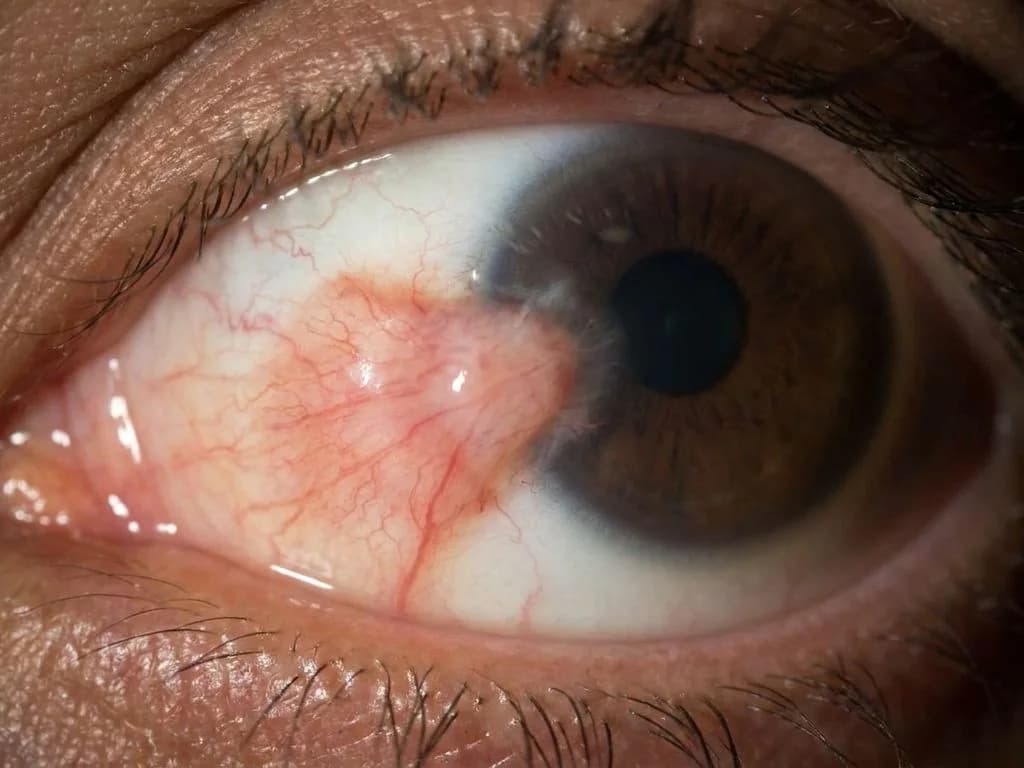
Correct Answer: C. Pterygium
Pterygium is a triangular, fibrovascular proliferation of the conjunctiva that encroaches onto the cornea, typically from the nasal side. The key discriminating feature is corneal involvement — the lesion crosses the limbus and extends onto the corneal surface, which distinguishes it from other conjunctival lesions. Pterygium is extremely common in India due to chronic UV exposure, dry climate, and outdoor occupational exposure. The pathogenesis involves chronic irritation, UV radiation, and conjunctival elastosis. Histologically, it shows fibrovascular tissue with elastotic degeneration. Clinically, patients present with a fleshy, vascularized mass that may cause astigmatism, foreign body sensation, or visual obstruction if it reaches the visual axis. The condition is progressive and may require surgical excision if it threatens vision or causes significant astigmatism. The nasal location and corneal encroachment are pathognomonic features that make pterygium the diagnosis when a triangular conjunctival mass crossing the limbus is visualized.
Why the other options are wrong
A. Lacrimal Concretions — Lacrimal concretions are calcified deposits within the lacrimal drainage system or conjunctival sac, appearing as small white or yellowish stones. They do not form a triangular vascularized mass and do not cross the limbus onto the cornea. This is a trap for students who confuse any conjunctival lesion with lacrimal pathology. B. Pinguecula — Pinguecula is a yellowish, non-vascularized, elastotic degeneration of the conjunctiva that does NOT cross the limbus or involve the cornea. While both pinguecula and pterygium result from UV damage, pinguecula remains confined to the interpalpebral conjunctiva and lacks the fibrovascular proliferation and corneal invasion characteristic of pterygium. NBE often pairs these two to test understanding of the critical difference: corneal involvement. D. Bitot's Spots — Bitot's spots are small, foamy, triangular patches on the temporal conjunctiva caused by vitamin A deficiency, appearing as keratinized epithelial debris. They are pathognomonic for xerophthalmia and are not vascularized fibrovascular masses. They do not encroach onto the cornea and are associated with systemic vitamin A deficiency, not UV exposure.
High-Yield Facts
- Pterygium crosses the limbus and invades the cornea; pinguecula does not — this is the single most important discriminating feature.
- Nasal location is typical for pterygium; temporal pterygium is rare and suggests occupational exposure or unusual UV patterns.
- UV exposure and dry climate are the primary risk factors; pterygium is endemic in tropical and subtropical regions including India.
- Astigmatism induction occurs when pterygium reaches the visual axis, causing irregular corneal surface and refractive error.
- Surgical excision is indicated when pterygium threatens vision, causes significant astigmatism, or causes cosmetic concern; recurrence rate is 15–50% depending on technique.
Mnemonics
PPP Rule: Pterygium vs Pinguecula Pterygium = Progressive, Passes limbus (crosses onto cornea). Pinguecula = Permanent, Prevented by limbus (stays on conjunctiva). Use this when you see a lesion at the limbus — ask 'Does it cross?' If yes → pterygium. WING Mnemonic for Pterygium Features Wide base at limbus, Invasion of cornea, Nasal origin, Growth from UV exposure. Helps recall the classic presentation in Indian patients with outdoor occupations.
NBE Trap
NBE commonly pairs pterygium with pinguecula to test whether students understand that corneal invasion is the discriminating feature. Students who only remember "both are UV-related conjunctival lesions" will incorrectly choose pinguecula if the image clearly shows limbal crossing.
Clinical Pearl
In rural and outdoor-working Indian populations, pterygium is so common that it is often overlooked until it causes visual symptoms. A patient presenting with progressive astigmatism and a nasal conjunctival mass should raise immediate suspicion for pterygium; early surgical intervention can prevent corneal scarring and vision loss.
_Reference: Robbins Ch. 29 (Conjunctiva); Harrison Ch. 427 (Ophthalmology); Bailey & Love Ch. 38 (Eye)_