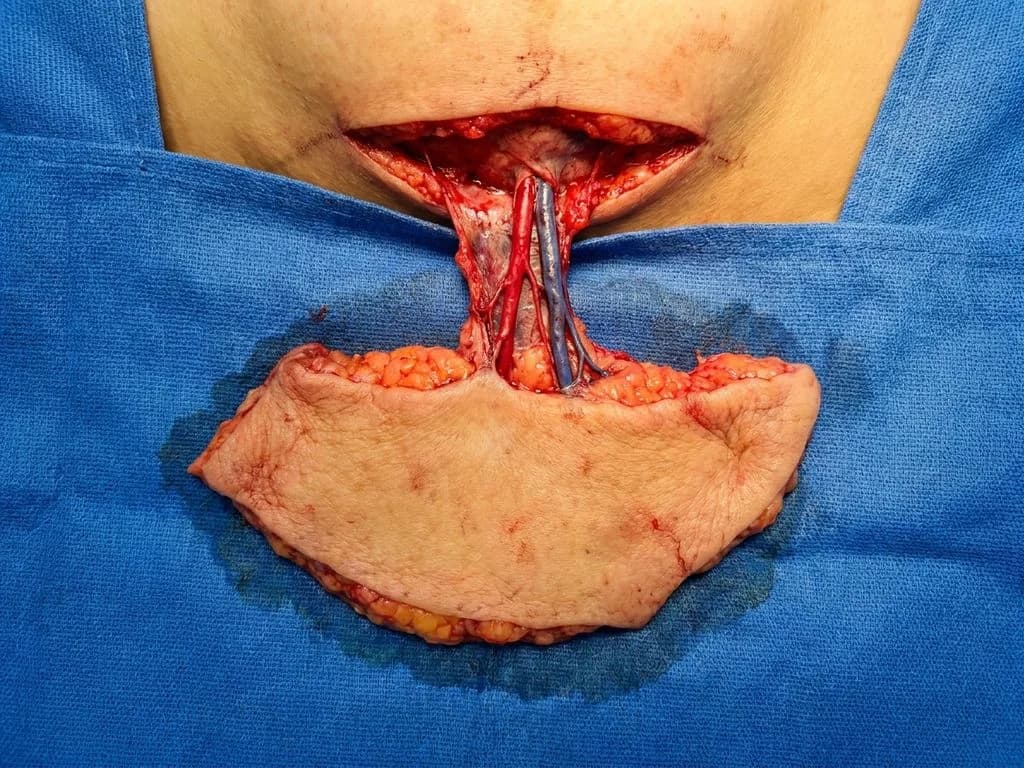
Correct Answer: A. DIEP based on deep inferior epigastric artery
The DIEP (Deep Inferior Epigastric Perforator) flap is a free tissue transfer based on the deep inferior epigastric artery and vein, which are branches of the external iliac vessels. This flap is harvested from the lower abdomen, preserving the rectus abdominis muscle and anterior rectus sheath—a critical distinction from the TRAM flap. The DIEP uses only the perforating vessels that penetrate the rectus muscle to supply the overlying skin and fat, making it a pure perforator flap. In Indian breast reconstruction practice (post-mastectomy for breast cancer), the DIEP has become increasingly popular because it avoids muscle harvest, reducing donor-site morbidity such as abdominal wall weakness, hernia formation, and loss of core strength—concerns particularly relevant in Indian women who often perform heavy manual labor. The flap is transferred as a free tissue transfer requiring microsurgical anastomosis to recipient vessels (typically internal mammary or thoracodorsal vessels). The deep inferior epigastric system provides reliable, large-caliber vessels suitable for microsurgery, making DIEP the gold standard for autologous breast reconstruction when expertise and resources are available.
Why the other options are wrong
B. Pedicled TRAM based on superior epigastric artery — Pedicled TRAM is indeed based on the superior epigastric artery (a branch of the internal mammary artery), but it is NOT the flap shown. Pedicled TRAM requires harvest of the rectus abdominis muscle itself, not just perforators, and is transferred on a vascular pedicle without requiring microsurgery. This option confuses the vascular anatomy and flap type—DIEP is a free perforator flap, not a pedicled muscle flap. C. Free TRAM based on superior and inferior epigastric artery — Free TRAM does use both superior and inferior epigastric vessels, but it requires harvest of the entire rectus abdominis muscle, not just the perforating vessels. The question specifies a flap based on the deep inferior epigastric artery alone, which is the hallmark of DIEP. Free TRAM causes greater donor-site morbidity than DIEP due to muscle removal, making it less preferred in modern Indian practice. D. Lower Abdominal Fat based inferior epigastric vessels — While this option correctly identifies the inferior epigastric vessels and lower abdominal location, it lacks the specific anatomical precision required. 'Lower Abdominal Fat' is vague and does not define the flap type. DIEP is specifically a perforator flap based on deep inferior epigastric perforators—the distinction between perforators and the main vessel trunk is critical in modern flap classification.
High-Yield Facts
- DIEP flap is a free perforator flap based on deep inferior epigastric artery and vein, preserving the rectus abdominis muscle.
- Muscle preservation in DIEP reduces donor-site morbidity (hernia, weakness) compared to TRAM, critical in Indian women with high physical labor demands.
- Microsurgical anastomosis is required for DIEP transfer; typically to internal mammary or thoracodorsal vessels in breast reconstruction.
- Superior epigastric artery supplies pedicled TRAM; inferior epigastric artery supplies free TRAM and DIEP—different vascular sources.
- DIEP is the gold standard for autologous breast reconstruction in centers with microsurgical expertise in India.
Mnemonics
DIEP vs TRAM: Muscle Rule DIEP = Don't take muscle (Perforators only). TRAM = Take Rectus Abdominis Muscle. Use when distinguishing flap types in breast reconstruction. Epigastric Artery Memory Superior = Superior TRAM (pedicled). Inferior = Inferior TRAM (free) or DIEP (free perforator). Use when asked about vascular source.
NBE Trap
NBE may pair TRAM and DIEP together to trap students who know both flaps use abdominal tissue but confuse the vascular anatomy (superior vs. inferior epigastric) and the critical distinction between muscle-based (TRAM) and perforator-only (DIEP) flaps. The presence of "epigastric artery" in multiple options is a classic distractor.
Clinical Pearl
In Indian breast cancer centers, DIEP has replaced TRAM as the preferred autologous flap for post-mastectomy reconstruction because it avoids the abdominal wall weakness and hernia risk that significantly impact quality of life in women who perform manual labor—a common scenario in rural and semi-urban India.
_Reference: Bailey & Love Ch. 58 (Plastic and Reconstructive Surgery); Harrison Ch. 344 (Principles of Reconstructive Surgery)_