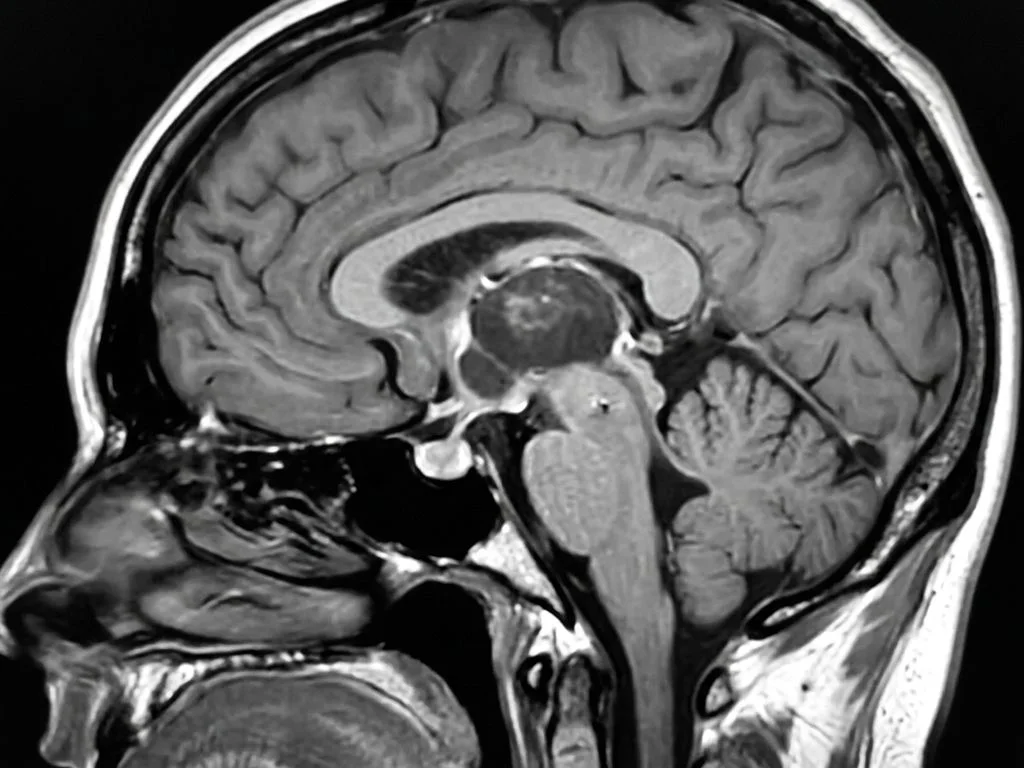
Correct Answer: D. Craniopharyngioma
Craniopharyngioma is the classic suprasellar cystic lesion with calcification on imaging. This tumor arises from remnants of Rathke's pouch (embryological origin from the oral ectoderm) and is the most common suprasellar mass in children, though it can present at any age. The pathognomonic imaging finding is a cystic lesion with calcification in the suprasellar region—this combination is virtually diagnostic. On MRI, craniopharyngiomas typically show mixed signal intensity with both solid and cystic components; calcification appears as hypointense foci on T2-weighted sequences. The cyst often contains cholesterol-rich fluid ("machine oil" appearance on CT). Clinically, patients present with visual disturbances (bitemporal hemianopsia from optic chiasm compression), endocrine dysfunction (growth hormone deficiency, hypogonadism), and headaches. In the Indian context, craniopharyngioma is a common neurosurgical referral and the differential diagnosis for any child with growth failure and visual symptoms. The combination of suprasellar location + cystic morphology + calcification makes craniopharyngioma the only reasonable answer among the options provided.
Why the other options are wrong
A. Meningioma — Meningiomas are solid, dural-based tumors that enhance homogeneously with contrast. They do not typically present as cystic lesions with calcification in the suprasellar region. While meningiomas can occur in the sellar/suprasellar region, they are firm, well-demarcated masses arising from dura, not cystic structures. Calcification in meningiomas is rare and when present appears as coarse calcification, not the fine stippled pattern seen in craniopharyngioma. B. Pituitary adenoma — Pituitary adenomas are intrasellar masses arising from the anterior pituitary gland itself. They are typically solid, homogeneous lesions that enhance uniformly with gadolinium. While they may have cystic degeneration, calcification is extremely rare in pituitary adenomas. The classic location is intrasellar (within the sella turcica), not suprasellar, and the imaging appearance is distinctly different—no calcification pattern. C. Oligodendroglioma — Oligodendrogliomas are intraparenchymal brain tumors that arise within the cerebral hemispheres (typically frontal lobe), not in the suprasellar region. While they can show calcification ('calcified glioma'), they do not present as suprasellar cystic masses. Their location, imaging characteristics (cortical/subcortical), and clinical presentation (seizures, focal neurological deficits) are entirely different from craniopharyngioma.
High-Yield Facts
- Craniopharyngioma = suprasellar cystic lesion with calcification (pathognomonic imaging finding).
- Rathke's pouch origin explains embryological derivation from oral ectoderm; explains why it occurs in suprasellar region.
- Bitemporal hemianopsia is the classic visual presentation due to optic chiasm compression from above.
- Bimodal age distribution: peak in children (5–14 years) and adults (50–74 years); common pediatric neurosurgical referral in India.
- Cyst contents are cholesterol-rich ('machine oil' on CT); calcification is fine and stippled, not coarse.
- Endocrine dysfunction (GH deficiency, hypogonadism, hypothyroidism) occurs due to pituitary stalk compression.
Mnemonics
CRANK for Craniopharyngioma imaging Cystic, Rathke's pouch origin, Above sella (suprasellar), No enhancement (cyst), Kalcification. Use when you see suprasellar cyst + calcification. Suprasellar masses: SACCADE Suprasellar meningioma, Aneurysm, Craniopharyngioma, Chiasmal glioma, Arachnoid cyst, Diencephalic glioma, Epidermal cyst. Craniopharyngioma is the only one with calcification + cyst.
NBE Trap
NBE may pair "cystic lesion" with pituitary adenoma (which can undergo cystic degeneration) to trap students who forget that calcification is the discriminating feature. Craniopharyngioma is the ONLY suprasellar mass with both cyst AND calcification together.
Clinical Pearl
In Indian pediatric practice, any child presenting with growth failure, visual complaints, and headaches should trigger imaging for craniopharyngioma. The combination of suprasellar cyst + calcification on MRI is virtually diagnostic and warrants urgent neurosurgical consultation for transsphenoidal resection, the gold standard treatment in Indian tertiary centers.
_Reference: Robbins & Cotran Pathology of the Nervous System (Ch. 28); Harrison Principles of Internal Medicine Ch. 375 (Pituitary Disorders); Bailey & Love's Short Practice of Surgery Ch. 53 (Neurosurgery)_