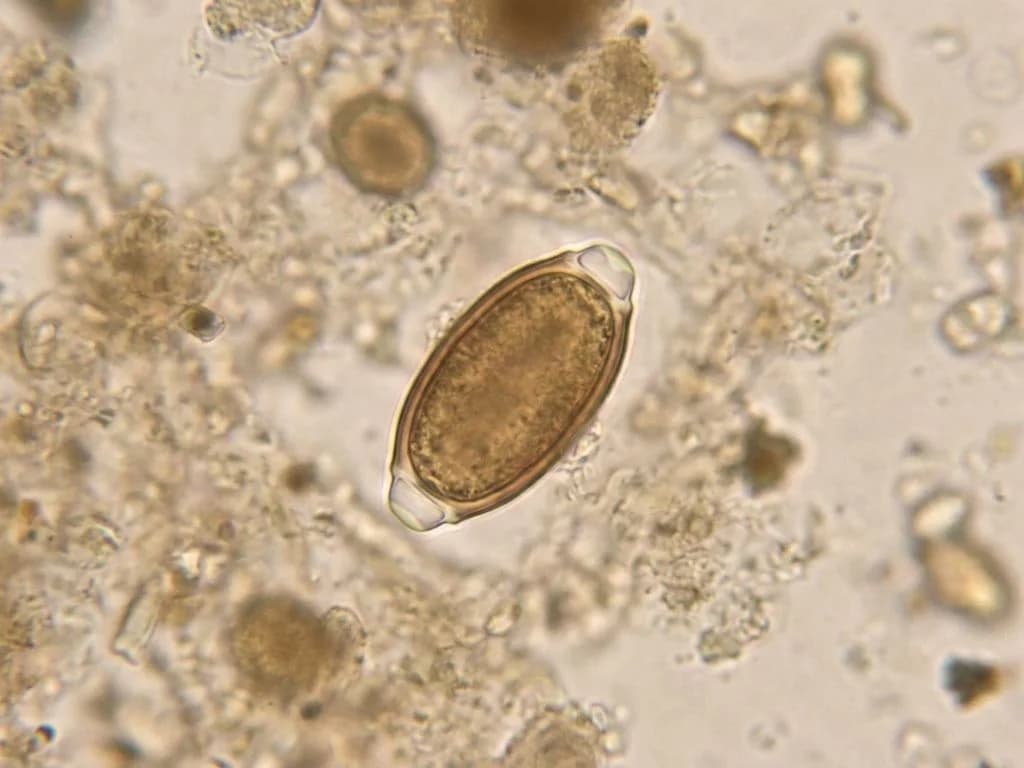
Correct Answer: B. Trichuris trichiura
Trichuris trichiura (whipworm) is the correct answer because it produces the pathognomonic barrel-shaped or lemon-shaped egg with bipolar mucoid plugs (opercula) at both ends, which is the distinctive morphology shown in the image. This egg is passed in stool and is immediately infectious in soil within 2–4 weeks under warm, moist conditions. T. trichiura is endemic in India, particularly in rural areas with poor sanitation, and is transmitted via fecal-oral route through contaminated soil (geophagia, unwashed vegetables, contaminated water). The adult worms reside in the cecum and colon, causing trichuriasis. The characteristic barrel-shaped egg with polar plugs is the gold standard for diagnosis on stool microscopy. Unlike hookworms (which have thin-shelled, oval eggs) or Ascaris (which has thick-shelled, mammillated eggs), Trichuris has this unique morphology that makes it instantly recognizable in Indian medical education and clinical practice.
Why the other options are wrong
A. Ancyclostoma duodenale — Ancyclostoma duodenale (Old World hookworm) produces thin-shelled, oval eggs (60–65 μm × 35–40 μm) that are morphologically distinct from the barrel-shaped egg shown. Hookworm eggs are also less immediately infectious in soil and require 5–10 days for larval development. While both are soil-transmitted, the egg morphology is completely different, making this a clear discriminator. C. Necator americanus — Necator americanus (New World hookworm) also produces thin-shelled, oval eggs similar to Ancyclostoma, not the characteristic barrel-shaped egg with bipolar plugs. Although Necator is less common in India than Ancyclostoma, both hookworms share similar egg morphology that differs fundamentally from Trichuris. This option exploits confusion between hookworm species. D. Ascaris lumbricoides — Ascaris lumbricoides produces thick-shelled, mammillated (bumpy) eggs (55–75 μm × 35–50 μm) with a characteristic rough, warty surface. These are easily distinguished from the smooth, barrel-shaped Trichuris egg with polar plugs. Ascaris eggs are also more resistant to environmental stress and remain viable longer in soil, but the morphology is unmistakable.
High-Yield Facts
- Trichuris trichiura egg: barrel-shaped or lemon-shaped with bipolar mucoid plugs (opercula) at both ends—pathognomonic morphology on stool microscopy.
- Soil transmission: T. trichiura eggs become infectious in warm, moist soil within 2–4 weeks; transmitted via fecal-oral route (geophagia, contaminated vegetables).
- Endemic in India: Trichuriasis is highly prevalent in rural India due to poor sanitation; part of the soil-transmitted helminth (STH) burden in children.
- Adult habitat: Trichuris worms reside in the cecum and colon, causing bloody diarrhea, tenesmus, and rectal prolapse in heavy infections.
- Hookworm eggs (Ancyclostoma, Necator): thin-shelled, oval, NOT barrel-shaped—key differentiator from Trichuris.
- Ascaris eggs: thick-shelled, mammillated (warty surface)—distinctly different from smooth Trichuris barrel-shaped egg.
Mnemonics
Trichuris Egg Shape BARREL = Trichuris — Think of a barrel (whip-shaped worm, barrel-shaped egg). Bipolar plugs = two ends of the barrel. STH Egg Morphology (Indian Context) TAB: Trichuris (Barrel), Ascaris (Bumpy/mammillated), Hookworm (Thin oval). Use this to rapidly differentiate the three most common STH in India on stool microscopy.
NBE Trap
NBE pairs soil-transmitted helminths (Ancyclostoma, Necator, Ascaris, Trichuris) together to test whether students can distinguish egg morphology. The trap is confusing Trichuris's barrel-shaped egg with the oval eggs of hookworms or the mammillated eggs of Ascaris—all are soil-transmitted, but only Trichuris has the characteristic bipolar plugs.
Clinical Pearl
In rural India, a child presenting with bloody diarrhea, tenesmus, and rectal prolapse should raise suspicion for heavy Trichuris infection. Stool microscopy showing barrel-shaped eggs with bipolar plugs confirms the diagnosis—this is a common presentation in endemic areas and requires anthelmintic therapy (albendazole or mebendazole) plus nutritional rehabilitation.
_Reference: Jawetz, Melnick & Adelberg's Medical Microbiology Ch. 46 (Helminths); Park's Textbook of Preventive and Social Medicine Ch. 7 (Parasitic Infections); Robbins & Cotran Pathologic Basis of Disease Ch. 8 (Infectious Diseases)_