Correct Answer: B. Immunochromatography
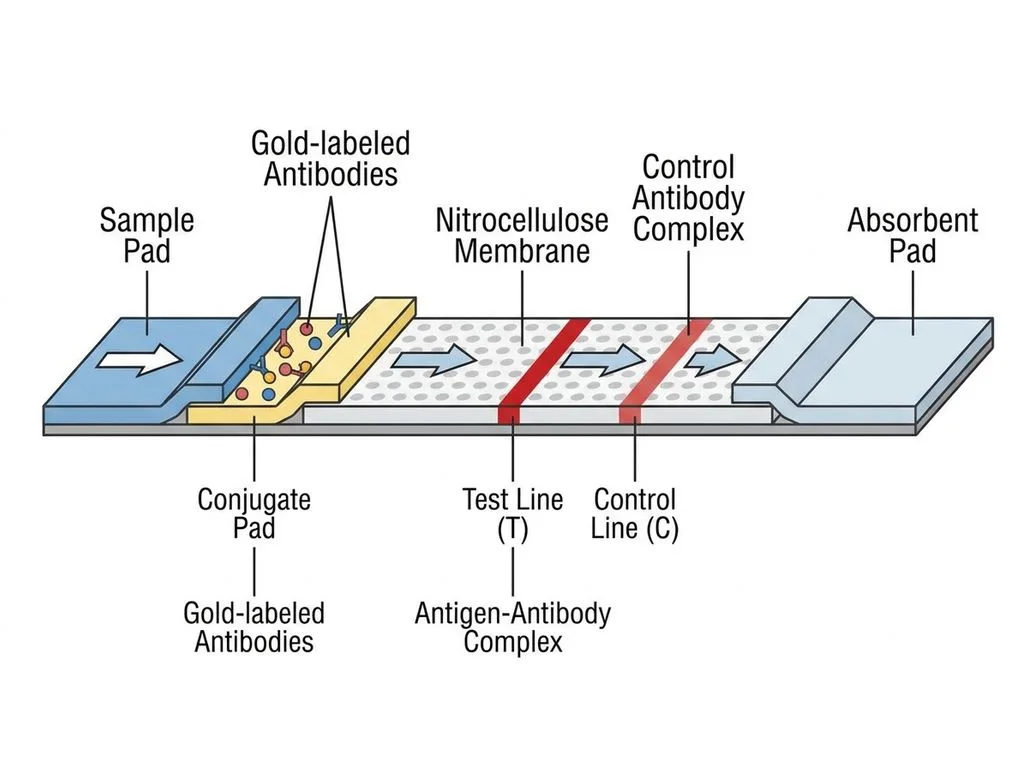
Immunochromatography is a rapid, lateral-flow immunoassay technique that forms the basis of point-of-care diagnostic test kits widely used in Indian clinical practice. The principle relies on the migration of antigen-antibody complexes along a nitrocellulose membrane strip under capillary action. When a sample (serum, urine, or swab) is applied to the sample pad, antigens bind to colloidal gold or latex particle-labeled antibodies. This complex then migrates laterally across the membrane toward the test line, where capture antibodies are immobilized. If antigen is present, a visible colored band appears at the test line; a control line confirms proper test execution. This technology is the basis of rapid diagnostic tests (RDTs) for malaria, dengue, COVID-19, pregnancy (hCG), and rapid plasma reagin (RPR) testing—all routinely performed in Indian primary health centers and laboratories. The test is rapid (5–20 minutes), requires minimal equipment, and is cost-effective, making it ideal for resource-limited Indian settings. Unlike ELISA (which requires incubation and plate readers) or immunofluorescence (which requires fluorescence microscopy), immunochromatography delivers results visually at the point of care.
Why the other options are wrong
A. Immunofluroscence — Immunofluorescence requires conjugation of antibodies with fluorescent dyes (FITC, rhodamine) and visualization under a fluorescence microscope. It is used for tissue/cell-based diagnostics (e.g., ANA testing, direct fluorescent antibody tests for rabies) but cannot be performed on a simple lateral-flow strip kit without specialized optical equipment. The test kit shown is a solid-phase, naked-eye readable format, not a microscopy-based technique. C. ELISA — ELISA (enzyme-linked immunosorbent assay) is a plate-based immunoassay requiring multiple incubation steps, washing steps, and a plate reader to measure optical density. It is labor-intensive, time-consuming (2–4 hours), and requires laboratory infrastructure. While ELISA is gold-standard for many serology tests in India, it is not the principle behind rapid point-of-care test kits that deliver results in minutes with visual interpretation. D. Chemiluminiscence — Chemiluminescence-based assays use enzyme-catalyzed light emission (e.g., horseradish peroxidase with luminol substrate) and require specialized automated analyzers to detect and quantify light output. These are used in high-throughput laboratory analyzers but are not applicable to simple, portable, naked-eye readable test strips used in field or primary care settings.
High-Yield Facts
- Immunochromatography is the principle behind all rapid diagnostic test (RDT) kits: malaria, dengue, COVID-19, pregnancy, and syphilis (RPR) screening in India.
- Lateral-flow principle: antigen-antibody complexes migrate along a nitrocellulose membrane under capillary action; visible colored band = positive result.
- Point-of-care advantage: results in 5–20 minutes without laboratory infrastructure, ideal for RNTCP TB screening and field epidemiology.
- Colloidal gold or latex particles are used as labels in immunochromatography; fluorescent dyes are used in immunofluorescence (different detection method).
- Sensitivity/specificity trade-off: RDTs are rapid and portable but less sensitive than ELISA or culture; used for screening, not confirmation in many diseases.
Mnemonics
RDT = Rapid Diagnostic Test = Immunochromatography Remember: RDT kits (malaria, dengue, COVID, pregnancy) all use lateral-flow immunochromatography. One strip, one sample, one result—no equipment needed. Use this when you see 'test kit' or 'rapid test' in the stem. ELISA vs. Immunochromatography: Lab vs. Field ELISA = plate + incubation + reader (lab-based, gold standard). Immunochromatography = strip + capillary flow + naked eye (field-based, rapid). If the question mentions a 'kit' or 'point-of-care,' think immunochromatography.
NBE Trap
NBE may pair "test kit" with ELISA because both are immunoassays, or with immunofluorescence because both use antibodies. The trap is confusing the principle (lateral-flow chromatography) with the detection method (fluorescence or enzyme). Focus on the physical format: a simple strip = immunochromatography.
Clinical Pearl
In Indian primary health centers and ASHA worker training, rapid malaria and dengue RDTs are the backbone of field diagnosis during monsoon outbreaks. A negative RDT does not rule out disease (sensitivity ~90–95%), so clinical judgment and confirmatory testing (microscopy, PCR) remain essential—especially in high-transmission areas.
_Reference: Jawetz, Melnick & Adelberg's Medical Microbiology Ch. 14 (Immunological Diagnosis); Park's Textbook of Preventive and Social Medicine Ch. 9 (Diagnostic Methods in Epidemiology)_