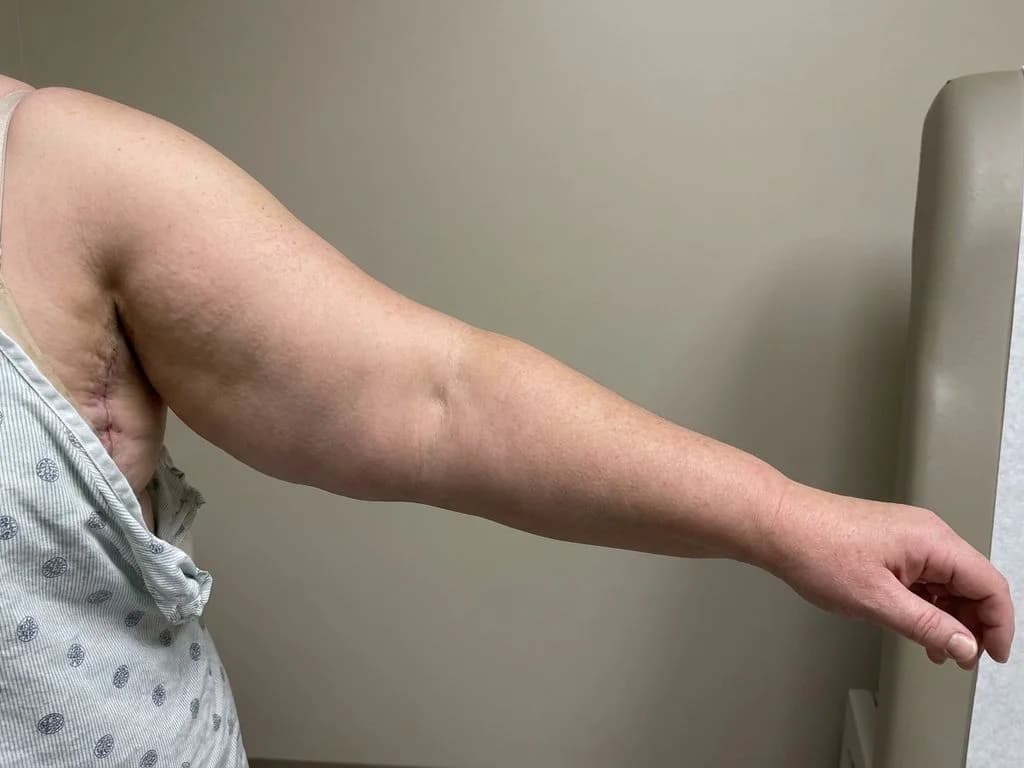
Correct Answer: D. Lymphedema
Lymphedema is the most common complication following breast cancer surgery, particularly after axillary lymph node dissection (ALND). The pathophysiology involves disruption of lymphatic drainage from the upper limb due to removal or damage to axillary lymph nodes and lymphatic vessels during mastectomy and nodal clearance. This leads to accumulation of lymph fluid in the interstitial spaces, causing painless, non-pitting swelling that is typically unilateral and affects the arm, forearm, and hand. The swelling is soft, doughy, and progressive. Risk factors include extensive nodal dissection, radiation therapy, obesity, and infection. In India, where many breast cancer patients present late with advanced disease requiring extensive surgery, lymphedema is encountered frequently in post-operative follow-up. The diagnosis is clinical, based on the characteristic presentation of painless swelling in the ipsilateral arm following breast cancer surgery. Management includes compression garments, physiotherapy, and lymphatic drainage techniques. The condition is chronic and requires long-term management to prevent complications like cellulitis and lymphangiosarcoma.
Why the other options are wrong
A. Cellulitis — Cellulitis presents with painful, erythematous, warm swelling with systemic signs (fever, malaise). The patient's presentation is painless swelling without erythema or systemic features. However, cellulitis can be a complication of chronic lymphedema due to impaired immune drainage, making this a trap for students who confuse the primary diagnosis with secondary complications. B. Venous thrombosis — DVT/venous thrombosis causes painful, acute swelling with calf tenderness, positive Homan's sign, and skin changes. The painless, chronic, progressive nature of swelling and the post-surgical lymph node dissection context point away from venous pathology. This option traps students who focus only on 'arm swelling' without considering the painless, non-acute character. C. Lymphangiosarcoma — Lymphangiosarcoma (Stewart-Treves syndrome) is a rare angiosarcoma that develops as a late complication of chronic lymphedema (typically 10+ years post-surgery). It presents with purple nodules or plaques on the edematous limb and is a malignant transformation, not the primary diagnosis. This is a classic NBE trap—confusing a late complication with the initial presentation.
High-Yield Facts
- Lymphedema incidence post-ALND: 15–40% of breast cancer patients develop arm lymphedema after axillary lymph node dissection.
- Painless, non-pitting swelling is the hallmark of lymphedema; pitting edema suggests venous or cardiac causes.
- Risk factors: Extensive nodal dissection (>10 nodes), radiation therapy, obesity, infection, and cellulitis.
- Stewart-Treves syndrome (lymphangiosarcoma) is a rare malignant complication of chronic lymphedema, not the primary diagnosis.
- Management: Compression therapy, lymphatic drainage, physiotherapy, and infection prevention; no cure, only symptom control.
- Cellulitis in lymphedema: Impaired lymphatic drainage increases infection risk; recurrent cellulitis is a common complication requiring prophylactic antibiotics.
Mnemonics
POST-BREAST SURGERY SWELLING: LYMPH vs OTHERS LYMPH = Late onset, Yellow/pale skin, Massive/progressive, Painless, Heavy feeling. Contrast: Cellulitis = red + hot + painful; DVT = acute + painful + calf tenderness. LYMPHEDEMA COMPLICATIONS (LATE): SCAR Stewart-Treves (angiosarcoma), Cellulitis (recurrent), Arthralgias, Recurrent infections. Remember: Lymphangiosarcoma is a late complication (10+ years), not the primary diagnosis.
NBE Trap
NBE pairs "arm swelling post-breast surgery" with cellulitis or DVT to trap students who focus on acute inflammatory features. The key discriminator is the painless, non-pitting, progressive character of lymphedema versus the painful, acute, erythematous presentation of cellulitis or the acute, painful calf tenderness of DVT.
Clinical Pearl
In Indian breast cancer practice, lymphedema is a major cause of morbidity and reduced quality of life, especially in rural patients who cannot access regular physiotherapy. Early recognition and compression therapy initiation can prevent progression to chronic, disabling edema and reduce the risk of recurrent cellulitis—a common trigger for hospital readmission in our setting.
_Reference: Bailey & Love's Short Practice of Surgery, Ch. 52 (Breast); Robbins Pathology, Ch. 10 (Lymphatic obstruction)_