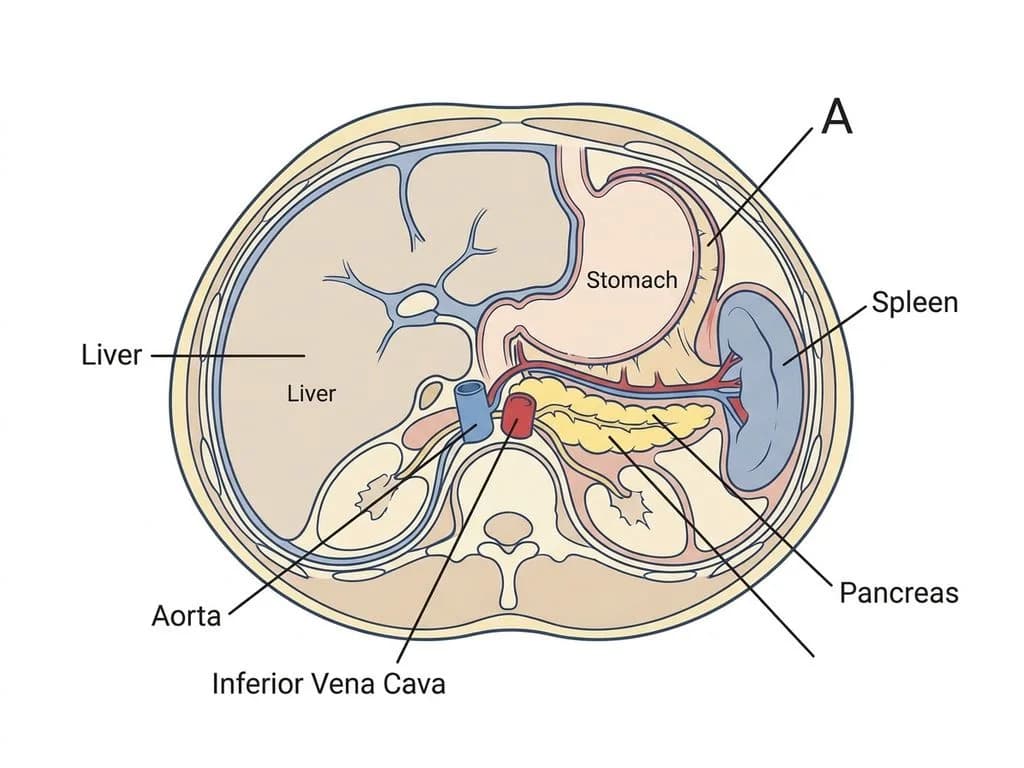
Correct Answer: B. Falciform ligament
The structure marked A in embryological diagrams of the peritoneum is the ventral mesentery (also called ventral mesogastrium). The ventral mesentery is the peritoneal fold connecting the ventral surface of the developing foregut to the anterior abdominal wall. During embryonic development, the ventral mesentery gives rise to two major ligaments: the falciform ligament (connecting the liver to the anterior abdominal wall and diaphragm) and the hepatogastric ligament (part of the lesser omentum, connecting the liver to the lesser curvature of the stomach). The falciform ligament is the direct derivative of the ventral mesentery cranial to the liver, and it contains the ligamentum teres hepatis (remnant of the umbilical vein) in its free edge. This is a fundamental embryological concept tested in NEET PG anatomy—the distinction between derivatives of the ventral mesentery (falciform, hepatogastric, hepatoduodenal ligaments) and those of the dorsal mesentery (lienorenal, gastrosplenic, greater omentum). The falciform ligament is clinically important as it marks the boundary between the right and left lobes of the liver and serves as a landmark during hepatic surgery in Indian surgical practice.
Why the other options are wrong
A. Lienorenal ligament — The lienorenal ligament is a derivative of the dorsal mesentery (dorsal mesogastrium), not the ventral mesentery. It connects the hilum of the spleen to the left kidney and contains the splenic vessels. This is a common trap—students confuse ligaments of the spleen, but only the gastrosplenic ligament arises from ventral mesentery; lienorenal is purely dorsal mesentery-derived. C. Gastrophrenic ligament — The gastrophrenic ligament is a dorsal mesentery derivative that connects the greater curvature of the stomach to the diaphragm. It is not derived from the ventral mesentery. This option tests whether students can distinguish between ventral (anterior) and dorsal (posterior) peritoneal folds—a key embryological distinction often missed. D. Gastrosplenic ligament — Although the gastrosplenic ligament does arise from the dorsal mesentery (not ventral), it is a common distractor because it connects two organs (stomach and spleen) and students may confuse it with ventral derivatives. The gastrosplenic ligament contains the short gastric vessels and left gastroepiploic vessels, but it is dorsal, not ventral mesentery-derived.
High-Yield Facts
- Ventral mesentery derivatives: falciform ligament, hepatogastric ligament, hepatoduodenal ligament, and lesser omentum—all connect liver/stomach to anterior structures.
- Dorsal mesentery derivatives: greater omentum, gastrosplenic ligament, lienorenal ligament, and mesentery proper—all connect to posterior/lateral structures.
- Falciform ligament contains ligamentum teres hepatis (remnant of umbilical vein), which becomes a surgical landmark in Indian hepatic surgery for portal hypertension management.
- Ventral mesentery appears only in foregut region (esophagus to duodenum); dorsal mesentery extends throughout the entire GI tract.
- Embryological rotation of stomach (90° clockwise) converts the dorsal mesentery into the greater omentum and positions the spleen posterolaterally—critical for understanding ligament anatomy.
Mnemonics
VENTRAL = LIVER LIGAMENTS Ventral mesentery → Falciform, Hepatic ligaments (hepatogastric, hepatoduodenal). Remember: Ventral = anterior = Liver-focused. Use when you see 'anterior abdominal wall' or 'liver' in the question stem. DORSAL = SPLEEN & STOMACH LIGAMENTS Dorsal mesentery → Gastrosplenic, Lienorenal, Greater omentum. Remember: Dorsal = posterior = Spleen-focused. Use when you see 'spleen,' 'greater curvature,' or 'posterior peritoneum' in the question.
NBE Trap
NBE pairs ventral mesentery with spleen-related ligaments (gastrosplenic, lienorenal) to trap students who memorize ligament names without understanding embryological origin. The key discriminator is whether the ligament connects to the anterior abdominal wall/liver (ventral) or posterior peritoneum/spleen (dorsal).
Clinical Pearl
During laparoscopic cholecystectomy in Indian surgical practice, the falciform ligament is the first landmark identified when entering the peritoneal cavity—it marks the midline and separates right from left liver lobes. Understanding its embryological origin (ventral mesentery) helps surgeons anticipate its position and avoid vascular injury during hepatic mobilization in portal hypertension cases.
_Reference: Robbins & Cotran Pathologic Basis of Disease, Ch. 1 (Embryology); Bailey & Love's Short Practice of Surgery, Ch. 62 (Peritoneum & Abdominal Wall); Clinically Oriented Anatomy by Moore & Dalley, Ch. 4 (Abdomen)_