
NEETPGAI
FeaturesBlogComparePricing
Log inStart Free
NEETPGAI

AI-powered NEET PG preparation platform. Master all 19 subjects with adaptive MCQs, AI tutoring, and spaced repetition.

Product

  • Features
  • Subjects
  • Previous Year Questions
  • Compare
  • Pricing
  • Blog

Features

  • Adaptive MCQ Practice
  • AI Tutor
  • Mock Tests
  • Spaced Repetition

Resources

  • Blog
  • Study Guides
  • NEET PG Updates
  • Contact & support

Legal

  • Privacy Policy
  • Terms of Service

Stay updated

© 2026 NEETPGAI. All rights reserved.
    PYQs/2022/Q131
    Verified answer (AI cross-checked + SME reviewed)

    Q131 (2022, General Physiology) — Correct answer: B. Paracrine.
    NEET PG 2022
    Q131
    heart-pulse Physiology
    General Physiology
    tier-2 (3/3 verifier agreement)
    Clinical image for NEET PG 2022 Q131

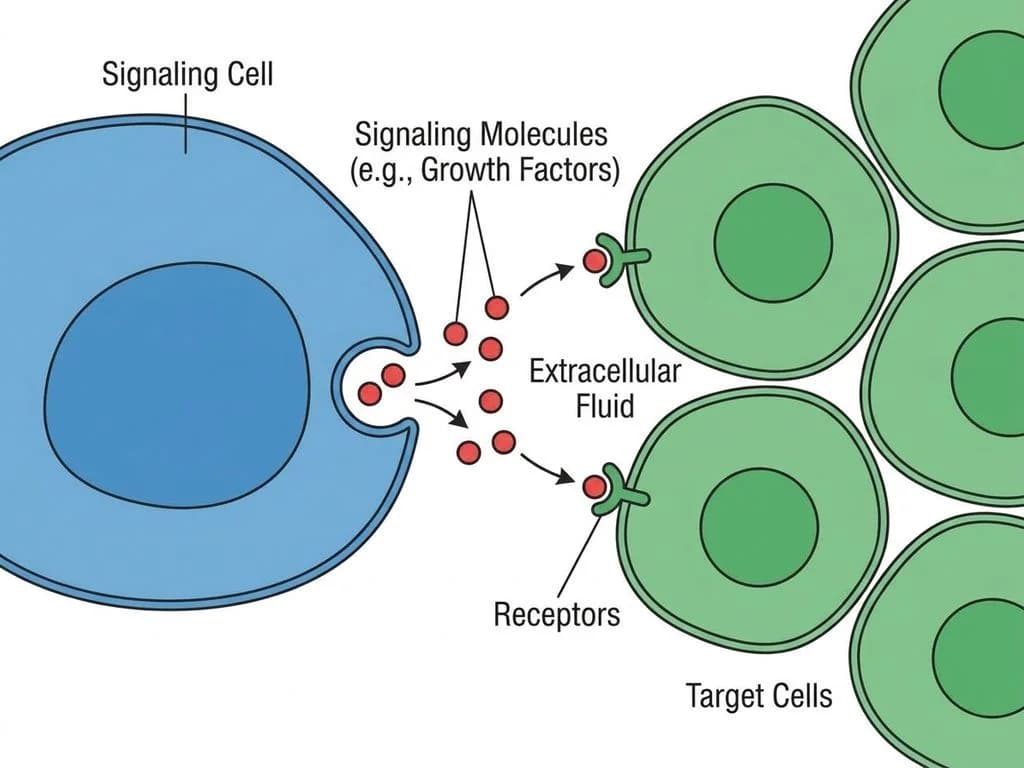
    The image below depicts which of the following types of cell-to-cell signaling? [image]

    A. Merocrine
    B. Paracrine
    C. Autocrine
    D. Endocrine

    Correct Answer: B. Paracrine

    Paracrine signaling is characterized by secretion of signaling molecules (ligands) that act on nearby target cells in the local microenvironment, typically within a distance of 100–200 μm. The discriminating feature is that the signal acts on adjacent cells rather than distant targets or the secreting cell itself. In the image, the cell releases mediators that diffuse across a short distance to affect neighboring cells—this is the hallmark of paracrine communication. Classic examples in Indian clinical practice include histamine release from mast cells affecting local vasodilation and increased vascular permeability in allergic reactions, or growth factors released by fibroblasts stimulating epithelial cell proliferation during wound healing. The signal does not enter the bloodstream for systemic distribution, and the effect is localized and rapid. This mechanism is fundamental to tissue homeostasis, inflammation, and regeneration—concepts tested frequently in NEET PG physiology.

    Why the other options are wrong

    A. Merocrine — Merocrine (eccrine) secretion refers to the mode of release of substances from cells (exocytosis without cell damage), not the type of cell-to-cell signaling. It describes how a cell releases its products, not where those products act. The question asks about signaling type, not secretion mechanism—this is a common NBE trap conflating secretion pathways with signaling distance/scope. C. Autocrine — Autocrine signaling occurs when a cell secretes a factor that acts on itself or identical neighboring cells of the same type. While the image shows local action, autocrine specifically implies self-stimulation (e.g., IL-2 from T cells stimulating T cell proliferation). Paracrine differs because the signal acts on different cell types in the neighborhood, not primarily on the secreting cell itself. D. Endocrine — Endocrine signaling involves secretion into the bloodstream for systemic, long-distance distribution to distant target organs (e.g., insulin from pancreatic β-cells, thyroid hormones). The image depicts local, short-range diffusion without vascular entry—the opposite of endocrine. This option tests whether students confuse local vs. systemic signaling scope.

    High-Yield Facts

    • Paracrine signaling distance: mediators act within 100–200 μm on adjacent cells; no bloodstream entry required.
    • Paracrine vs. endocrine: paracrine = local tissue effect; endocrine = systemic via blood (e.g., histamine in allergy vs. epinephrine in stress).
    • Common paracrine mediators: histamine (mast cells → local vasodilation), growth factors (fibroblasts → epithelial proliferation), cytokines (immune cells → local inflammation).
    • Autocrine overlap: some cells release factors affecting both themselves AND neighbors; distinguish by primary target (self = autocrine; neighbors = paracrine).
    • Merocrine ≠ signaling type: merocrine describes exocytotic release mechanism, not signaling scope—a frequent NEET confusion point.

    Mnemonics

    PACE for Signaling Scope Paracrine = Proximity (nearby cells); Autocrine = Auto (self); Crine = Circulation (endocrine via blood); Endocrine = Everywhere (systemic). Local vs. Systemic Rule If the signal stays in tissue → paracrine/autocrine. If it enters blood → endocrine. If you're describing how it's released (not where it acts) → merocrine/apocrine/holocrine.

    NBE Trap

    NBE pairs "merocrine" (a secretion mechanism) with paracrine/autocrine/endocrine (signaling scope) to trap students who conflate the two concepts. The question tests whether you distinguish how a cell releases a signal from where that signal acts.

    Clinical Pearl

    In acute allergic reactions (urticaria, angioedema), mast cells release histamine via merocrine exocytosis—but the paracrine effect on nearby endothelial cells causes local vasodilation and edema. Understanding this distinction explains why antihistamines work locally and why systemic anaphylaxis requires epinephrine (endocrine hormone) for widespread vascular effects.

    _Reference: Guyton & Hall Textbook of Medical Physiology, Ch. 1 (Cell Physiology); Robbins & Cotran Pathologic Basis of Disease, Ch. 1 (Cell Injury & Adaptation)_

    Ask AI Tutor about this question

    Stuck on a distractor? Want a worked-through clinical scenario? The AI Tutor is a NEETPGAI Pro feature — sign up free to practice the full question bank, then unlock the AI Tutor when you're ready.

    Explain this concept in plain language
    Why is each wrong option wrong?
    Give me a clinical scenario where this is tested
    Sign up free Already have an account? Log in

    Free to start, no credit card required. The 3 prompts/day quota is shared with practice + tutor + deep-dive across NEETPGAI.

    Memory-based reconstruction

    NBE does not officially release NEET PG papers per the 2025 Supreme Court directive. This question was reconstructed from 1 community source: PrepLadder NEET PG 2022 Recall PDF. Cross-verified by Claude Haiku 4.5 + Gemini 2.5 Flash + community-aggregate vote, then reviewed by a practising medical SME.

    ← All NEET PG 2022 questionsPractice with AI Tutor →