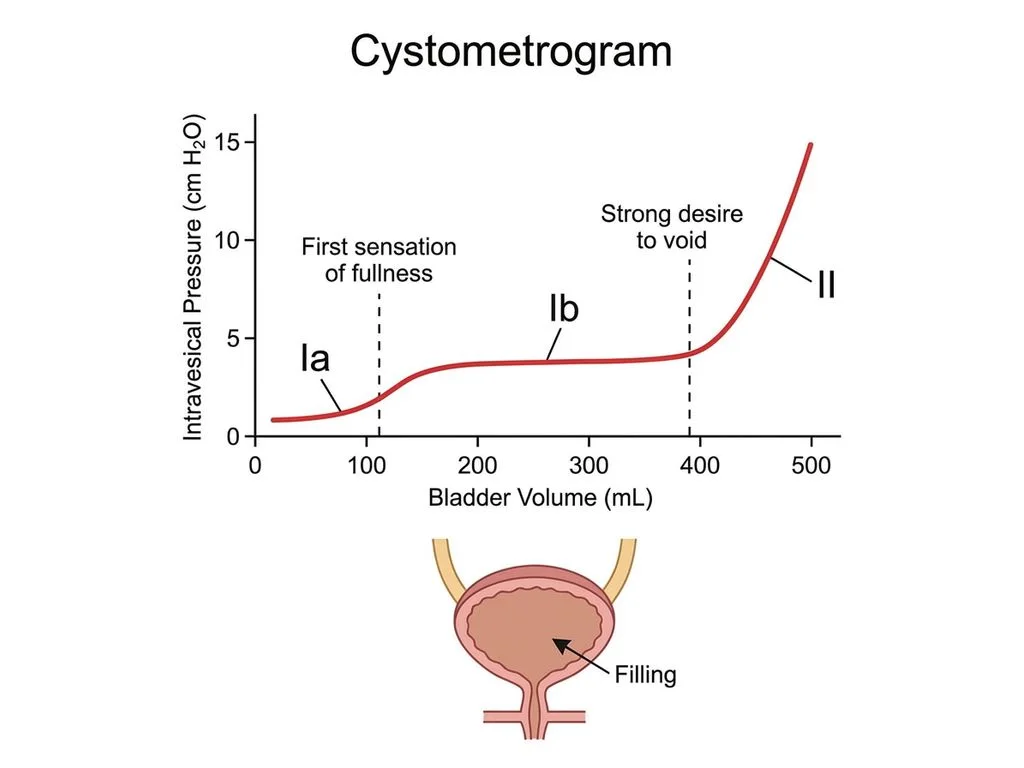
Correct Answer: A. Segment Ib is due to Laplace law
A cystometrogram plots intravesical pressure against bladder volume during filling and micturition. Segment Ib represents the compliance phase or accommodation phase of the bladder, where the detrusor muscle relaxes progressively as the bladder fills. This relaxation is governed by the Laplace law (also called Law of Laplace), which states that wall tension is inversely proportional to radius: T = P × r/2h. As the bladder radius increases during filling, the detrusor must generate less tension to maintain the same intravesical pressure—hence pressure rises minimally despite increasing volume. This is the physiological basis of bladder compliance. Segment Ia (initial filling) shows a steeper pressure rise because the bladder is smaller and the law of Laplace predicts higher wall tension for a given pressure. Segment Ib's gentle slope reflects the protective relaxation reflex (mediated by parasympathetic inhibition and sympathetic facilitation via sacral spinal cord) that allows the bladder to accommodate large volumes at low pressure—a critical feature for continence and normal micturition. This is distinct from residual urine (which is post-void) and from the micturition reflex itself (segment II).
Why the other options are wrong
B. Segment Ia is due to residual urine — Segment Ia occurs during the initial filling phase of a fresh cystometrogram, not after micturition. Residual urine is the volume remaining in the bladder after normal voiding (normally <50 mL in adults); it does not cause the pressure-volume relationship seen in segment Ia. Segment Ia's steeper slope reflects the smaller bladder radius at the start of filling, not the presence of pre-existing urine. This option confuses post-void residue with the filling phase dynamics. C. The dotted line represents that micturition has occurred — In a standard cystometrogram, the dotted line typically represents the abdominal pressure (measured via rectal or esophageal catheter), not the occurrence of micturition. The difference between the intravesical pressure curve and the dotted abdominal pressure line gives the true detrusor pressure (Pdet = Pves − Pab). Micturition is represented by a sharp drop in the intravesical pressure curve (segment II), not by a dotted line. This is a common NBE trap conflating pressure measurement technique with voiding events. D. Micturition fails to happen in segment II — Segment II is the micturition phase itself, characterized by a sharp, sustained drop in intravesical pressure as the detrusor contracts and the external urethral sphincter relaxes. Micturition actively occurs during segment II, not fails. The pressure drop reflects successful detrusor contraction overcoming urethral resistance and emptying the bladder. This option directly contradicts the physiological definition of segment II and may trap students who confuse pressure changes with failure of voiding.
High-Yield Facts
- Laplace law (T = Pr/2h) explains why bladder pressure rises minimally during filling despite increasing volume—wall tension decreases as radius increases.
- Segment Ib (compliance/accommodation phase) shows a gentle pressure rise due to progressive detrusor relaxation mediated by sacral parasympathetic inhibition.
- Segment Ia shows steeper initial pressure rise because the bladder is small; Laplace law predicts higher wall tension at smaller radius.
- Segment II (micturition phase) is marked by a sharp drop in intravesical pressure as detrusor contracts and external sphincter relaxes.
- Dotted line in cystometrogram represents abdominal pressure; true detrusor pressure = intravesical pressure − abdominal pressure.
- Normal bladder compliance allows accommodation of 400–500 mL at pressures <20 cm H₂O; loss of compliance (as in spinal cord injury or interstitial cystitis) causes steep pressure rise.
Mnemonics
LAPLACE for Bladder Filling Large radius → Accommodation → Pressure stays Low → Allows Compliance → Easy filling. As bladder expands, wall tension drops (Laplace), so pressure rises gently despite volume increase. Cystometrogram Segments: FIM Filling (Ia + Ib) → Increased volume, low pressure. Micturition (II) → Sharp pressure drop, voiding. Segment Ia = steep (small radius), Segment Ib = gentle (large radius, Laplace effect).
NBE Trap
NBE pairs "residual urine" with segment Ia to trap students who confuse post-void residue with the initial filling phase. Similarly, the dotted line is presented as a distractor because students may conflate abdominal pressure measurement with the micturition event itself.
Clinical Pearl
In Indian clinical practice, loss of bladder compliance (seen in spinal cord injury, chronic outlet obstruction, or interstitial cystitis) causes the cystometrogram to show a steep, unrelenting pressure rise throughout filling—the Laplace accommodation is lost. Recognizing segment Ib's gentle slope on cystometry is a key sign of preserved detrusor function and normal sacral reflex arc, critical for assessing continence and voiding dysfunction in post-stroke or diabetic patients.
_Reference: Guyton & Hall Textbook of Medical Physiology, Ch. 65 (Micturition); Harrison's Principles of Internal Medicine, Ch. 48 (Urinary Tract Obstruction)_