
NEETPGAI
FeaturesBlogComparePricing
Log inStart Free
NEETPGAI

AI-powered NEET PG preparation platform. Master all 19 subjects with adaptive MCQs, AI tutoring, and spaced repetition.

Product

  • Features
  • Subjects
  • Previous Year Questions
  • Compare
  • Pricing
  • Blog

Features

  • Adaptive MCQ Practice
  • AI Tutor
  • Mock Tests
  • Spaced Repetition

Resources

  • Blog
  • Study Guides
  • NEET PG Updates
  • Contact & support

Legal

  • Privacy Policy
  • Terms of Service

Stay updated

© 2026 NEETPGAI. All rights reserved.
    PYQs/2022/Q143
    Verified answer (AI cross-checked + SME reviewed)

    Q143 (2022, Others) — Correct answer: A. Thromboelastography.
    NEET PG 2022
    Q143
    scissors Surgery
    Others
    tier-2 (3/3 verifier agreement)
    Clinical image for NEET PG 2022 Q143

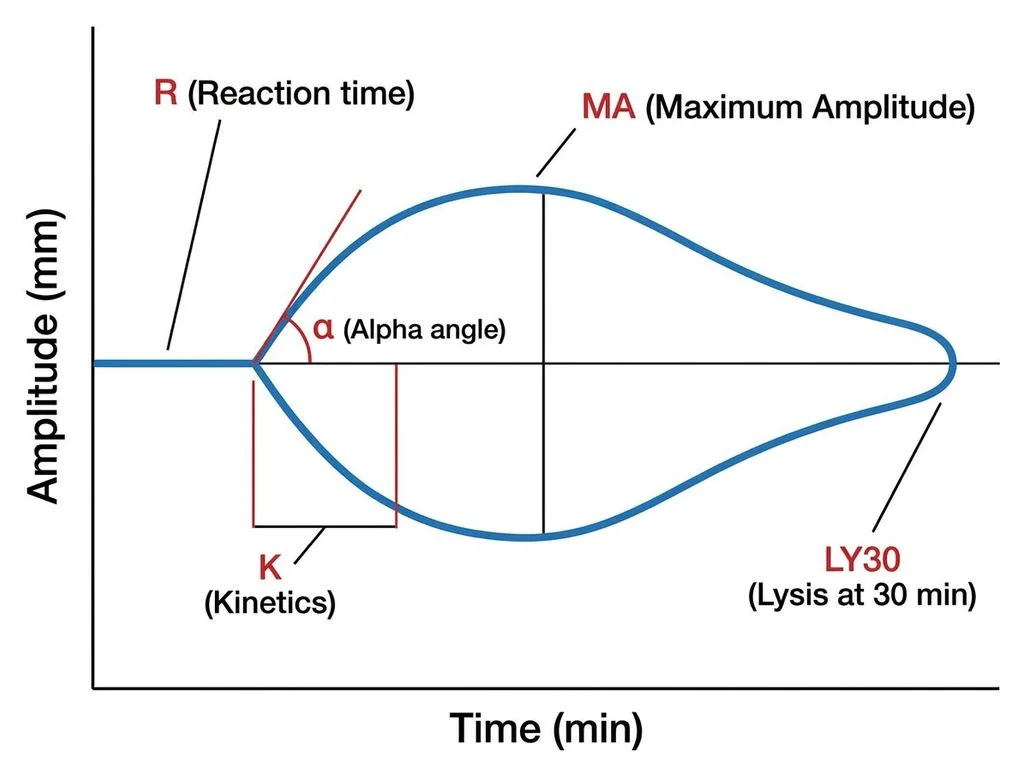
    A patient presented with blunt trauma to the abdomen. On evaluation, liver injury was noted, for which primary repair was done. Coagulation function was monitored intraoperatively, using the method shown below. What is the method used? [image] [image]

    A. Thromboelastography
    B. Plethysmography
    C. Elastography
    D. Sonography

    Correct Answer: A. Thromboelastography

    Thromboelastography (TEG) is a point-of-care viscoelastic test that measures the dynamic properties of blood coagulation in real time. The characteristic tracing shown in the image displays the classic TEG waveform: initial lag phase (R time—reaction time until clot initiation), angle of clot formation (α angle—rate of fibrin polymerization), maximum amplitude (MA—clot strength), and lysis at 30 minutes (LY30). In acute liver trauma with primary repair, TEG is invaluable for intraoperative coagulation monitoring because it detects platelet dysfunction, fibrinogen depletion, and hyperfibrinolysis—all common in massive transfusion protocols and hepatic injury. Unlike conventional PT/INR and aPTT (which are static tests), TEG provides real-time assessment of clot formation kinetics and stability, guiding transfusion decisions and hemostatic interventions. This is the gold standard in trauma surgery across Indian trauma centers and aligns with current massive transfusion protocol guidelines. The visual waveform pattern is pathognomonic and directly correlates with clinical coagulation status.

    Why the other options are wrong

    B. Plethysmography — Plethysmography measures changes in blood volume and vascular compliance in limbs; it assesses peripheral perfusion and vascular tone, not coagulation function. It cannot detect clot formation kinetics, fibrinogen levels, or platelet dysfunction. This is a vascular physiology tool, not a hemostasis monitor—a common trap for students who confuse vascular assessment with coagulation testing. C. Elastography — Elastography (transient or shear-wave) measures tissue stiffness and fibrosis, primarily used for liver fibrosis staging in chronic liver disease. It has no role in acute coagulation assessment or intraoperative hemostasis monitoring. The visual waveform in the image is distinctly different from elastography patterns—this option exploits confusion between liver-related tests. D. Sonography — Sonography is an imaging modality for structural assessment of organs and tissues; it cannot measure coagulation function or clot dynamics. While ultrasound may be used to assess liver injury extent, it provides no real-time hemostatic data. The waveform shown is a functional coagulation tracing, not an anatomical image—a fundamental category error.

    High-Yield Facts

    • TEG R time (reaction time) reflects initiation phase; prolonged R suggests factor deficiency or anticoagulation.
    • TEG MA (maximum amplitude) reflects platelet count and function; low MA (<50 mm) indicates platelet dysfunction or thrombocytopenia requiring transfusion.
    • TEG α angle (angle of clot formation) reflects fibrinogen and platelet interaction; angle <55° suggests hypofibrinogenemia.
    • TEG LY30 (lysis at 30 min) detects hyperfibrinolysis; LY30 >3% is abnormal and indicates need for antifibrinolytic therapy (tranexamic acid).
    • Point-of-care TEG guides massive transfusion protocol in trauma: RBC:FFP:PLT ratios adjusted based on real-time TEG parameters, not static PT/INR.
    • TEG vs. PT/INR: TEG detects platelet dysfunction and fibrinolysis (missed by PT/INR); superior for guiding hemostatic interventions in acute hemorrhage.

    Mnemonics

    TEG Parameters (RAML) R = Reaction time (clot initiation), A = Angle (fibrin polymerization rate), M = Maximum amplitude (clot strength), L = Lysis (fibrinolysis). Use this to recall the four key TEG variables in order of appearance on the tracing. When TEG Beats PT/INR TEG detects Platelet dysfunction, Fibrinolysis, Hypofibrinogenemia in real time; PT/INR misses these. In trauma, TEG guides transfusion; PT/INR does not. Remember: TEG = Dynamic, PT/INR = Static.

    NBE Trap

    NBE pairs liver trauma with coagulation monitoring to lure students into choosing imaging modalities (sonography, elastography) or vascular tests (plethysmography) instead of the functional hemostasis test. The waveform image is the key discriminator—only TEG produces this characteristic viscoelastic tracing.

    Clinical Pearl

    In Indian trauma centers managing blunt liver injuries with massive transfusion, TEG-guided resuscitation reduces mortality and morbidity compared to conventional PT/INR-based protocols. A single TEG tracing in the OR can detect occult hyperfibrinolysis (LY30 >3%) and prompt early tranexamic acid administration—a life-saving intervention often missed by static coagulation tests.

    _Reference: Bailey & Love Ch. 5 (Hemostasis & Transfusion); Harrison Ch. 179 (Coagulation Disorders); Indian Trauma Society Guidelines on Massive Transfusion Protocol_

    Ask AI Tutor about this question

    Stuck on a distractor? Want a worked-through clinical scenario? The AI Tutor is a NEETPGAI Pro feature — sign up free to practice the full question bank, then unlock the AI Tutor when you're ready.

    Explain this concept in plain language
    Why is each wrong option wrong?
    Give me a clinical scenario where this is tested
    Sign up free Already have an account? Log in

    Free to start, no credit card required. The 3 prompts/day quota is shared with practice + tutor + deep-dive across NEETPGAI.

    Memory-based reconstruction

    NBE does not officially release NEET PG papers per the 2025 Supreme Court directive. This question was reconstructed from 1 community source: PrepLadder NEET PG 2022 Recall PDF. Cross-verified by Claude Haiku 4.5 + Gemini 2.5 Flash + community-aggregate vote, then reviewed by a practising medical SME.

    ← All NEET PG 2022 questionsPractice with AI Tutor →