Correct Answer: A. Tay-Sachs disease
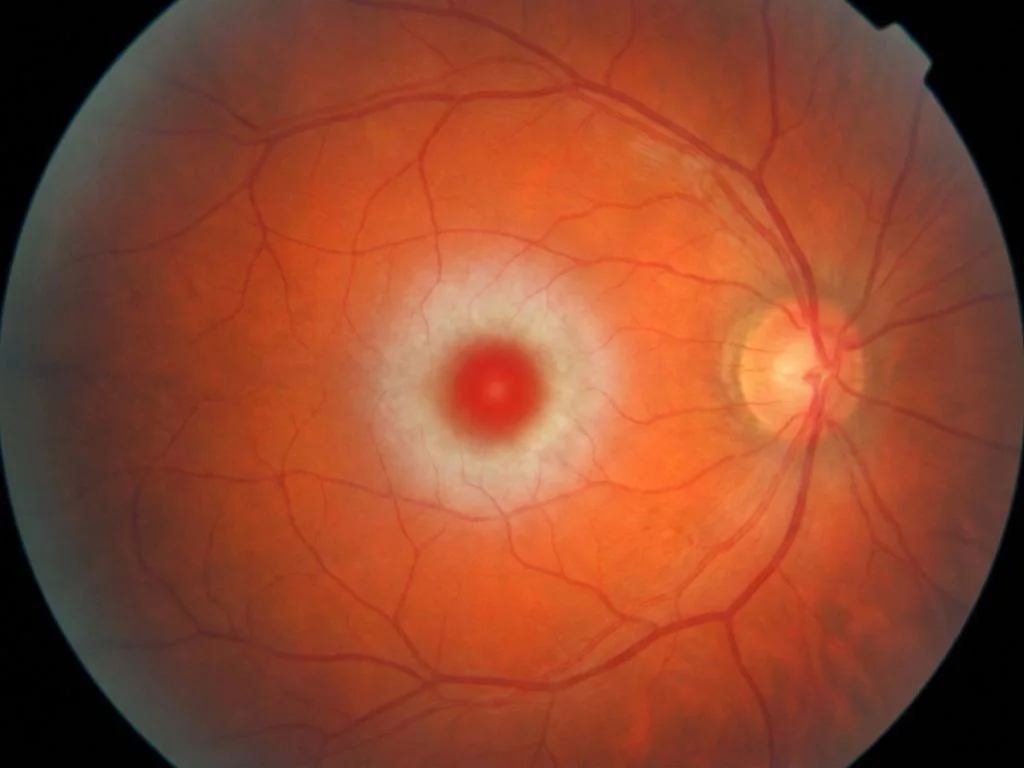
Tay-Sachs disease is a lysosomal storage disorder caused by deficiency of hexosaminidase A (Hex-A), leading to accumulation of GM2 gangliosides in neurons and retinal cells. The pathognomonic fundoscopic finding is the cherry-red spot on the macula—a bright red fovea surrounded by a pale, edematous retina due to ganglioside accumulation in the inner retinal layers. The clinical presentation of progressive neurological deterioration (mental retardation, loss of motor skills, inability to walk) in a 3-year-old fits the infantile form perfectly. Onset typically occurs between 3–6 months of age with developmental regression, seizures, blindness, and death by age 3–5 years. The combination of cherry-red spot + progressive neurological decline in early childhood is virtually pathognomonic for Tay-Sachs. In India, while less common than in Ashkenazi Jewish populations, Tay-Sachs occurs sporadically and in consanguineous families. Diagnosis is confirmed by reduced Hex-A activity on leukocyte enzyme assay. No disease-modifying treatment exists; management is supportive.
Why the other options are wrong
B. Hurler syndrome — Hurler syndrome (MPS I) causes coarse facial features, hepatosplenomegaly, corneal clouding, and retinal degeneration—but NOT a cherry-red spot. The fundoscopic finding is retinal pigmentary degeneration or optic disc pallor, not the pathognomonic cherry-red macula. While both present with developmental delay, Hurler's systemic features (skeletal dysplasia, cardiac valve disease) dominate the clinical picture. C. Hunter disease — Hunter syndrome (MPS II) is X-linked and presents similarly to Hurler with coarse features, hepatosplenomegaly, and progressive neurodegeneration. However, the retinal findings are retinal pigmentary degeneration and optic atrophy—never a cherry-red spot. The absence of corneal clouding (present in Hurler) and the X-linked inheritance pattern further distinguish it from the autosomal recessive Tay-Sachs. D. Gaucher disease — Gaucher disease (glucocerebroside accumulation) presents with hepatosplenomegaly, bone involvement, and in the neuronopathic forms, neurological decline. However, the characteristic retinal finding is pinguecula-like lesions or retinal infiltration, not a cherry-red spot. The fundoscopic appearance and the prominence of systemic features (hepatosplenomegaly, bone pain) make Gaucher clinically and ophthalmologically distinct from Tay-Sachs.
High-Yield Facts
- Cherry-red spot on macula is the pathognomonic fundoscopic sign of Tay-Sachs disease, caused by GM2 ganglioside accumulation in inner retinal layers.
- Hexosaminidase A (Hex-A) deficiency is the enzymatic defect in Tay-Sachs; diagnosis confirmed by leukocyte enzyme assay showing reduced or absent Hex-A activity.
- Infantile Tay-Sachs presents with developmental regression, seizures, blindness, and death by age 3–5 years; onset typically 3–6 months.
- Autosomal recessive inheritance pattern; higher incidence in Ashkenazi Jewish populations but occurs sporadically in Indian families.
- No disease-modifying therapy exists; management is purely supportive with seizure control and palliative care.
Mnemonics
Cherry-Red Spot Differential (CHAMP) Central retinal artery occlusion, Hypertensive retinopathy, Amyloidosis, Mitochondrial disease, Pancreatic insufficiency (Tay-Sachs). When you see cherry-red spot + neurodegeneration in a child, think Tay-Sachs first. Lysosomal Storage + Retina (LSR Rule) Lipidosis (Tay-Sachs = cherry-red), Sphingolipidosis (Niemann-Pick = cherry-red), Retinal findings vary by storage type. Cherry-red spot = think lipid/sphingolipid storage, not mucopolysaccharide (MPS).
NBE Trap
NBE pairs "neurodegeneration + retinal findings" across all four lysosomal storage disorders, hoping students confuse MPS (Hurler/Hunter) retinal degeneration with the cherry-red spot of Tay-Sachs. The key discriminator is the specific fundoscopic finding—cherry-red spot is unique to Tay-Sachs and Niemann-Pick, not MPS.
Clinical Pearl
In Indian pediatric practice, a 3-year-old presenting with regression of milestones and blindness warrants immediate fundoscopy—a cherry-red spot is a red flag for Tay-Sachs and demands urgent enzyme assay and genetic counseling for the family. Early recognition, though not curative, allows informed family planning and palliative care optimization.
_Reference: Robbins Ch. 5 (Genetic Disorders); Harrison Ch. 356 (Lysosomal Storage Diseases); OP Ghai Ch. 6 (Inborn Errors of Metabolism)_