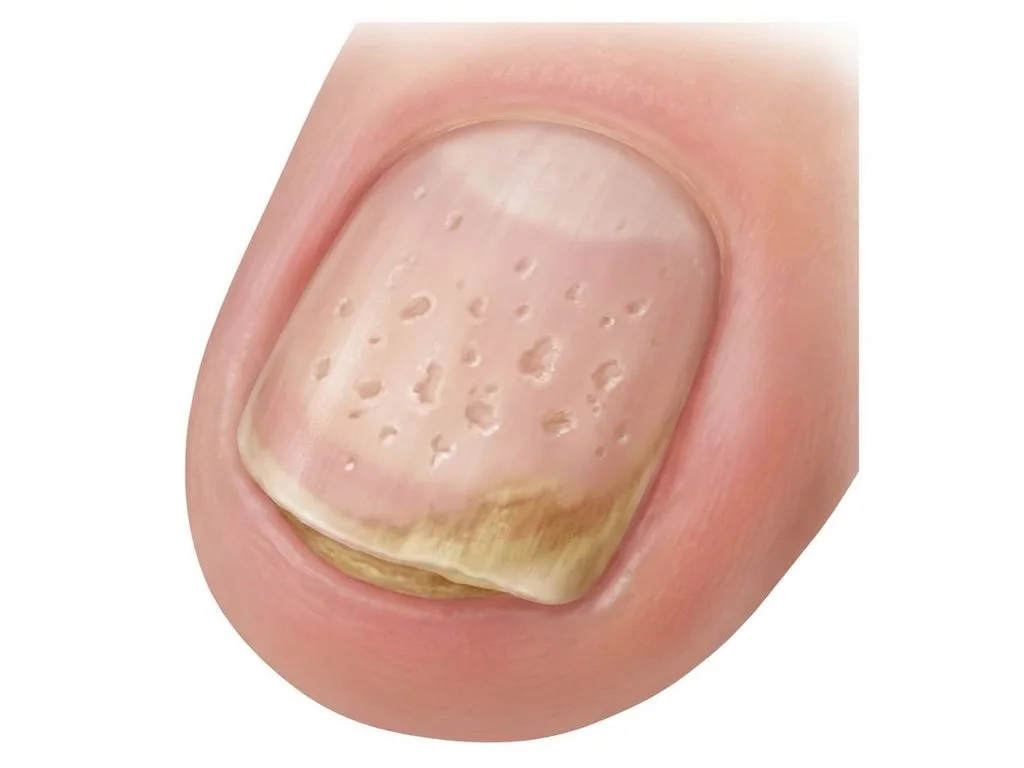
Correct Answer: B. Psoriasis
Psoriasis is the classic condition presenting with irregular pitting of nails combined with subungual hyperkeratosis. The pathophysiology involves inflammation of the nail matrix (causing pitting) and nail bed (causing hyperkeratosis and onycholysis). Pitting in psoriasis is characteristically irregular and deep, affecting multiple nails in a random distribution—this distinguishes it from the regular pitting seen in alopecia areata. The subungual hyperkeratosis appears as yellowish-brown discoloration beneath the nail plate, often described as "oil-drop" or "salmon patch" appearance when combined with nail bed involvement. In Indian dermatology practice, nail psoriasis is one of the earliest manifestations and may precede skin lesions by months. The combination of matrix damage (pitting) and bed inflammation (hyperkeratosis) is pathognomonic for psoriasis among the given options. Approximately 10–50% of psoriasis patients develop nail involvement, making this a high-yield clinical sign for NEET PG.
Why the other options are wrong
A. Alopecia areata — Alopecia areata causes regular, uniform pitting arranged in a geometric pattern (grid-like), not irregular pitting. The pits are shallow and evenly spaced. Subungual hyperkeratosis is NOT a feature of alopecia areata; instead, nail involvement presents as thinning, ridging, or leukonychia. This is the NBE trap—both cause pitting, but the pattern and associated findings differ fundamentally. C. Lichen planus — Lichen planus causes longitudinal ridging and thinning of nails (pterygium unguis formation), not pitting. Subungual hyperkeratosis is absent. Nail involvement in lichen planus is characterized by destruction of the nail matrix leading to permanent nail loss or pterygium formation, not the reversible pitting and hyperkeratosis seen in psoriasis. D. Atopic dermatitis — Atopic dermatitis causes horizontal ridging (Beau's lines) and nail thickening due to chronic rubbing and inflammation, not pitting. Subungual hyperkeratosis is not a typical feature. Nail changes in atopic dermatitis are secondary to scratching behavior and are non-specific, lacking the characteristic pitting and hyperkeratosis combination.
High-Yield Facts
- Psoriasis nail pitting is irregular and deep, affecting multiple nails randomly; alopecia areata pitting is regular and geometric.
- Subungual hyperkeratosis with yellowish-brown discoloration ('oil-drop sign') is pathognomonic for psoriasis when combined with pitting.
- Nail psoriasis occurs in 10–50% of psoriasis patients and may be the sole manifestation or precede cutaneous lesions.
- Lichen planus causes pterygium unguis (nail loss) and longitudinal ridging, NOT pitting or hyperkeratosis.
- Alopecia areata pitting is shallow, regular, and grid-patterned; nail bed and subungual structures are spared.
Mnemonics
PITTING PATTERNS Psoriasis = Irregular, deep pits + hyperkeratosis | Alopecia = Regular, geometric pits only | Lichen = Ridges + pterygium (no pits) | Atopic = Horizontal ridges only NAIL PSORIASIS TRIAD Pitting (matrix damage) + Hyperkeratosis (bed inflammation) + Oil-drop sign (onycholysis with discoloration) = Psoriasis
NBE Trap
NBE pairs pitting with multiple conditions to test whether students can distinguish irregular, deep pitting with subungual hyperkeratosis (psoriasis) from regular, shallow, geometric pitting (alopecia areata). The trap is recognizing that both cause pitting but the pattern and associated findings are mutually exclusive.
Clinical Pearl
In Indian outpatient dermatology, nail psoriasis is often the first clue to diagnosis in patients presenting with isolated nail complaints before obvious skin lesions appear. A patient with irregular nail pitting and subungual hyperkeratosis should prompt immediate examination for subtle psoriatic plaques on elbows, knees, and scalp—early recognition allows timely systemic therapy initiation.
_Reference: Robbins & Cotran Pathologic Basis of Disease, Ch. 25 (Skin); Harrison's Principles of Internal Medicine, Ch. 52 (Dermatologic Manifestations of Systemic Disease)_