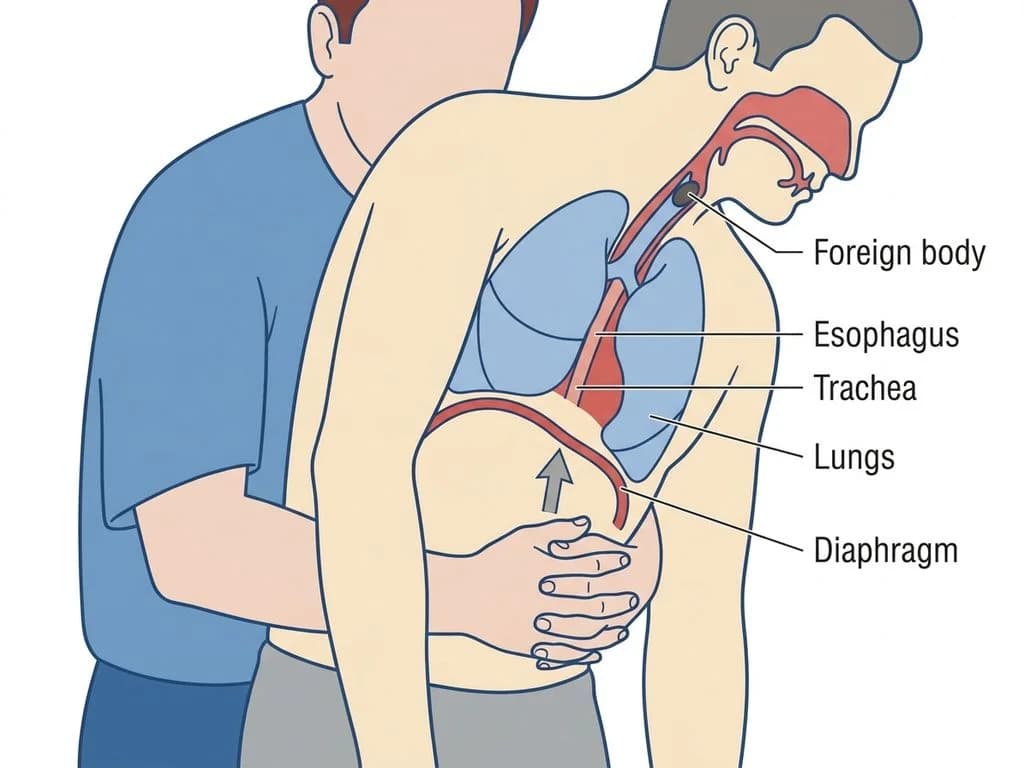
Correct Answer: C. Heimlich's maneuver
Heimlich's maneuver is the gold-standard emergency procedure for relieving acute airway obstruction caused by foreign body aspiration in a conscious adult. The technique involves standing behind the choking victim, placing a clenched fist just above the umbilicus and below the xiphoid process, and delivering rapid upward thrusts to create sudden increase in intra-abdominal pressure. This sudden pressure surge is transmitted to the thoracic cavity, forcefully expelling air from the lungs and dislodging the obstructing food bolus. According to Indian guidelines and international protocols (AHA/ACC), Heimlich's maneuver is the first-line intervention for conscious adults with complete airway obstruction. The procedure is highly effective because it bypasses the need for direct visualization or instrumentation—critical in a restaurant setting where no equipment is available. The upward direction of the thrust (not downward or horizontal) is essential to direct force along the esophageal axis and maximize expulsion. In India, this remains the standard teaching in emergency medicine and ENT curricula, particularly for lay rescuers and healthcare workers managing choking incidents in public spaces.
Why the other options are wrong
A. Blind insertion of finger — This is wrong because blind finger insertion risks pushing the foreign body deeper into the airway, worsening obstruction and potentially causing aspiration into the lower respiratory tract. It is contraindicated in conscious adults with complete airway obstruction and is reserved only for unconscious patients where visualization is impossible. The maneuver also risks injury to the pharyngeal structures and is ineffective at generating the pressure needed to expel the bolus. B. Chest thrust — This is wrong because chest thrusts are the alternative procedure reserved specifically for pregnant women or obese patients where abdominal thrusts cannot be safely applied. In a non-pregnant, non-obese adult, chest thrusts are less effective than Heimlich's maneuver at generating sufficient intra-abdominal pressure to dislodge the foreign body. The question describes a standard adult male, making abdominal thrusts the clear first choice. D. Back slap — This is wrong because back slaps alone are ineffective for complete airway obstruction in conscious adults and may paradoxically lodge the foreign body more firmly in the airway. Back slaps are sometimes used in infants (alternating with chest thrusts) but have no role in adult choking management. The procedure does not generate the sustained intra-abdominal pressure needed to expel a food bolus from the pharynx or esophagus.
High-Yield Facts
- Heimlich's maneuver is the first-line emergency procedure for conscious adults with complete foreign body airway obstruction.
- Abdominal thrusts (Heimlich) work by increasing intra-abdominal pressure to forcefully expel air from the lungs and dislodge the bolus.
- Fist placement is critical: just above the umbilicus, below the xiphoid process, with upward (not downward) thrusts.
- Chest thrusts are the alternative only for pregnant women, obese patients, or post-operative abdominal patients where abdominal thrusts are contraindicated.
- Blind finger insertion is contraindicated in conscious adults; it risks deeper impaction and aspiration—reserved only for unconscious patients with visualization.
Mnemonics
HAB for Choking Adult Heimlich (abdominal thrusts) → Alternative chest thrusts (pregnant/obese) → Back slaps (infants only). For conscious adult: always start with Heimlich. FIST Rule for Heimlich Fist above umbilicus, Inward and upward thrusts, Sudden pressure surge, Thrust until object expelled. Prevents wrong hand placement.
NBE Trap
NBE may pair back slaps or blind finger insertion with the image to trap students who confuse infant choking protocols (where back slaps + chest thrusts are used) with adult management. The key discriminator is the patient's age and consciousness level.
Clinical Pearl
In Indian restaurants and public settings, Heimlich's maneuver is often the only intervention available before emergency services arrive. Training lay rescuers in this technique has proven life-saving in preventing aspiration deaths from food boluses—a common preventable emergency in India, particularly in elderly patients with dysphagia or those eating too quickly.
_Reference: Harrison Ch. 295 (Respiratory Emergencies); Indian guidelines: AHA/ACC Emergency Cardiovascular Care protocols adapted for Indian practice; Bailey & Love Ch. 21 (Acute Airway Management)_