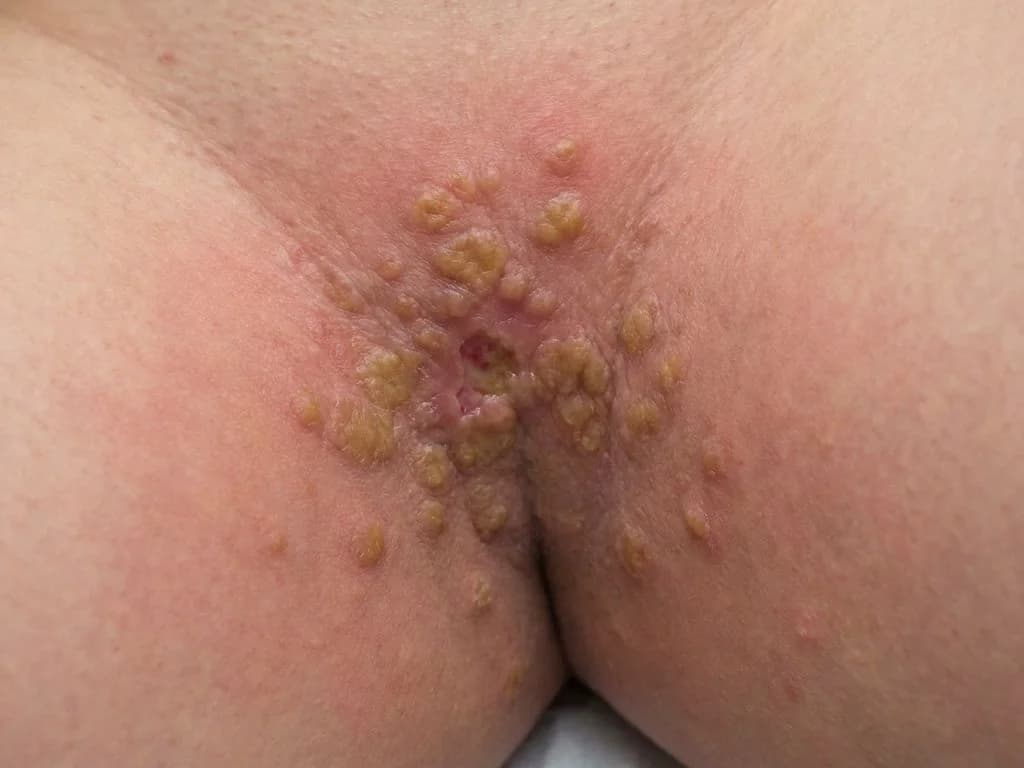
Correct Answer: B. Malakoplakia
Malakoplakia is a chronic granulomatous inflammation of the bladder characterized by yellow-white plaques, typically in the trigone—exactly matching the clinical presentation. The histopathology shows the pathognomonic Michaelis-Gutmann bodies, which are laminated, calcified, intracellular inclusions within foamy macrophages. These bodies form due to defective lysosomal digestion of bacteria (especially E. coli) in patients with impaired cell-mediated immunity or phagocytic dysfunction. The disease results from incomplete bacterial degradation, leading to accumulation of calcium and iron-containing debris. Malakoplakia is rare in India but occurs in immunocompromised patients, those with recurrent UTIs, or post-instrumentation. The trigone location is classic. Diagnosis is confirmed by histology showing Michaelis-Gutmann bodies (PAS-positive, von Kossa positive for calcium). Treatment involves prolonging antibiotic courses (fluoroquinolones or trimethoprim-sulfamethoxazole) and managing underlying immunosuppression. The yellow-white plaques represent collections of foamy macrophages laden with these inclusion bodies.
Why the other options are wrong
A. Acute cystitis — Acute cystitis presents with dysuria, frequency, and urgency but does NOT produce yellow-white plaques on cystoscopy. Histology shows acute inflammation (neutrophilic infiltrate) without Michaelis-Gutmann bodies. This is a trap for students who see 'bladder inflammation' and choose the most common diagnosis without considering the specific plaques and histology. C. Interstitial cystitis — Interstitial cystitis is a chronic pain syndrome with bladder ulcers (Hunner's ulcers) and fibrosis, NOT yellow-white plaques. Histology shows chronic inflammation and fibrosis without Michaelis-Gutmann bodies. The clinical presentation and cystoscopic findings are entirely different; this option confuses chronic bladder conditions. D. Polypoid cystitis — Polypoid cystitis presents with polypoid or nodular masses in the bladder, often post-instrumentation, but lacks the characteristic yellow-white plaques of malakoplakia. Histology shows benign polypoid tissue without Michaelis-Gutmann bodies. This is a distractor for students unfamiliar with the specific histological hallmark of malakoplakia.
High-Yield Facts
- Michaelis-Gutmann bodies are the pathognomonic histological hallmark of malakoplakia—laminated, calcified inclusions within foamy macrophages.
- Trigone location of yellow-white plaques is classic for malakoplakia; caused by defective lysosomal digestion of E. coli.
- Malakoplakia risk factors include immunosuppression, recurrent UTIs, post-instrumentation, and phagocytic dysfunction (e.g., chronic granulomatous disease).
- Michaelis-Gutmann bodies are PAS-positive and von Kossa-positive (calcium stain), confirming the calcified nature.
- Treatment involves prolonged fluoroquinolones or TMP-SMX (6–12 weeks) plus management of underlying immunosuppression.
Mnemonics
MGM Bodies = Malakoplakia Michaelis-Gutmann bodies → Malakoplakia. Laminated calcified inclusions in foamy macrophages = defective bacterial digestion. YELLOW-WHITE PLAQUES + TRIGONE = Malakoplakia Yellow-white plaques in trigone + Michaelis-Gutmann on histology = Malakoplakia (not acute cystitis, not IC, not polypoid).
NBE Trap
NBE pairs "chronic bladder inflammation" with multiple options (interstitial cystitis, polypoid cystitis) to trap students who don't recognize the specific yellow-white plaques + Michaelis-Gutmann bodies as pathognomonic for malakoplakia. The trigone location is the key discriminator.
Clinical Pearl
In Indian practice, malakoplakia is rare but should be suspected in patients with recurrent UTIs post-instrumentation (catheterization, cystoscopy) who develop persistent symptoms despite antibiotics. The yellow-white plaques are a red flag for this diagnosis, and early recognition prevents unnecessary surgical intervention.
_Reference: Robbins Ch. 20 (Urinary System); Harrison Ch. 280 (Urinary Tract Infections)_