Correct Answer: D. Thyroid receptor antibody
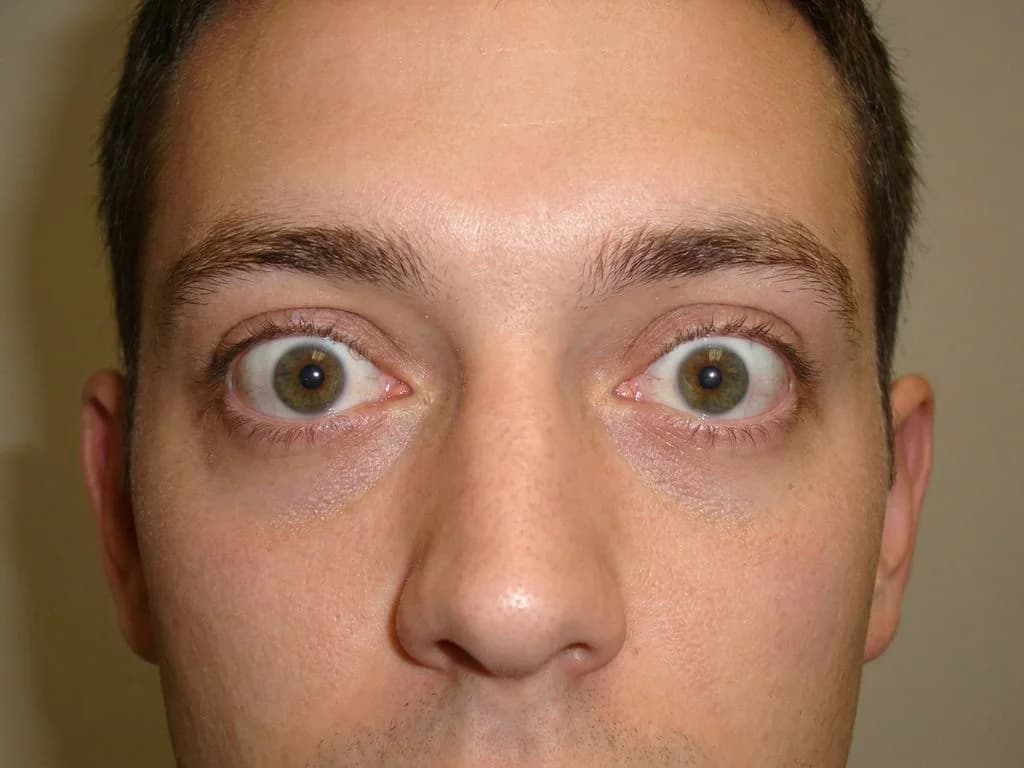
The clinical presentation of palpitations, sweating, restlessness, and sweaty palms in a young adult strongly suggests hyperthyroidism, most likely Graves' disease. The image (though not visible here) likely shows clinical signs such as exophthalmos, lid lag, or thyroid bruit—pathognomonic for Graves' disease. Graves' disease is an autoimmune condition caused by thyroid-stimulating immunoglobulins (TSI), which are antibodies against the thyroid-stimulating hormone (TSH) receptor. These antibodies bind to TSH receptors on thyroid follicular cells, mimicking TSH action and causing uncontrolled thyroid hormone synthesis and release. The diagnostic test of choice for confirming Graves' disease is TSH receptor antibody (TRAb) or thyroid-stimulating immunoglobulin (TSI) assay. This test directly identifies the pathogenic mechanism and differentiates Graves' disease from other causes of hyperthyroidism (toxic nodule, thyroiditis, iodine-induced). While suppressed TSH and elevated free T4/T3 confirm hyperthyroidism biochemically, TRAb specifically confirms the autoimmune etiology. In Indian clinical practice, TRAb positivity is particularly useful in pregnant women with Graves' disease to predict neonatal thyroid dysfunction risk, and in patients requiring radioactive iodine or antithyroid drug therapy decisions.
Why the other options are wrong
A. Elevated ultrasensitive thyrotropin levels — This is wrong because in Graves' disease (hyperthyroidism), TSH is suppressed, not elevated. Elevated ultrasensitive TSH is seen in primary hypothyroidism (Hashimoto's thyroiditis), not hyperthyroidism. This option confuses the biochemical pattern of hyperthyroidism with hypothyroidism—a classic NBE trap for students who remember 'TSH abnormality in thyroid disease' without recalling the direction of change. B. Anti-thyroglobulin antibody — This is wrong because anti-thyroglobulin antibodies are markers of chronic autoimmune thyroiditis (Hashimoto's disease), not Graves' disease. While both are autoimmune thyroid conditions, they have different pathogenic antibodies and clinical presentations. Hashimoto's causes hypothyroidism with gradual onset, whereas Graves' causes acute hyperthyroidism. This option tests whether students can differentiate between two autoimmune thyroid diseases. C. Anti-thyroid peroxidase antibody — This is wrong because anti-TPO antibodies are also characteristic of Hashimoto's thyroiditis and chronic autoimmune thyroiditis, not Graves' disease. Although anti-TPO can be present in Graves' disease patients, it is not the defining diagnostic antibody. The pathogenic mechanism in Graves' is TSH receptor stimulation, not thyroid peroxidase destruction. This option is a distractor for students confusing autoimmune hypothyroidism with autoimmune hyperthyroidism.
High-Yield Facts
- TSH receptor antibody (TRAb) is the pathognomonic antibody in Graves' disease, causing TSH-independent thyroid hormone synthesis.
- Graves' disease presents with hyperthyroidism + exophthalmos + pretibial myxedema, distinguishing it from toxic nodule or thyroiditis.
- Anti-TPO and anti-thyroglobulin antibodies are markers of Hashimoto's thyroiditis (hypothyroidism), not Graves' disease.
- In Graves' disease, TSH is suppressed while free T4 and free T3 are elevated—opposite to primary hypothyroidism.
- TRAb positivity in pregnant women with Graves' disease predicts neonatal thyroid dysfunction risk due to transplacental antibody transfer.
- Thyroid-stimulating immunoglobulin (TSI) assay is an alternative name for TRAb and is used interchangeably in clinical practice.
Mnemonics
GAG = Graves' Antibody is against TSH receptor (G-receptor) Graves' → TSH receptor Antibody (TRAb/TSI). Hashimoto's → Anti-TPO + Anti-thyroglobulin. Use this when differentiating autoimmune thyroid diseases. GRAVES = Graves' Receptor Antibody Versus Enzyme (TPO) antibodies Graves' = Receptor antibody (TSH-R). Hashimoto's = Enzyme antibody (TPO). Quick recall for exam differentiation.
NBE Trap
NBE pairs 'autoimmune thyroid disease' with 'elevated TSH' or 'anti-TPO antibody' to lure students who remember thyroid autoimmunity without recalling that Graves' is hyperthyroid (suppressed TSH) with TSH receptor antibodies, not hypothyroid with TPO antibodies. The clinical presentation of acute hyperthyroidism symptoms is the key discriminator.
Clinical Pearl
In Indian clinical practice, TRAb testing is critical in pregnant women with Graves' disease to assess neonatal thyroid dysfunction risk—high TRAb titers warrant closer fetal monitoring and neonatal pediatric follow-up. Additionally, TRAb positivity guides the choice between antithyroid drugs (PTU preferred in pregnancy) and radioactive iodine therapy in non-pregnant patients.
_Reference: Harrison Ch. 405 (Thyroid Disorders); KD Tripathi Ch. 33 (Thyroid Hormones & Antithyroid Drugs); Robbins Ch. 24 (Endocrine System)_