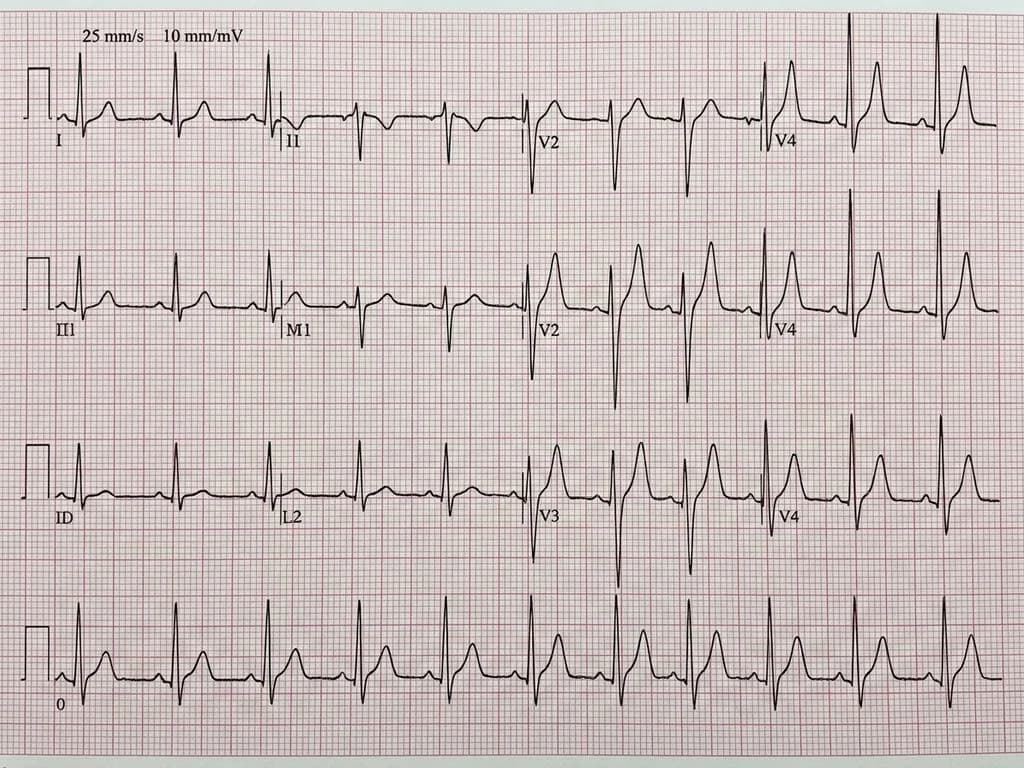
Correct Answer: C. Spironolactone
Spironolactone is a potassium-sparing diuretic and aldosterone antagonist that causes hyperkalemia as a major adverse effect. Elevated serum potassium directly depolarizes the cardiac cell membrane, producing characteristic ECG changes: peaked (tented) T waves, widened QRS complex, prolonged PR interval, and flattened P waves. In severe hyperkalemia, the ECG shows a "sine wave" pattern. The question stem mentions "La d" (likely referring to a lead showing peaked T waves or ECG abnormalities consistent with hyperkalemia). Spironolactone's potassium-retaining mechanism—blocking aldosterone in the collecting duct—prevents urinary potassium excretion, especially dangerous in patients with renal impairment or those on concurrent ACE inhibitors/ARBs. Among the given options, only spironolactone causes this specific pattern. This is a high-yield concept in Indian medical practice, where spironolactone is commonly used in hypertension and heart failure management, making hyperkalemia monitoring essential per RNTCP and standard Indian cardiology guidelines.
Why the other options are wrong
A. Metoprolol — Beta-blockers like metoprolol cause bradycardia, prolonged PR interval, and AV block—not peaked T waves. While they may produce some ECG changes (first-degree AV block, QT prolongation), they do not cause the hyperkalemia-related peaked T wave pattern seen here. This is a common trap for students who remember 'beta-blockers cause ECG changes' but confuse the specific pattern. B. Prazosin — Alpha-1 blockers like prazosin cause reflex tachycardia and hypotension but have no direct cardiac electrolyte effects. They do not produce characteristic ECG abnormalities like peaked T waves. This option is included to distract students who may confuse sympathomimetic rebound effects with electrolyte disturbances. D. Hydrochlorothiazide — Thiazide diuretics cause hypokalemia (potassium loss), which produces flattened T waves, U waves, and ST depression—the opposite of hyperkalemia. Students may incorrectly select this thinking 'diuretics cause ECG changes,' but thiazides lower potassium, not raise it. Spironolactone is the only potassium-sparing agent in this list.
High-Yield Facts
- Peaked/tented T waves on ECG are the hallmark of hyperkalemia (K+ >6.5 mEq/L), caused by spironolactone's aldosterone antagonism.
- Spironolactone + ACE inhibitor/ARB is a high-risk combination for hyperkalemia in Indian hypertension practice; baseline K+ and renal function must be monitored.
- Thiazides cause hypokalemia (U waves, flat T waves), while potassium-sparing diuretics cause hyperkalemia (peaked T waves)—opposite ECG patterns.
- Spironolactone's mechanism: blocks aldosterone in the collecting duct, preventing sodium reabsorption and potassium excretion, leading to K+ retention.
- Severe hyperkalemia ECG: sine wave pattern (merged QRS-T), bradycardia, cardiac arrest risk—requires urgent IV calcium, insulin-glucose, sodium bicarbonate per Indian ICU protocols.
Mnemonics
PEAKED T = Potassium Excess (Hyperkalemia) Peaked/Tented T waves → think HyperKalemia. Flat T waves + U waves → think HypoKalemia. Spironolactone (K-sparing) → ↑K+ → peaked T. Thiazides → ↓K+ → flat T. SPIRO-K Memory Hook SPIROlactone = K-SPARING = K+ RISES. Remember: 'Spiro saves potassium' → hyperkalemia risk. Use in Indian practice only with renal function monitoring and K+ checks every 3 months.
NBE Trap
NBE pairs 'diuretic' with 'ECG changes' to lure students into selecting hydrochlorothiazide (which also causes ECG changes via hypokalemia). The discriminator is recognizing that peaked T waves specifically indicate hyperkalemia, not hypokalemia—a concept many students confuse under exam pressure.
Clinical Pearl
In Indian clinical practice, spironolactone is increasingly used in resistant hypertension and heart failure. A patient presenting with palpitations, weakness, or syncope on spironolactone should trigger immediate K+ and ECG assessment—hyperkalemia can precipitate fatal arrhythmias. Always check baseline renal function and K+ before starting, and repeat every 3 months or after dose changes.
_Reference: KD Tripathi Pharmacology Ch. 45 (Diuretics); Harrison Ch. 276 (Hypertension); Robbins Ch. 4 (Cellular Injury—electrolyte disturbances)_