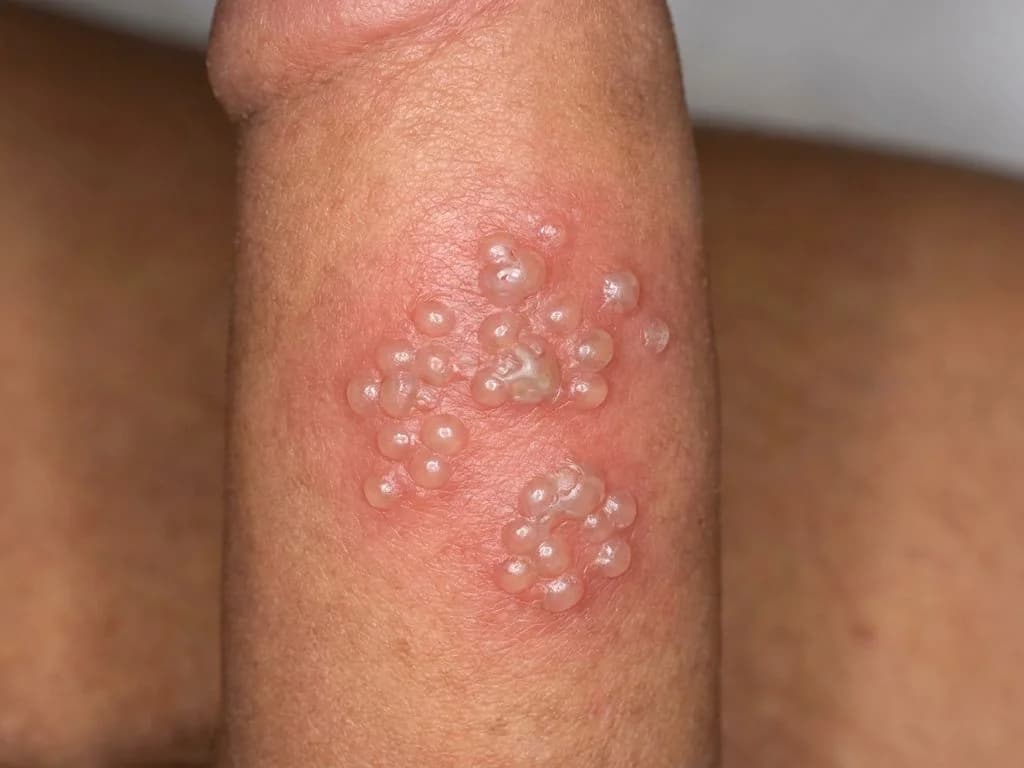
Correct Answer: C. Herpes
Genital herpes presents with painful vesicles on an erythematous base, which is the pathognomonic finding in this case. The discriminating feature is the vesicular morphology — small, grouped, fluid-filled blisters that are extremely tender and often preceded by prodromal symptoms (burning, tingling). Herpes simplex virus (HSV-1 or HSV-2, predominantly HSV-2 in genital disease) causes lytic infection of epithelial cells, leading to intraepidermal acantholysis and formation of Tzanck cells (multinucleated giant cells). The vesicles rupture within 3–5 days, leaving painful erosions that eventually crust and heal without scarring. In India, HSV-2 seroprevalence in STI clinic attendees ranges from 15–40%. Diagnosis is clinical but can be confirmed by Tzanck smear (showing multinucleated giant cells), viral culture, or PCR. The condition is self-limiting but recurrent, and antiviral therapy (acyclovir 400 mg 5 times daily for 7–10 days, or valacyclovir) shortens duration and reduces viral shedding. Recurrent episodes are typically milder and shorter than primary infection.
Why the other options are wrong
A. Candidiasis — Candidiasis presents with erythema, maceration, and white plaques or curdy discharge, NOT vesicles. The lesions are typically non-vesicular and associated with vulvovaginal itching rather than severe pain. Candida causes superficial mucosal infection without the characteristic grouped vesicles on erythematous base seen in herpes. This is a common NBE trap pairing genital infections. B. Chancroid — Chancroid (Haemophilus ducreyi) presents with a single painful ulcer with undermined edges and purulent base, NOT vesicles. The lesion is a deep ulcer, not a vesicle, and typically appears 3–7 days after exposure. Chancroid is rare in India compared to other STIs and does not produce the characteristic grouped vesicular eruption diagnostic of herpes. D. Syphilis — Primary syphilis (Treponema pallidum) presents with a single, painless, indurated ulcer (chancre) with a clean base and rolled edges, NOT painful vesicles. Syphilis is classically painless, whereas herpes is exquisitely painful. The morphology is completely different — a solitary ulcer versus grouped vesicles. This distinction is fundamental to differential diagnosis of genital ulcers in India.
High-Yield Facts
- Vesicles on erythematous base are pathognomonic for genital herpes; they rupture in 3–5 days leaving painful erosions.
- Tzanck smear shows multinucleated giant cells and is a rapid bedside diagnostic tool for herpes (sensitivity ~60%).
- HSV-2 causes 70–90% of genital herpes; HSV-1 accounts for 10–30% and is increasing due to oral sex practices.
- Acyclovir 400 mg 5 times daily × 7–10 days is the standard DOC for primary genital herpes in India; valacyclovir is alternative.
- Recurrent herpes is triggered by stress, menstruation, immunosuppression, and presents with milder, shorter episodes than primary infection.
- Painful ulcers (herpes, chancroid) vs painless ulcers (syphilis, LGV) is the key clinical discriminator in genital ulcer disease.
Mnemonics
Genital Ulcer Differential: PAINS Painful = Herpes, Chancroid; Acute = Herpes; Indurated = Syphilis; Nodes = Syphilis (regional lymphadenopathy); Single = Syphilis, Chancroid. Herpes = multiple vesicles → erosions. Herpes vs Syphilis Memory Hook Herpes = Hot (painful, vesicles, burning); Syphilis = Silent (painless, indurated, clean base). Use when seeing genital ulcers in Indian STI clinics.
NBE Trap
NBE pairs candidiasis and herpes as "genital infections" to trap students who conflate all genital lesions. The key discriminator is vesicular morphology — candidiasis never presents with vesicles, only plaques and discharge. Similarly, syphilis is paired with herpes as "genital ulcers," but syphilis is painless and solitary, whereas herpes is painful and grouped.
Clinical Pearl
In Indian STI clinics, the "painful vesicles → erosions" sequence is the fastest way to diagnose herpes at the bedside. A Tzanck smear (scraping the base of a fresh vesicle, staining with Giemsa, and looking for multinucleated giant cells) takes 10 minutes and confirms the diagnosis without waiting for culture or PCR — critical in resource-limited settings.
_Reference: Jawetz, Melnick & Adelberg's Medical Microbiology Ch. 37 (Herpesviruses); Harrison's Principles of Internal Medicine Ch. 187 (Herpes Simplex Virus Infections); Park's Textbook of Preventive and Social Medicine (STI epidemiology in India)_