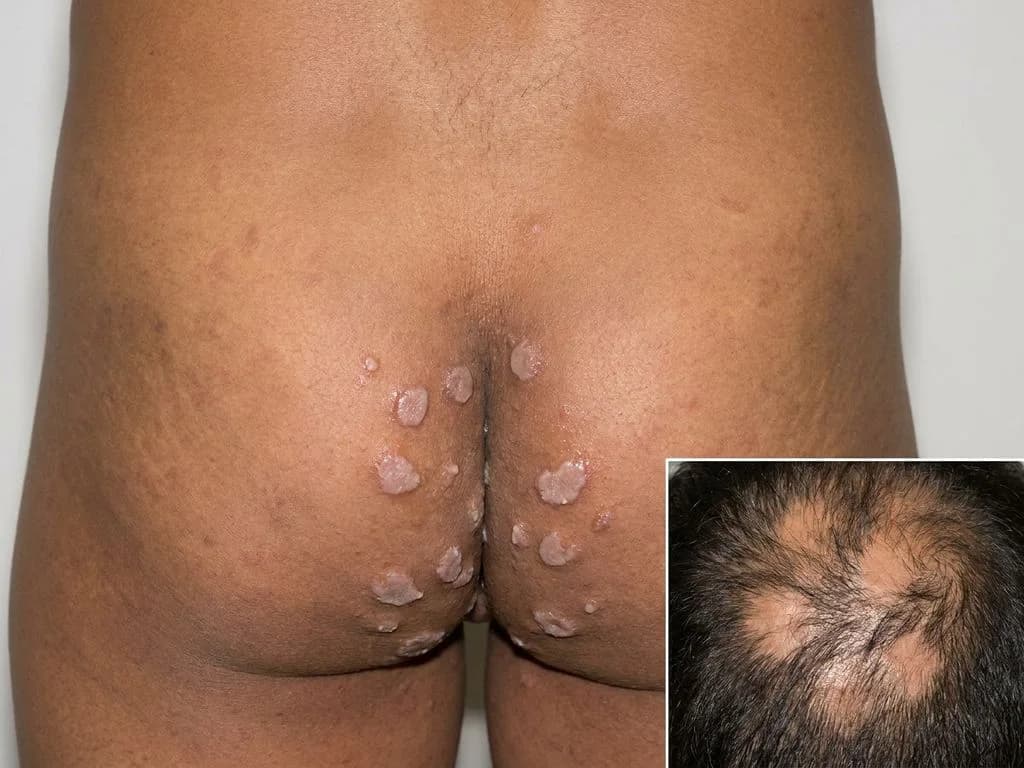
Correct Answer: D. Secondary syphilis
Secondary syphilis is a systemic manifestation of Treponema pallidum infection occurring 4–10 weeks after primary chancre. The clinical triad presented—flat lesions near the anal canal (condyloma lata), generalized body rashes, and alopecia in a moth-eaten pattern—is pathognomonic for secondary syphilis. Condyloma lata are painless, flat, broad-based papules or plaques in intertriginous areas (perianal, inguinal) that are highly infectious and distinguish secondary syphilis from other STIs. The rash in secondary syphilis is polymorphic, involving the trunk and extremities including palms and soles (a key discriminator). The alopecia areata-like hair loss in secondary syphilis follows a characteristic "moth-eaten" pattern due to Treponema invasion of hair follicles, differing from true alopecia areata which shows discrete round patches. Diagnosis is confirmed by RPR/VDRL (non-treponemal) and FTA-ABS/TP-PA (treponemal). Per Indian guidelines (NACO/NTEP), the DOC is benzathine penicillin G 2.4 MU IM weekly × 3 weeks. This constellation of findings—condyloma lata + polymorphic rash + moth-eaten alopecia—makes secondary syphilis the only diagnosis that fits all three clinical features simultaneously.
Why the other options are wrong
A. Alopecia areata — Alopecia areata presents with discrete, well-demarcated round patches of hair loss on the scalp, not a diffuse moth-eaten pattern. It is an autoimmune condition with no associated systemic rash, condyloma lata, or perianal lesions. While secondary syphilis can mimic alopecia areata histologically, the clinical context of condyloma lata and polymorphic rash excludes this diagnosis. NBE trap: students may focus only on the hair loss and miss the systemic features. B. Trichotillomania — Trichotillomania is a psychogenic hair-pulling disorder with irregular, non-scarring alopecia and broken hairs of varying lengths. It has no associated systemic manifestations, rashes, or perianal lesions. The presence of condyloma lata and generalized body rashes immediately excludes this diagnosis. This is a distractor for students who focus narrowly on hair loss without considering the full clinical picture. C. Malassezia — Malassezia (formerly Pityrosporum) causes pityriasis versicolor and seborrheic dermatitis—localized fungal infections with hypopigmented or hyperpigmented macules and fine scale, not systemic rash or condyloma lata. Malassezia does not cause alopecia or perianal lesions. This is a distractor for students who recognize a rash but confuse fungal causes with systemic infections. No serological confirmation exists for Malassezia as a systemic disease.
High-Yield Facts
- Condyloma lata = flat, broad-based papules/plaques in intertriginous areas (perianal, inguinal), highly infectious, pathognomonic for secondary syphilis.
- Moth-eaten alopecia in secondary syphilis = diffuse hair loss in a scattered pattern (not discrete patches like alopecia areata), due to Treponema folliculitis.
- Polymorphic rash in secondary syphilis = involves trunk, extremities, palms, and soles; may include macules, papules, pustules, or lichenoid lesions.
- RPR/VDRL (non-treponemal) and FTA-ABS/TP-PA (treponemal) = diagnostic tests; RPR/VDRL titers correlate with disease activity.
- Benzathine penicillin G 2.4 MU IM weekly × 3 weeks = DOC for secondary syphilis per Indian NACO/NTEP guidelines.
- Secondary syphilis occurs 4–10 weeks post-primary chancre and is highly infectious; all sexual contacts require screening and prophylaxis.
Mnemonics
SYPHILIS Rash Features Systemic (trunk + extremities) | Yes to palms/soles | Polymorphic | Highly infectious | Intertriginous condyloma lata | Lichenoid/papular | Involves mucous patches | Serological confirmation (RPR/VDRL) Condyloma Lata vs Condyloma Acuminata Lata = Syphilis, Large, Large base, Less infectious (false—highly infectious), Low-grade inflammation. Acuminata = HPV, pointed, pedunculated, benign.
NBE Trap
NBE pairs "alopecia" with "alopecia areata" to trap students who focus only on hair loss and ignore the systemic features (condyloma lata, polymorphic rash) that are diagnostic of secondary syphilis. The moth-eaten pattern is the key discriminator.
Clinical Pearl
In Indian STI clinics, secondary syphilis is often missed because patients present with isolated rash or alopecia and the perianal condyloma lata are not examined. Always examine intertriginous areas and perform RPR/VDRL in any patient with polymorphic rash + systemic symptoms, especially in high-prevalence populations (MSM, sex workers, migrants).
_Reference: Robbins Ch. 8 (Infectious Diseases); Harrison Ch. 207 (Syphilis); KD Tripathi Ch. 47 (Antiinfectives)_