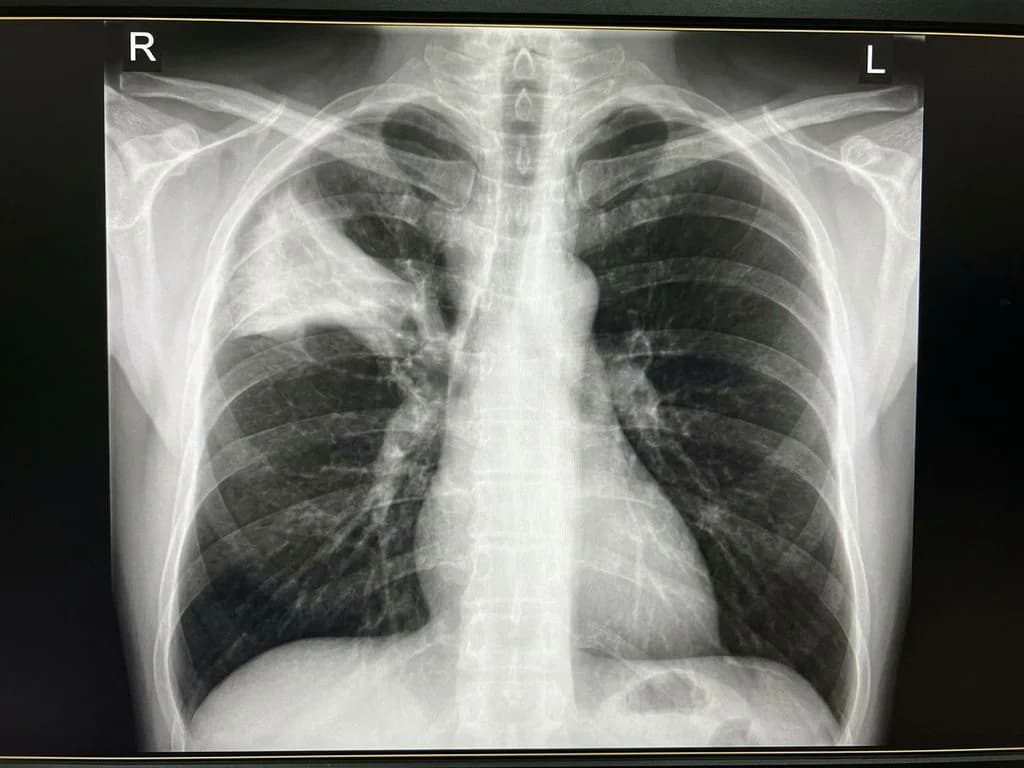
Correct Answer: C. Collapse of right upper lobe
Right upper lobe collapse presents with a characteristic radiological sign: the silhouette sign where the right heart border is obliterated due to consolidation of the medial segment of the right upper lobe. On chest X-ray, collapsed lung tissue appears as a triangular or wedge-shaped opacity with its apex at the hilum, and the collapsed lobe retracts upward and medially. The key discriminating feature is the sharp, well-defined borders of the opacity that conform to anatomical boundaries of the lobe, combined with ipsilateral tracheal deviation toward the collapsed side and elevation of the right hilum. Unlike consolidation (which shows air bronchograms and gradual margins), collapse demonstrates loss of volume with crowding of bronchi and vessels. The mediastinal shift toward the affected side and the characteristic triangular opacity in the right upper zone are pathognomonic for right upper lobe atelectasis. Common causes in Indian clinical practice include post-operative atelectasis, mucus plugging in ICU patients, and endobronchial obstruction from tuberculosis or malignancy. The absence of an air-fluid level rules out abscess, and the absence of a mass lesion with irregular borders rules out bronchogenic carcinoma.
Why the other options are wrong
A. Consolidation of right upper lobe — Consolidation shows air bronchograms (visible bronchi within the opacity) and gradual, ill-defined margins that blend with surrounding lung. The silhouette sign here is due to loss of volume (collapse), not filling of alveoli. Consolidation does not cause the characteristic mediastinal shift and hilum elevation seen in atelectasis. This is an NBE trap for students who confuse opacity with consolidation. B. Right upper lobe bronchogenic carcinoma — Bronchogenic carcinoma typically presents as a peripheral, irregular mass with spiculated borders and pleural involvement, not a triangular opacity with anatomical lobe boundaries. Malignancy does not cause the acute mediastinal shift and volume loss characteristic of collapse. While carcinoma can cause post-obstructive pneumonia, the clean triangular opacity and hilum elevation point to mechanical obstruction causing atelectasis, not a primary tumor. D. Right lung abscess — Lung abscess presents with a cavity containing an air-fluid level (pathognomonic sign) and thick, irregular walls. The image shows a homogeneous triangular opacity without cavitation or air-fluid level. Abscess typically occurs in dependent lung zones (posterior segments) and is associated with fever, putrid sputum, and anaerobic infection—clinical features absent in simple atelectasis. The sharp, well-defined borders of collapse differ from the ragged appearance of abscess.
High-Yield Facts
- Silhouette sign = loss of right heart border due to medial segment right upper lobe collapse (consolidation of medial segment obliterates the border)
- Triangular/wedge-shaped opacity with apex at hilum and ipsilateral mediastinal shift are pathognomonic for lobar atelectasis
- Hilum elevation and crowding of bronchovascular markings distinguish collapse from consolidation (which shows air bronchograms)
- Post-operative atelectasis is the most common cause in Indian hospital settings; mucus plugging in ICU patients is the second most common
- Tracheal deviation toward the collapsed side occurs due to loss of volume and negative pressure from the atelectatic lobe
Mnemonics
COLLAPSE vs CONSOLIDATION Crowding of vessels (collapse) vs Air bronchograms (consolidation); Loss of volume (collapse) vs Level margins (consolidation); Acute shift (collapse) vs Progressive filling (consolidation); Silhouette sign (collapse) vs Even distribution (consolidation) ATELECTASIS SIGNS (3 T's) Triangular opacity, Tracheal shift, Tented hilum (elevated). Use when you see a wedge-shaped opacity with mediastinal shift on CXR.
NBE Trap
NBE pairs "opacity on CXR" with "consolidation" to trap students who confuse radiodensity with pathology. The key is recognizing that loss of volume (mediastinal shift, hilum elevation, crowding) indicates collapse, not filling of alveoli. Students must distinguish between space-occupying (consolidation, abscess, carcinoma) and space-losing (atelectasis) lesions.
Clinical Pearl
In Indian ICU practice, right upper lobe collapse is the most common post-operative complication after cardiac surgery or upper abdominal surgery. Aggressive chest physiotherapy, incentive spirometry, and early mobilization are the first-line management—recognizing collapse on CXR early prevents progression to post-obstructive pneumonia and sepsis.
_Reference: Robbins Ch. 15 (Lung pathology); Harrison Ch. 246 (Pulmonary imaging); Felson's Principles of Chest Roentgenology (Silhouette sign and atelectasis patterns)_