
## Clinical Diagnosis and Rationale **Key Point:** This patient has acute appendicitis with clear clinical, laboratory, and imaging evidence. The classic presentation includes migration of pain from periumbilical to right iliac fossa, positive Rovsing's sign, rebound tenderness, leukocytosis with left shift, and ultrasound confirmation of a dilated, non-compressible appendix. ## Diagnostic Criteria Met | Finding | Significance | |---------|-------------| | Pain migration (periumbilical → RLQ) | Visceral → somatic innervation | | Rovsing's sign positive | Peritoneal irritation | | Rebound tenderness | Peritonitis | | WBC 12,500 with left shift | Bacterial infection | | Ultrasound: dilated (8 mm), non-compressible appendix | Diagnostic | **High-Yield:** In uncomplicated acute appendicitis with diagnostic imaging confirmation, immediate appendicectomy is the gold standard. Delay increases risk of perforation, abscess formation, and peritonitis [cite:Sabiston Textbook of Surgery Ch 50]. ## Why Immediate Surgery? **Clinical Pearl:** The appendix becomes increasingly friable and prone to perforation as inflammation progresses. Perforation risk rises significantly after 48–72 hours of symptoms. This patient is within the critical window and has no contraindications to surgery. **Mnemonic: APPENDICITIS RED FLAGS** — Age <5 or >60, Perforation signs (free air, abscess), Pregnancy, Elderly/immunocompromised, Necrosis/gangrene, Delay >48 hrs, Immunosuppression, Comorbidities, Imaging equivocal, Toxemia, Inability to tolerate surgery, Systemic signs (shock), Immunocompromised. This patient has none of these contraindications. ## Why Not Conservative Management? Conservative antibiotic-only management (Appendiceal Inflammatory Response Evaluation, AIRE trial) is increasingly studied but remains controversial in uncomplicated appendicitis. However, in this case with clear peritonitis (rebound tenderness) and imaging confirmation, surgery is safer and more definitive. 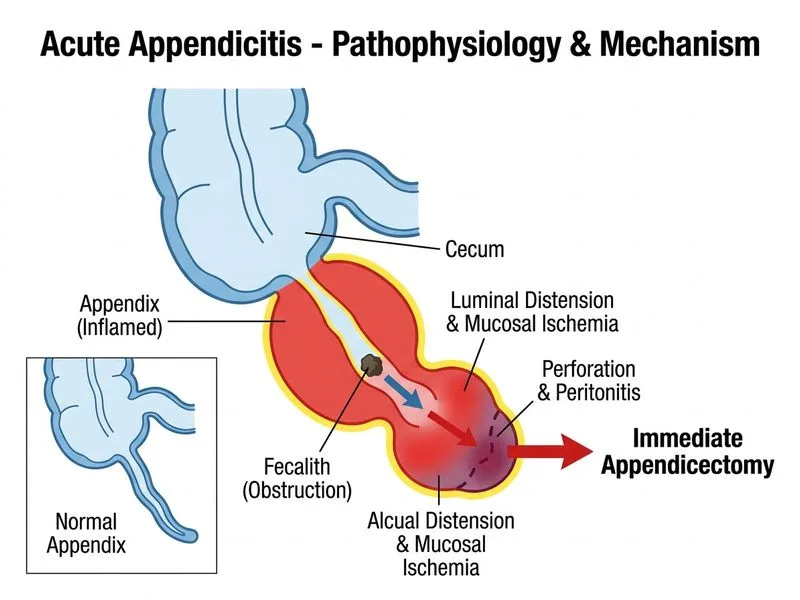
Sign up free to access AI-powered MCQ practice with detailed explanations and adaptive learning.