
## Acute Limb Ischemia: Emergency Management ### Clinical Presentation Recognition **Key Point:** This patient presents with classic acute limb ischemia (ALI) with sudden onset of pain, pallor, pulselessness, and sensory loss—the hallmark of embolic occlusion in a patient with atrial fibrillation. ### Rutherford Classification & Viability Assessment This limb demonstrates **Rutherford IIA (Viable limb with sensory loss but intact motor function)**—the critical window for intervention. | Feature | Assessment | |---------|------------| | Pain | Severe, acute | | Sensory loss | Present (ischemic) | | Motor function | Preserved (viable muscle) | | Muscle tenderness | Absent | | Prognosis | Salvageable if reperfused within 6–8 hours | ### Immediate Management Algorithm ```mermaid flowchart TD A[Acute Limb Ischemia confirmed]:::outcome --> B[Anticoagulate immediately]:::action B --> C[IV Heparin bolus + infusion]:::action C --> D{Embolic vs Thrombotic?}:::decision D -->|Embolic: AF, cardiac source| E[Urgent embolectomy]:::action D -->|Thrombotic: atherosclerosis| F[Consider thrombolysis vs surgery]:::decision E --> G[Restore limb perfusion]:::outcome F --> H{Limb viable?}:::decision H -->|Yes, early| I[Catheter-directed thrombolysis]:::action H -->|No, late| J[Amputation]:::urgent ``` ### Why Heparin + Embolectomy? **High-Yield:** Immediate anticoagulation prevents propagation of thrombus and buys time for definitive intervention. In **embolic ALI** (as here, with AF source), **surgical embolectomy within 6–8 hours of symptom onset offers the highest limb salvage rate** (>90% if performed promptly). Thrombolysis is slower and risks distal embolization in acute emboli. **Clinical Pearl:** The presence of **motor function preservation** is the critical sign that muscle necrosis has NOT yet occurred—this is the "golden window" for embolectomy. ### Why NOT the Other Options? - **Aspirin alone + observation:** Delays definitive therapy; irreversible muscle necrosis begins within 4–6 hours of complete ischemia. - **Immediate amputation:** Premature; the limb is still viable (motor function intact). Amputation is reserved for irreversible ischemia (Rutherford III or late IIB). - **Thrombolysis as first-line:** Slower than embolectomy in acute emboli; increases risk of distal embolization and is contraindicated in acute embolic occlusion from a cardiac source. **Mnemonic:** **HALT** — **H**eparin, **A**nticoagulate, **L**imb salvage, **T**ime-sensitive embolectomy. 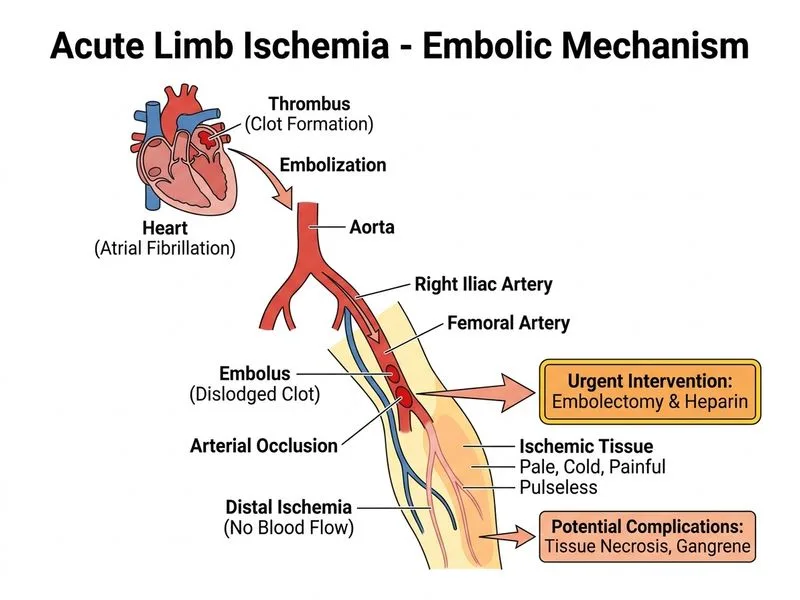
Sign up free to access AI-powered MCQ practice with detailed explanations and adaptive learning.