
## Acute Limb Ischemia: Irreversible Ischemia & Amputation Decision ### Clinical Assessment: Rutherford Classification **Key Point:** This patient has **Rutherford IIIB (Irreversible ischemia)** — the limb is unsalvageable and amputation is mandatory. ### Diagnostic Criteria for Irreversibility | Finding | Significance | |---------|-------------| | **Duration: 8 hours** | Beyond the 6–8 hour salvage window | | **Complete sensory loss** | Indicates advanced muscle ischemia | | **Complete motor loss** | Muscle necrosis has begun | | **Muscle tenderness on palpation** | **Pathognomonic for muscle necrosis** | | **Mottled, cold skin** | Indicates microvascular collapse | **High-Yield:** **Muscle tenderness is the single most reliable clinical sign of irreversible ischemia.** Once present, myonecrosis is underway and salvage is impossible. ### Why This Limb Cannot Be Saved ```mermaid flowchart TD A[Acute thrombotic occlusion]:::outcome --> B[8 hours of complete ischemia]:::outcome B --> C{Muscle viability?}:::decision C -->|Complete sensory loss + motor loss + tenderness| D[Muscle necrosis established]:::urgent D --> E[Rhabdomyolysis & myoglobinuria risk]:::urgent E --> F[Sepsis, hyperkalemia, acute kidney injury]:::urgent F --> G[Amputation is only safe option]:::action ``` **Clinical Pearl:** After **4–6 hours of complete ischemia**, irreversible muscle damage begins. By **8 hours with clinical signs of necrosis** (tenderness, complete motor/sensory loss), the window for salvage has closed. Attempting embolectomy, thrombectomy, or thrombolysis in irreversible ischemia risks: - Release of myoglobin and potassium into circulation → acute kidney injury, cardiac arrhythmias - Sepsis from necrotic tissue - Compartment syndrome - Death from metabolic complications ### Why NOT the Other Options? - **Heparin + thrombectomy/bypass:** The limb is already dead (muscle tenderness = necrosis). Reperfusion of necrotic tissue causes **reperfusion injury** and **rhabdomyolysis**, leading to hyperkalemia, arrhythmia, and renal failure. Intervention is futile and harmful. - **Thrombolysis:** Slower than surgery and contraindicated in irreversible ischemia. Reperfusion of dead muscle is lethal. - **Percutaneous angioplasty:** Delays amputation and risks metabolic catastrophe from reperfusion of necrotic tissue. **Mnemonic:** **MUSCLE** — **M**uscle tenderness = **U**nsalvageable, **S**urgery futile, **C**omplete loss = **L**imb lost, **E**xsanguination amputation. ### Surgical Approach - **Level:** Above-knee amputation (AKA) is preferred because: - Ensures removal of all necrotic tissue - Better rehabilitation outcomes than below-knee in elderly patients - Reduces infection risk - **Timing:** Urgent (within hours) to prevent systemic toxicity - **Preoperative:** Aggressive fluid resuscitation, monitor K^+^, uric acid, myoglobin; prepare for acute kidney injury 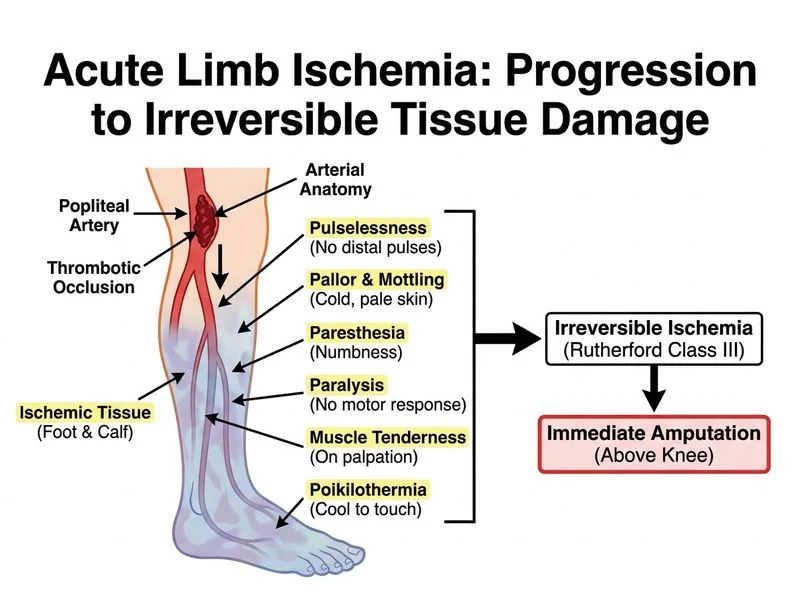
Sign up free to access AI-powered MCQ practice with detailed explanations and adaptive learning.