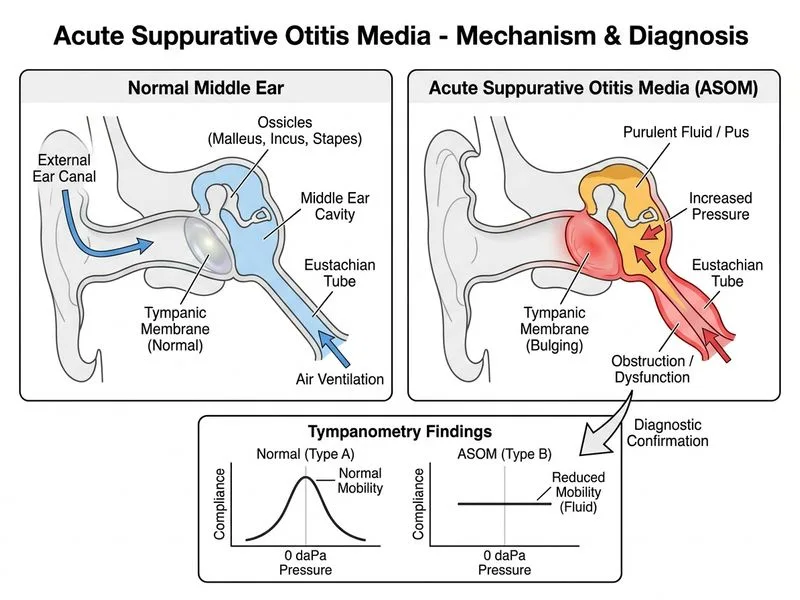
A 6-year-old child presents with severe otalgia, fever (38.5°C), and conductive hearing loss for 3 days. Otoscopy reveals a bulging, hyperemic tympanic membrane with loss of landmarks. The child has no history of ear discharge. Which investigation is most appropriate to confirm the diagnosis of acute suppurative otitis media and guide further management?
A. Pure tone audiometry
B. High-resolution CT temporal bone
C. Tympanometry
D. X-ray mastoid (Schuller's view)
Explanation
Diagnosis of Acute Suppurative Otitis Media
Role of Tympanometry in ASOM
Key Point
Tympanometry is the investigation of choice for confirming acute suppurative otitis media, particularly in the pre-perforation stage when the tympanic membrane is intact but under tension.
Why Tympanometry?
Tympanometry measures middle ear compliance and pressure by introducing a probe tone at 226 Hz and varying air pressure in the external auditory canal. In acute suppurative otitis media:
Type B curve (flat tympanogram) = absent or severely reduced compliance, indicating fluid/pus accumulation in the middle ear
Negative middle ear pressure = retraction of the tympanic membrane due to Eustachian tube dysfunction
Non-invasive and painless = ideal for pediatric patients
Objective documentation = provides baseline for monitoring resolution
In the acute phase with bulging tympanum, tympanometry is more reliable than otoscopy alone for quantifying middle ear dysfunction and serves as an objective baseline for follow-up.
High-YieldNEET PG
Tympanometry does NOT require patient cooperation for hearing responses (unlike audiometry) and is the gold standard for objective assessment of middle ear status in children with suspected ASOM.
Why NOT the Other Options?
Pure tone audiometry: Requires patient cooperation and active response; cannot be reliably performed in young children; documents hearing loss but does NOT confirm the diagnosis of ASOM
High-resolution CT temporal bone: Reserved for complications (mastoiditis, intracranial spread, facial nerve involvement); not indicated for uncomplicated ASOM
X-ray mastoid (Schuller's view): Outdated; poor sensitivity for early mastoiditis; not used for diagnosis of ASOM in modern practice
Loading illustration…
Practice similar questions
Sign up free to access AI-powered MCQ practice with detailed explanations and adaptive learning.