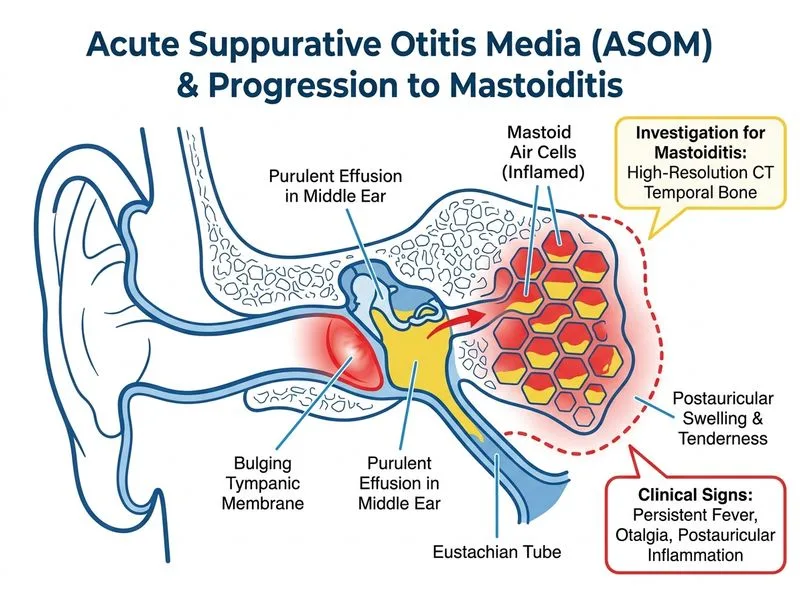
A 4-year-old boy with acute suppurative otitis media and a bulging tympanic membrane develops spontaneous perforation with purulent discharge. The child has persistent fever and otalgia despite antibiotic therapy for 5 days. The mastoid region shows mild tenderness and postauricular swelling. Which investigation is most appropriate to assess for mastoiditis?
A. Impedance audiometry
B. High-resolution CT temporal bone
C. Otoacoustic emissions (OAE)
D. Tympanometry with acoustic reflex testing
Explanation
Investigation for Suspected Mastoiditis Complication
Clinical Context: ASOM with Perforation and Persistent Symptoms
Key Point
When acute suppurative otitis media progresses to mastoiditis (evidenced by postauricular swelling, tenderness, and persistent symptoms despite antibiotics), high-resolution CT temporal bone is the investigation of choice to confirm bony involvement and guide surgical intervention.
Why HRCT Temporal Bone in This Scenario?
HRCT is the gold standard for detecting mastoiditis because it:
1.
Visualizes bony architecture = shows loss of mastoid air cell definition, coalescence of air cells, and cortical erosion
2.
Detects subperiosteal abscess = critical for surgical planning (cortical mastoidectomy vs. simple drainage)
High sensitivity and specificity = superior to plain radiographs or clinical examination alone
5.
Guides surgical approach = determines extent of mastoidectomy needed
HRCT Findings in Mastoiditis
Table
Finding
Significance
Loss of air cell definition
Early mastoiditis
Coalescence of air cells
Suppurative mastoiditis
Cortical erosion
Subperiosteal abscess formation
Facial nerve canal erosion
Risk of facial nerve paralysis
Sigmoid sinus thrombosis
Intracranial extension
Clinical Pearl
In a child with ASOM, perforation, and clinical signs of mastoiditis (postauricular swelling, tenderness, fever despite antibiotics), HRCT is essential before surgical intervention to define the extent of disease and plan the appropriate procedure.
High-YieldNEET PG
HRCT temporal bone is the imaging modality of choice for all suspected complications of ASOM (mastoiditis, intracranial extension, facial nerve involvement); it should be obtained urgently in this clinical scenario.
Why NOT the Other Options?
Otoacoustic emissions (OAE): Measures cochlear function; does not assess bony structures or mastoid pathology; irrelevant for diagnosing mastoiditis
Tympanometry with acoustic reflex testing: Assesses middle ear mechanics and ossicular chain function; cannot visualize mastoid bone or detect osteitis; inappropriate for suspected mastoiditis
Impedance audiometry: Functional test of middle ear compliance; does not provide anatomical information about mastoid air cells or bony erosion
Loading illustration…
Practice similar questions
Sign up free to access AI-powered MCQ practice with detailed explanations and adaptive learning.