Acute Suppurative Otitis Media MCQ — NEET PG Practice Question | NEETPGAI
Acute Suppurative Otitis Media
medium
ear ENT
Which clinical finding best distinguishes acute suppurative otitis media (ASOM) in the pre-perforation stage from the stage of coalescence?
A. Bulging tympanic membrane with loss of landmarks
B. Purulent discharge in the external auditory canal
C. Conductive hearing loss with air-bone gap
D. Severe ear pain with fever and systemic toxicity
Explanation
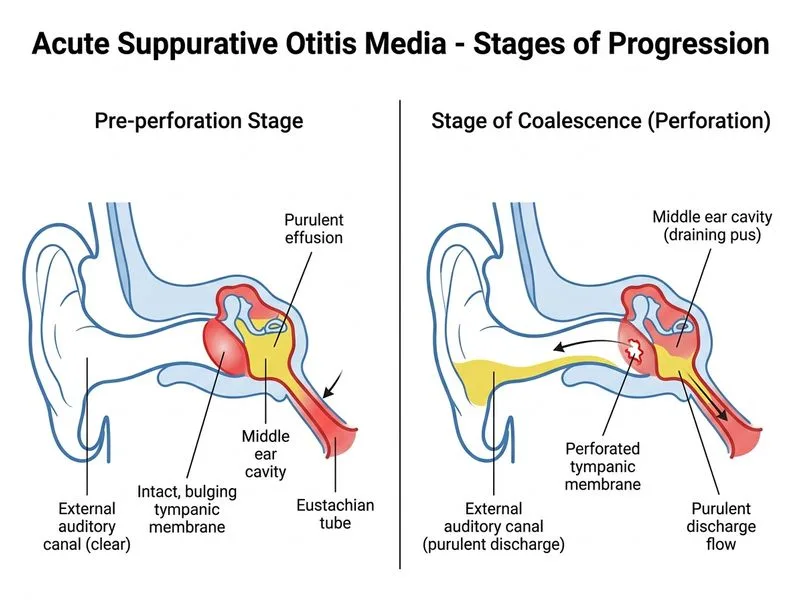
Distinguishing Pre-perforation Stage from Stage of Coalescence in ASOM
Clinical Stages of ASOM
Key Point
The question asks what best distinguishes the pre-perforation stage (stage of suppuration) FROM the stage of coalescence. The correct discriminator must be present in one stage but NOT the other — or must differ markedly between the two.
Understanding the Stages
Table
Feature
Pre-perforation Stage (Suppuration)
Stage of Coalescence
Tympanic membrane
Bulging, intact, landmarks lost
Perforated; may show sagging or destruction
Discharge in EAC
Absent
Purulent discharge present
Ear pain
Severe, throbbing
Sudden relief after perforation
Fever / Toxicity
Present
Persists or may worsen
Hearing loss
Conductive (air-bone gap)
Conductive (persists)
Why Option A is the Best Discriminator
High-YieldNEET PG
A bulging tympanic membrane with loss of landmarks is the hallmark of the pre-perforation (suppuration) stage — it reflects intact tympanum under pressure from accumulated pus in the middle ear. In the stage of coalescence, the tympanic membrane has perforated, so it is no longer bulging and intact; instead, a perforation is visible with pus draining into the EAC. This makes the bulging intact tympanum the single best feature that distinguishes the pre-perforation stage FROM coalescence.
Clinical Pearl
The stage of coalescence in classical ENT teaching (Scott-Brown / Dhingra) refers to the stage where the tympanic membrane perforates and pus discharges into the external auditory canal. The bulging intact drum is therefore exclusive to the pre-perforation stage.
Why the Other Options Are NOT the Best Discriminators
Option D (Purulent discharge in EAC): This is present in the stage of coalescence but ABSENT in pre-perforation. While it marks coalescence, the question asks what distinguishes pre-perforation FROM coalescence — the bulging intact drum is the positive finding in pre-perforation that is absent in coalescence, making it the better discriminator for the pre-perforation stage specifically.
Option B (Severe ear pain with fever): Both stages can have fever and systemic toxicity; pain actually relieves after perforation, but this is a symptom change, not a single pathognomonic finding.
Option C (Conductive hearing loss with air-bone gap): Present in BOTH stages; not discriminatory.
Pathophysiology
1.
Pus accumulates in middle ear → pressure rises → tympanum bulges (pre-perforation stage)
2.
Pressure exceeds tissue strength → spontaneous perforation → pus drains into EAC (coalescence stage)