
| Feature | Acute Suppurative Otitis Media (ASOM) | Acute Secretory Otitis Media (SOM) |
|---|---|---|
| Fever | Present (often high, >38.5°C) | Absent or low-grade |
| Systemic toxicity | Present (malaise, irritability) | Absent |
| Ear pain | Severe, throbbing | Mild or absent (fullness) |
| Fluid type | Purulent (infected) | Serous/mucoid (sterile) |
| Tympanic membrane | Dull, may bulge or retract | Retracted, dull |
| Air-fluid level | May be present | Often present |
| Hearing loss | Conductive | Conductive |
These findings are therefore NOT discriminatory between the two entities.
ASOM: Bacterial infection of middle ear mucosa → acute inflammation → fever, pain, systemic signs → pus accumulation
SOM: Eustachian tube dysfunction → negative middle ear pressure → transudation of sterile serous fluid → no fever, minimal symptoms
Loading illustration…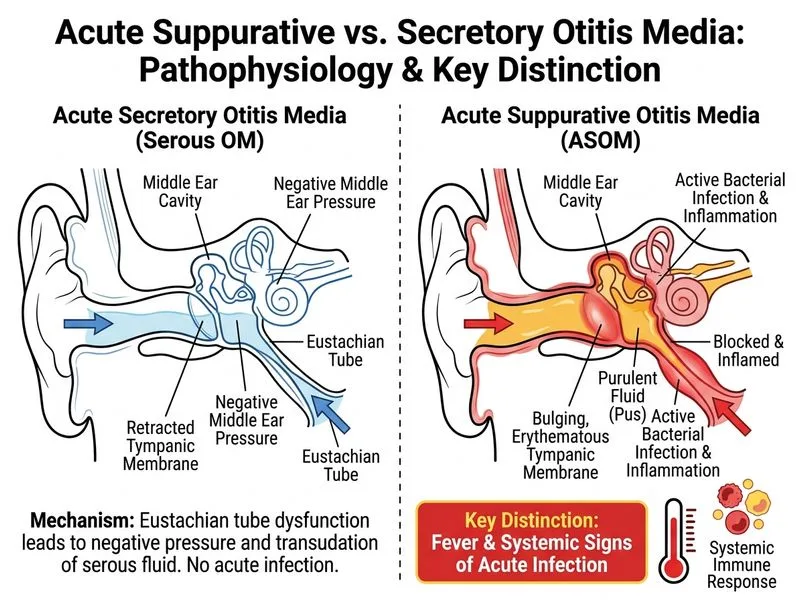
Sign up free to access AI-powered MCQ practice with detailed explanations and adaptive learning.
Daily MCQs, study tips, and topper strategies on Telegram.
Join on Telegram →