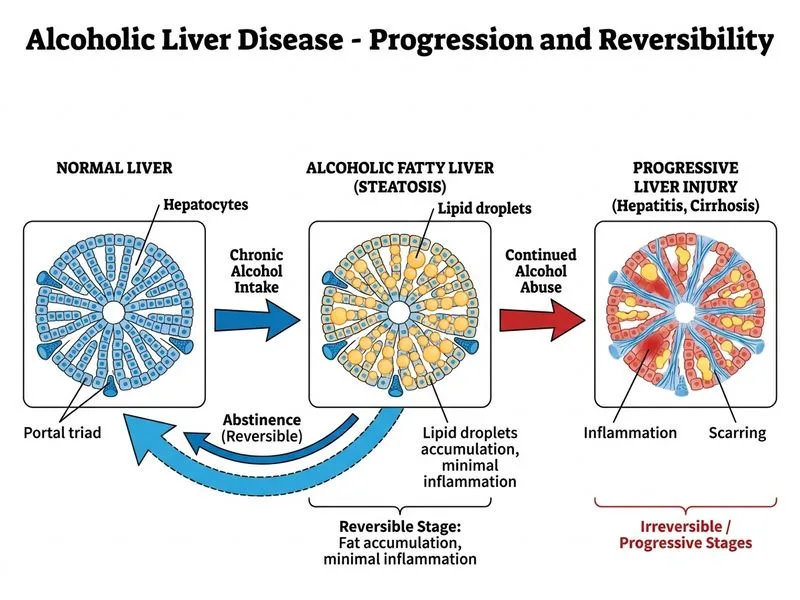
## Stages of Alcoholic Liver Disease Progression **Key Point:** Alcoholic liver disease progresses through three main histological stages, each with distinct pathological features and clinical implications. ### Stage 1: Alcoholic Fatty Liver (Steatosis) - **Pathology:** Accumulation of triglycerides in hepatocytes (macrovesicular steatosis) - **Mechanism:** Increased fatty acid synthesis, decreased fatty acid oxidation, impaired VLDL export - **Reversibility:** Completely reversible with alcohol cessation - **Inflammation:** Minimal to absent - **Fibrosis:** None - **Clinical features:** Often asymptomatic; mild hepatomegaly; elevated transaminases (ALT < AST) ### Stage 2: Alcoholic Hepatitis - Hepatocellular necrosis + inflammation (neutrophilic infiltration) - Mallory-Denk bodies present - Portal inflammation and early fibrosis - Partially reversible if alcohol cessation occurs early - Clinical: Jaundice, fever, right upper quadrant pain, elevated AST/ALT, elevated bilirubin ### Stage 3: Alcoholic Cirrhosis - Bridging fibrosis progressing to cirrhosis - Irreversible architectural distortion - Portal hypertension develops - High mortality; complications include variceal bleeding, ascites, hepatic encephalopathy **High-Yield:** The key distinguishing feature of Stage 1 is **reversibility** — if the patient stops drinking, hepatic steatosis resolves completely without residual damage. ### Mnemonic: ASH (Alcoholic Steatohepatitis) - **A** = Alcohol exposure - **S** = Steatosis (reversible stage) - **H** = Hepatitis (inflammatory stage) ## Why Alcoholic Fatty Liver is the Answer | Feature | Fatty Liver | Hepatitis | Cirrhosis | |---------|-------------|-----------|----------| | **Steatosis** | Yes | Yes | Yes | | **Inflammation** | Minimal | Marked | Variable | | **Fibrosis** | None | Early | Bridging/Cirrhosis | | **Reversibility** | Complete | Partial | None | | **Hepatomegaly** | Present | Present | Present/Shrunken | **Clinical Pearl:** Many patients with alcoholic fatty liver remain asymptomatic and are discovered incidentally on imaging or during routine screening. This is why screening for alcohol use disorder is critical in primary care. 
Sign up free to access AI-powered MCQ practice with detailed explanations and adaptive learning.