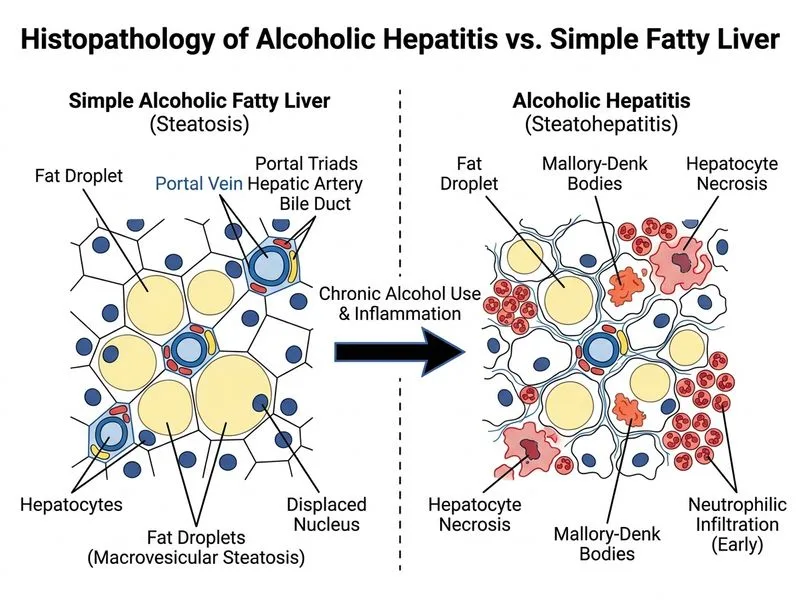
## Distinguishing Alcoholic Hepatitis from Fatty Liver ### Histopathological Comparison | Feature | Alcoholic Fatty Liver | Alcoholic Hepatitis | |---------|----------------------|---------------------| | **Steatosis** | Predominant finding | Present but not sole feature | | **Inflammation** | Minimal or absent | Acute neutrophilic infiltration | | **Hepatocyte Necrosis** | Absent | Present (ballooning) | | **Mallory-Denk Bodies** | Absent or rare | Characteristic finding | | **Fibrosis** | None or minimal | Portal and perivenular | | **Clinical Severity** | Reversible | Potentially fulminant | ### Key Pathological Features of Alcoholic Hepatitis **Key Point:** Alcoholic hepatitis is characterized by the **triad of hepatocyte injury, acute inflammation, and Mallory-Denk bodies** — this combination distinguishes it from simple steatosis. **High-Yield:** Mallory-Denk bodies (also called Mallory hyaline) are aggregates of ubiquitinated proteins and represent a hallmark of alcoholic hepatitis. They appear as eosinophilic intracytoplasmic inclusions on H&E staining. **Clinical Pearl:** Alcoholic hepatitis is a clinical diagnosis supported by histology. Patients present with jaundice, hepatomegaly, elevated transaminases (AST > ALT), and elevated bilirubin. The presence of neutrophilic infiltration correlates with disease severity and prognosis. ### Why Neutrophilic Infiltration + Necrosis + Mallory-Denk Bodies? These three findings together indicate **active hepatocellular injury and inflammation** — the defining pathology of alcoholic hepatitis. Simple steatosis lacks this inflammatory component and carries a better prognosis if alcohol is withdrawn. **Mnemonic:** **MAD** = **M**allory bodies, **A**cute inflammation, **D**amage (necrosis) = Alcoholic hepatitis. [cite:Robbins 10e Ch 18] 
Sign up free to access AI-powered MCQ practice with detailed explanations and adaptive learning.