Antiarrhythmics — Class IC mechanism and PSVT management MCQ — NEET PG Practice Question | NEETPGAI
Antiarrhythmics — Class IC mechanism and PSVT management
medium
pill Pharmacology
A 52-year-old man with a history of paroxysmal supraventricular tachycardia (PSVT) is prescribed flecainide for rhythm control. Which of the following best describes the primary mechanism of action of flecainide in terminating PSVT?
A. Blocks calcium channels in the AV node and slows AV nodal conduction velocity
B. Blocks beta-adrenergic receptors and reduces AV nodal conduction
C. Blocks sodium channels and slows conduction velocity in the accessory pathway and AV node
D. Prolongs the action potential duration and refractory period by blocking potassium channels
Explanation
Mechanism of Flecainide in PSVT Termination
Key Point
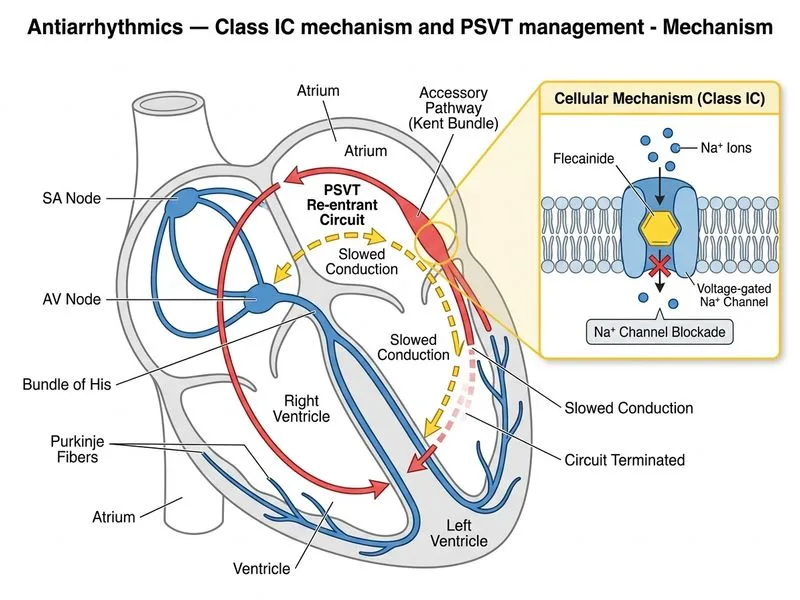
Flecainide is a Class IC antiarrhythmic agent that works primarily by blocking fast sodium channels, which slows conduction velocity throughout the heart, including in the accessory pathway and AV node.
Class IC Antiarrhythmics
Flecainide and propafenone are Class IC agents characterized by:
Marked slowing of conduction velocity (Phase 0 depression)
Minimal effects on action potential duration or refractory period
High affinity for sodium channels in a use-dependent manner
Mechanism in PSVT
In paroxysmal SVT (often due to an accessory pathway in Wolff-Parkinson-White syndrome or AV nodal reentry), flecainide terminates the reentrant circuit by:
1.
Slowing conduction in the accessory pathway — reduces the speed of impulse propagation
2.
Slowing AV nodal conduction — increases the PR interval and AV nodal refractory period indirectly
3.
Breaking the reentrant loop — by creating sufficient conduction delay that the retrograde impulse encounters refractory tissue
Clinical Pearl
Flecainide is highly effective for PSVT because it preferentially slows conduction in the fastest-conducting tissue (the accessory pathway), which is essential for maintaining reentry.
Why Class IC Over Other Classes for PSVT?
Table
Class
Primary Effect
Use in PSVT
Ia
Na+ block + K+ block
Moderate; prolongs QT
Ib
Na+ block (mild)
Poor; shortens action potential
Ic
Na+ block (marked)
Excellent; minimal QT prolongation
II
β-blockade
Moderate; slower onset
III
K+ block
Good; but more QT prolongation
IV
Ca2+ block
Good for AV nodal reentry only
High-YieldNEET PG
For accessory pathway-mediated PSVT (WPW), Class IC agents are preferred because they slow conduction in the accessory pathway itself, whereas beta-blockers and calcium channel blockers only slow the AV node.
Flecainide Pharmacokinetics
Oral bioavailability: 90%
Hepatic metabolism (CYP2D6)
Half-life: 12–27 hours
Steady state: 3–5 days
Warning
Flecainide is contraindicated in structural heart disease (especially post-MI) due to increased mortality risk (CAST trial), but is safe in patients with normal cardiac structure and function.
Loading illustration…
Practice similar questions
Sign up free to access AI-powered MCQ practice with detailed explanations and adaptive learning.