
## Amiodarone: Unique Multiclass Profile **Key Point:** Amiodarone is a Class III antiarrhythmic with prominent potassium channel blockade that prolongs the action potential duration (APD) and effective refractory period (ERP) across all cardiac tissues. This Class III property is the primary mechanism underlying its superior efficacy in refractory arrhythmias. ### Amiodarone's Multiclass Properties | Class Effect | Mechanism | Contribution to Efficacy | |--------------|-----------|-------------------------| | **Class III (Primary)** | K^+^ channel blockade → ↑ APD, ↑ ERP | **Broadest spectrum; most critical** | | Class I | Na^+^ channel blockade → ↓ conduction velocity | Additive; helps suppress ectopy | | Class II | β-adrenergic antagonism | Modest; slows sinus rate and AV conduction | | Class IV | Ca^2+^ channel blockade | Minimal; slight AV nodal effect | **High-Yield:** Amiodarone's Class III effect (K^+^ channel blockade) is the dominant mechanism that makes it effective against both atrial and ventricular arrhythmias, including those refractory to single-class agents. The prolongation of refractoriness prevents re-entry in multiple pathways. **Mnemonic:** **ACLS** — Amiodarone's Class III (potassium blockade) is the **L**ead mechanism; the other classes are **S**upporting. **Clinical Pearl:** Amiodarone's broad spectrum and potassium channel blockade allow it to suppress arrhythmias arising from multiple mechanisms (automaticity, re-entry, triggered activity). However, this comes at the cost of significant extracardiac toxicity (thyroid, lung, liver, cornea). 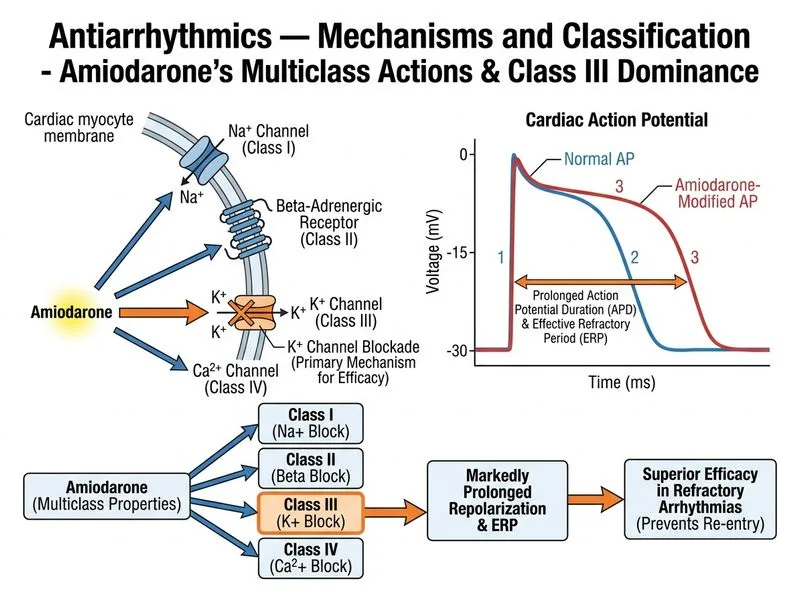
Sign up free to access AI-powered MCQ practice with detailed explanations and adaptive learning.