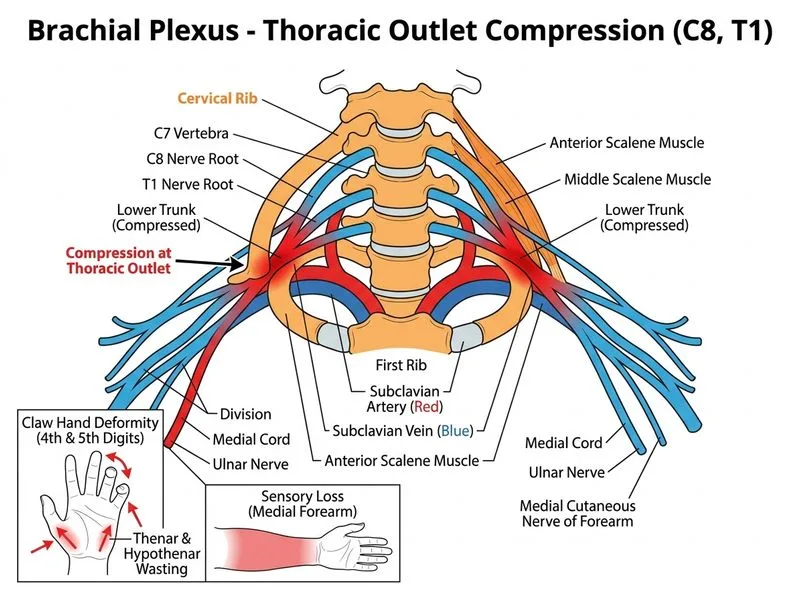
## Thoracic Outlet Syndrome (TOS) – Lower Trunk Compression This patient presents with **neurogenic TOS** affecting the lower trunk of the brachial plexus bilaterally. ### Clinical Features Explained **Motor Findings:** - **Thenar and hypothenar wasting** → Intrinsic hand muscles (C8, T1) - Thenar: Abductor pollicis brevis, flexor pollicis brevis, opponens pollicis (median and ulnar) - Hypothenar: Abductor digiti minimi, flexor digiti minimi, opponens digiti minimi (ulnar) - **Claw hand (4th and 5th digits)** → Interossei and lumbricals (C8, T1 via ulnar nerve) **Sensory Findings:** - **Medial forearm sensory loss** → Medial antebrachial cutaneous nerve (C8, T1) ### Anatomical Basis for Bilateral Presentation ```mermaid flowchart TD A[Cervical Rib - Structural Abnormality]:::outcome --> B[Compression of Lower Trunk<br/>C8 and T1]:::urgent B --> C[Intrinsic Hand Muscle Paralysis]:::action B --> D[Medial Forearm Sensory Loss]:::action C --> E[Claw Hand Deformity]:::outcome D --> F[Medial Forearm Anesthesia]:::outcome G[Bilateral Cervical Ribs<br/>or Fibrous Band Anomalies]:::outcome --> H[Bilateral Lower Trunk Compression]:::urgent H --> I[Bilateral Intrinsic Muscle Wasting]:::outcome ``` **Key Point:** **Cervical rib** is the most common anatomical cause of neurogenic TOS. It arises from the C7 transverse process and can compress the lower trunk (C8–T1) as it passes over the rib. Bilateral presentation suggests either bilateral cervical ribs or bilateral fibrous bands. **High-Yield:** Lower trunk (C8–T1) compression produces: 1. **Intrinsic hand muscle atrophy** (thenar + hypothenar) 2. **Claw hand** (especially 4th and 5th digits) 3. **Medial forearm sensory loss** (C8–T1 dermatome) 4. **Horner's syndrome** (if T1 root severely compressed) **Mnemonic: LOAF** — Lumbricals (C8–T1), Opponens pollicis (C8–T1), Abductor pollicis brevis (C8–T1), Flexor pollicis brevis (C8–T1) — all supplied by C8–T1 and affected in lower trunk injury. **Clinical Pearl:** The **bilateral** nature is the key diagnostic clue—it points to a structural anatomical abnormality (cervical ribs, fibrous bands) rather than a single traumatic event. Unilateral TOS is more commonly from trauma or postural compression. ### Differential Diagnosis | Condition | Motor Loss | Sensory Loss | Bilateral? | Cause | |---|---|---|---|---| | **Lower trunk TOS** | Intrinsic hand muscles (C8–T1) | Medial forearm (C8–T1) | Often | Cervical rib, fibrous band | | Ulnar nerve (cubital tunnel) | Intrinsic hand muscles | Medial 1.5 digits | Rare | Compression at elbow | | Median nerve (carpal tunnel) | Thenar only | Lateral 3.5 digits | Possible | Compression at wrist | | Musculocutaneous entrapment | Biceps, brachialis | Lateral forearm | Rare | Compression in arm | 
Sign up free to access AI-powered MCQ practice with detailed explanations and adaptive learning.