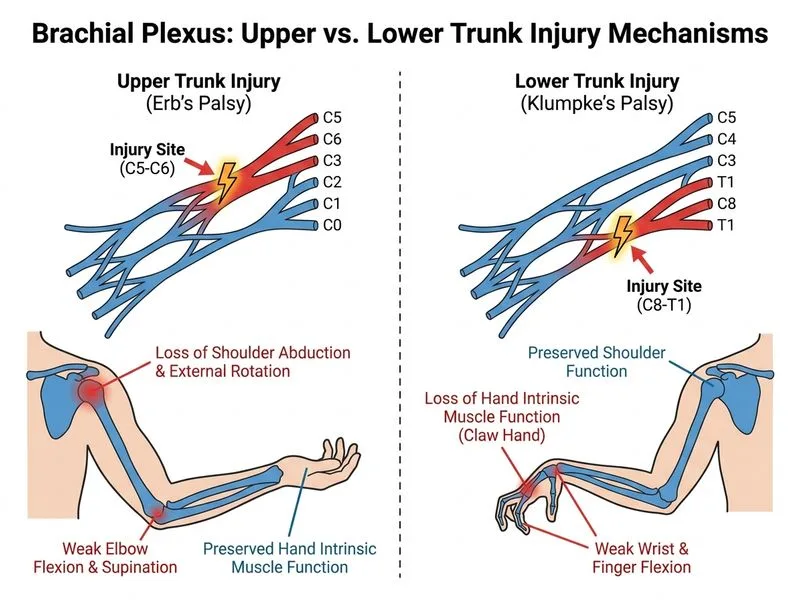
## Distinguishing Upper vs Lower Trunk Injuries **Key Point:** Upper trunk (C5–C6) and lower trunk (C8–T1) injuries produce opposite patterns of motor loss, and the **proximal vs distal** gradient is the primary discriminator. ### Upper Trunk (Erb's Palsy) — C5–C6 - **Affected nerves:** Suprascapular, axillary, musculocutaneous - **Motor loss:** Shoulder abduction (supraspinatus), shoulder external rotation (infraspinatus), elbow flexion (biceps, brachialis) - **Preserved:** Wrist/finger movements, hand intrinsics (lower trunk spared) - **Classic posture:** "Waiter's tip" — arm hangs at side, internally rotated, elbow extended ### Lower Trunk (Klumpke's Palsy) — C8–T1 - **Affected nerves:** Ulnar, medial cutaneous, medial head of median - **Motor loss:** Wrist flexion, finger flexion, hand intrinsics (lumbricals, interossei) - **Preserved:** Shoulder and elbow movements (upper trunk spared) - **Classic sign:** Claw hand — hyperextended MCP, flexed IP joints (unopposed extensor action) ### Comparison Table | Feature | Upper Trunk (Erb's) | Lower Trunk (Klumpke's) | |---------|---------------------|------------------------| | **Shoulder abduction** | ✗ Lost | ✓ Preserved | | **Shoulder external rotation** | ✗ Lost | ✓ Preserved | | **Elbow flexion** | ✗ Lost | ✓ Preserved | | **Wrist flexion** | ✓ Preserved | ✗ Lost | | **Finger flexion** | ✓ Preserved | ✗ Lost | | **Hand intrinsics** | ✓ Preserved | ✗ Lost | | **Claw hand** | Absent | Present | | **Waiter's tip posture** | Present | Absent | **High-Yield:** The **proximal-distal rule** is absolute: upper trunk = proximal loss (shoulder/elbow), lower trunk = distal loss (wrist/hand). Option B captures this perfectly — loss of shoulder abduction/external rotation (proximal) with preserved hand intrinsics (distal) = upper trunk. **Clinical Pearl:** In birth injuries, Erb's palsy (upper trunk) is far more common (~95% of brachial plexus injuries) than Klumpke's because upper trunk is more vulnerable to traction during delivery. 
Sign up free to access AI-powered MCQ practice with detailed explanations and adaptive learning.