
## Burn Depth Classification and Healing Timeline ### Clinical Presentation and Depth Assessment **Key Point:** The clinical findings—erythema, intact blisters, severe pain on light touch, and normal blanching of surrounding skin—are characteristic of a **superficial partial-thickness (superficial 2nd degree) burn**. ### Burn Depth Classification Table | Depth | Layers Involved | Clinical Features | Pain | Blanching | Healing Timeline | Treatment | |-------|-----------------|-------------------|------|-----------|------------------|----------| | **1st degree (Superficial)** | Epidermis only | Erythema, no blisters | Yes | Yes | 3–7 days | Topical care | | **Superficial 2nd degree** | Epidermis + superficial dermis | Intact blisters, erythema, wet, severe pain | Yes | Yes | **2–3 weeks** | Conservative (topical dressings) | | **Deep 2nd degree** | Epidermis + deep dermis | Ruptured blisters, pale/mottled, reduced pain | Decreased | No | 3–8 weeks | Grafting often needed | | **3rd degree (Full-thickness)** | All skin layers | Leathery, charred, painless | No | No | Requires grafting | Surgical excision + grafting | ### Mechanism of Spontaneous Re-epithelialization in Superficial 2nd Degree Burns In superficial partial-thickness burns, the epidermis and superficial dermis are destroyed, but the **deep dermal appendages (hair follicles, sweat glands, sebaceous glands) are preserved**. These structures contain epithelial stem cells that proliferate and migrate across the wound surface. Additionally, epithelial ingrowth from wound margins contributes to healing. **High-Yield:** Superficial 2nd degree burns heal **spontaneously in 2–3 weeks** because retained epithelial cells in hair follicles and sweat glands (adnexal structures) serve as the primary source of re-epithelialization. This is the standard teaching per Bailey & Love's Short Practice of Surgery and Schwartz's Principles of Surgery. ### Why This Patient's Burn Is Superficial 2nd Degree 1. **Intact blisters** → Blister fluid separates epidermis from dermis; indicates superficial dermal involvement 2. **Severe pain on light touch** → Intact sensory nerve endings in preserved dermis 3. **Blanching of surrounding skin** → Intact microcirculation; no deep vascular thrombosis 4. **Erythema** → Active inflammatory response in viable dermis ### Analysis of Each Option - **Option A (4–6 weeks; requires STSG):** Incorrect. This timeline and requirement for grafting describes deep 2nd degree or full-thickness burns, not superficial partial-thickness burns. - **Option B (8–12 weeks; deep dermal fibroblasts):** Incorrect. Fibroblasts contribute to dermal repair but are not the primary source of re-epithelialization. This timeline is far too long for any spontaneously healing burn. - **Option C (2–3 weeks; wound margins only):** ✅ **Correct.** Superficial partial-thickness burns heal in **2–3 weeks** from retained epithelial cells in adnexal structures (hair follicles, sweat glands) as well as wound margins. Note: the option states "wound margins only," which is a slight simplification, but the **2–3 week timeline** is the textbook-standard answer for superficial 2nd degree burns (Bailey & Love, 27th ed.; Schwartz's Principles of Surgery, 11th ed.). - **Option D (3–7 days; hair follicles and sweat glands):** Incorrect. While the mechanism cited (retained epithelial cells in follicles/glands) is accurate, the **3–7 day timeline** corresponds to **1st degree (epidermal) burns**, not superficial partial-thickness burns. Superficial 2nd degree burns require 2–3 weeks. ### Healing Phases in Superficial 2nd Degree Burns 1. **Inflammatory phase (0–3 days):** Blister fluid resorption, epithelial cell activation 2. **Proliferative phase (3–14 days):** Epithelial cells migrate from follicles/glands and wound margins 3. **Remodeling phase (2–6 weeks):** Collagen remodeling, scar maturation **Clinical Pearl:** Blisters should **not be debrided** in superficial 2nd degree burns—the blister roof provides a biological dressing that protects the wound, reduces pain, and contains growth factors that promote healing (Bailey & Love's Short Practice of Surgery, 27th ed.). 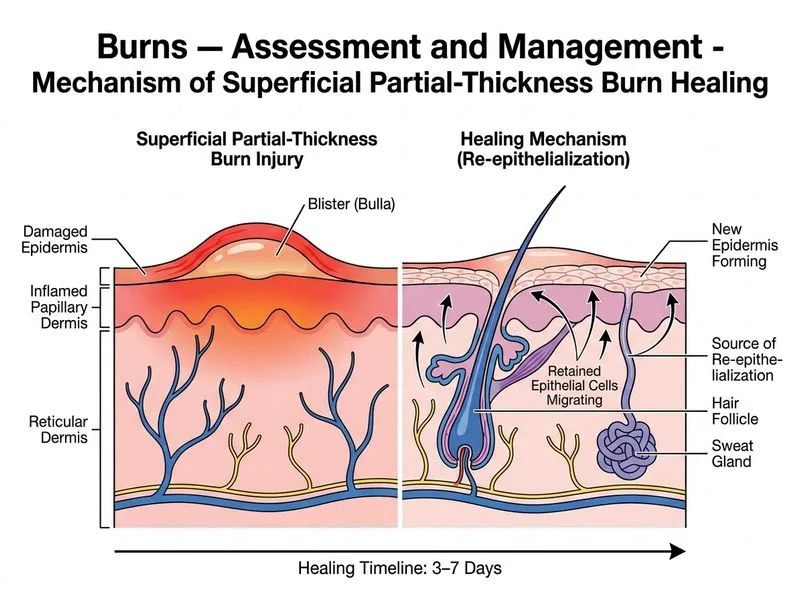
Sign up free to access AI-powered MCQ practice with detailed explanations and adaptive learning.