Cardiac Cycle MCQ — NEET PG Practice Question | NEETPGAI
Cardiac Cycle
easy
heart-pulse Physiology
Which of the following events occurs during the isovolumetric contraction phase of the left ventricle?
A. Both aortic and mitral valves are closed; ventricular volume remains constant while pressure increases
B. The mitral valve opens while the aortic valve remains closed
C. Both aortic and mitral valves are open, allowing blood to flow into the aorta
D. Blood is ejected into the aorta at a constant rate
Explanation
Isovolumetric Contraction Phase
Key Point
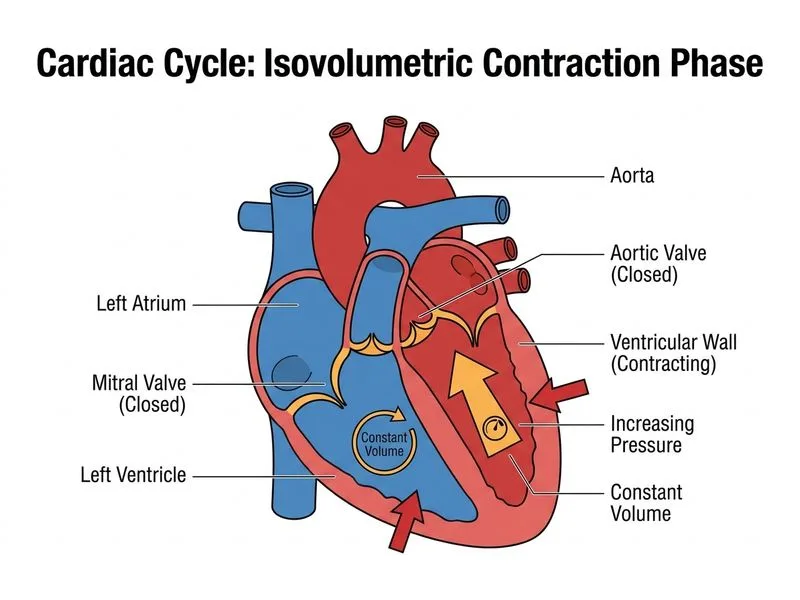
During isovolumetric contraction, both the aortic and mitral valves are closed, the ventricle contracts without changing volume, and pressure rises sharply.
Definition and Characteristics
Isovolumetric contraction is the brief period (approximately 0.05 seconds) between the closure of the mitral valve and the opening of the aortic valve. During this phase:
1.
Mitral valve closes — as LV pressure exceeds left atrial (LA) pressure
2.
Aortic valve remains closed — because LV pressure has not yet exceeded aortic pressure
3.
No blood flows in or out — both inflow and outflow valves are sealed
4.
Ventricular volume is constant — hence "isovolumetric"
5.
LV pressure rises sharply — due to myocardial contraction against a fixed volume
Pressure Dynamics During Isovolumetric Contraction
Loading diagram...
High-YieldNEET PG
The pressure rise during isovolumetric contraction is the steepest in the entire cardiac cycle — this is why it is clinically important for assessing LV contractility.
Mnemonic: "ISO = Same Volume, Both Valves Closed"
ISO = same/constant
Volumetric = volume
Both mitral and aortic valves are closed
Clinical Pearl
The rate of LV pressure rise during isovolumetric contraction (dP/dt) is a sensitive indicator of LV contractile function and is often measured during cardiac catheterization.
Loading illustration…
Practice similar questions
Sign up free to access AI-powered MCQ practice with detailed explanations and adaptive learning.